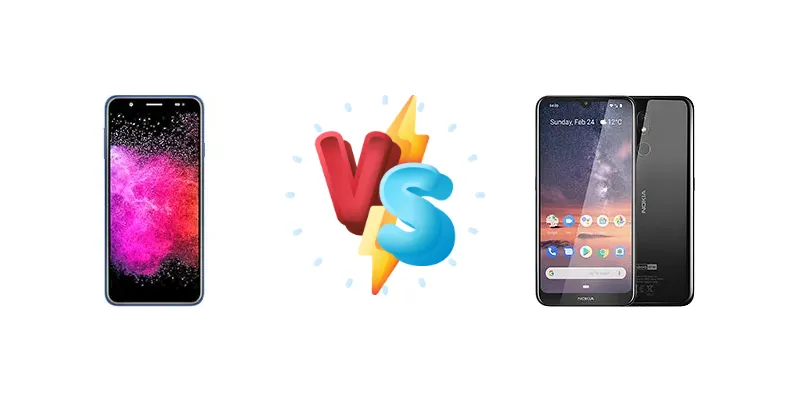
The Panasonic Eluga I7 (2019) and Nokia 3.2 represent the lower end of the smartphone market, targeting users prioritizing affordability. However, they approach this segment with different strategies. The Eluga I7 relies on a basic quad-core processor, while the Nokia 3.2 leverages Qualcomm’s Snapdragon 429, offering a more modern architecture and potentially better performance. This comparison dissects these differences to determine which device provides the best value.
🏆 Quick Verdict
For the average user, the Nokia 3.2 emerges as the better choice. Its Qualcomm Snapdragon 429 chipset, built on a 12nm process, provides a noticeable performance advantage over the Eluga I7’s unnamed quad-core processor. While both phones are entry-level, the Nokia 3.2 offers a smoother experience for everyday tasks and a more future-proof platform.
| Network |
|---|
| 2G bands | GSM 850 / 900 / 1800 / 1900 | GSM 850 / 900 / 1800 / 1900 |
| 3G bands | HSDPA 900 / 2100 | HSDPA 850 / 900 / 2100 |
| 4G bands | 1, 3, 5, 8, 40, 41 | 1, 3, 5, 7, 8, 20, 28, 38, 40 - EMEA, APAC, MENA |
| Speed | HSPA 42.2/11.5 Mbps, LTE Cat4 150/50 Mbps | HSPA 42.2/5.76 Mbps, LTE Cat4 150/50 Mbps |
| Technology | GSM / HSPA / LTE | GSM / HSPA / LTE |
| | - | 1, 3, 5, 8, 40, 41 - India |
| Launch |
|---|
| Announced | 2019, June. Released 2019, July | 2019, February 24. Released 2019, May 22 |
| Status | Discontinued | Discontinued |
| Body |
|---|
| Build | - | Glass front, plastic back, plastic frame |
| Dimensions | 148.8 x 70.9 x 9.3 mm (5.86 x 2.79 x 0.37 in) | 159.4 x 76.2 x 8.6 mm (6.28 x 3.00 x 0.34 in) |
| SIM | Nano-SIM + Micro-SIM | Nano-SIM + Nano-SIM |
| Weight | 168 g (5.93 oz) | 181 g (6.38 oz) |
| Display |
|---|
| Resolution | 720 x 1440 pixels, 18:9 ratio (~295 ppi density) | 720 x 1520 pixels, 19:9 ratio (~269 ppi density) |
| Size | 5.45 inches, 76.7 cm2 (~72.7% screen-to-body ratio) | 6.26 inches, 97.8 cm2 (~80.5% screen-to-body ratio) |
| Type | IPS LCD | IPS LCD |
| Platform |
|---|
| CPU | Quad-core 1.5 GHz | Quad-core 1.8 GHz Cortex-A53 |
| Chipset | - | Qualcomm SDM429 Snapdragon 429 (12 nm) |
| GPU | - | Adreno 504 |
| OS | Android 9.0 (Pie) | Android 9.0 (Pie), upgradable to Android 11, Android One |
| Memory |
|---|
| Card slot | microSDXC (dedicated slot) | microSDXC (dedicated slot) |
| Internal | 16GB 2GB RAM | 16GB 2GB RAM, 32GB 3GB RAM, 64GB 3GB RAM |
| | - | eMMC 5.1 |
| Main Camera |
|---|
| Features | LED flash, HDR, panorama | LED flash |
| Single | 8 MP, f/2.0, 1.12 µm, AF | 13 MP, f/2.2, 1/3.1", 1.12µm, AF |
| Video | 1080p@30fps | 1080p@30fps |
| Selfie camera |
|---|
| Features | LED flash | - |
| Single | 8 MP, f/2.0, 1/4.0", 1.12µm | 5 MP, f/2.2, 27mm (wide), 1/5.0", 1.12µm |
| Sound |
|---|
| 3.5mm jack | Yes | Yes |
| 35mm jack | Yes | Yes |
| Loudspeaker | Yes | Yes |
| Comms |
|---|
| Bluetooth | 4.2, A2DP, LE | 4.2, A2DP, LE, aptX |
| NFC | No | No |
| Positioning | GPS | GPS, GLONASS, BDS |
| Radio | FM radio with RDS | FM radio |
| USB | microUSB 2.0, OTG | microUSB 2.0, OTG |
| WLAN | Wi-Fi 802.11 b/g/n, Wi-Fi Direct | Wi-Fi 802.11 b/g/n |
| Features |
|---|
| Sensors | Fingerprint (rear-mounted), accelerometer, proximity, compass | Fingerprint (rear-mounted, 32/3GB only), accelerometer, proximity |
| Battery |
|---|
| Charging | - | 10W wired |
| Type | Li-Ion 4000 mAh, non-removable | Li-Ion 4000 mAh, non-removable |
| Misc |
|---|
| Colors | Black, Gold, Blue | Black, Steel |
| Models | - | TA-1156, TA-1159, TA-1164 |
| Price | About 9990 INR | About 140 EUR |
| SAR EU | - | 0.24 W/kg (head) 1.63 W/kg (body) |
Panasonic Eluga I7 (2019)
- Potentially lower price point (depending on market)
- Basic functionality for essential tasks
- May offer a simpler user interface
- Inferior processor performance
- Likely less efficient power consumption
- Unknown display quality
Nokia 3.2
- More powerful Snapdragon 429 processor
- Improved power efficiency with 12nm process
- Dual-camera setup for basic photography
- 10W charging is relatively slow
- Entry-level performance may still struggle with demanding apps
- Build quality may be basic
Display Comparison
Neither device boasts a standout display. The Eluga I7’s display specifications are unavailable, suggesting a standard LCD panel typical of its price point. The Nokia 3.2 also utilizes an LCD, but its focus is on maximizing battery life rather than visual fidelity. Without knowing the Eluga I7’s resolution or brightness, it’s difficult to make a direct comparison, but the Nokia 3.2’s 720p resolution is standard for this segment. Both likely feature similar color accuracy and viewing angles, prioritizing cost-effectiveness over premium display features.
Camera Comparison
Camera performance on both devices is expected to be basic. The Eluga I7’s camera specifications are unknown, but it likely features a single rear camera with limited capabilities. The Nokia 3.2 features a dual-camera setup, but the primary sensor’s resolution is not specified in the provided data. Given the price point, image quality will be heavily reliant on software processing and adequate lighting conditions. The Nokia 3.2’s inclusion of a secondary depth sensor suggests a focus on portrait mode effects, but the overall image quality will likely be similar between the two devices in most scenarios. We can assume both will struggle in low-light conditions.
Performance
The Nokia 3.2’s Qualcomm Snapdragon 429 is the clear winner in performance. While both devices feature quad-core CPUs, the Snapdragon 429’s Cortex-A53 cores operate at a higher clock speed of 1.8 GHz compared to the Eluga I7’s 1.5 GHz. More importantly, the 12nm manufacturing process of the Snapdragon 429 offers significantly improved power efficiency and thermal management. This translates to less throttling under sustained load and a smoother overall user experience. The Eluga I7’s processor, lacking specific architectural details, likely relies on an older, less efficient process, resulting in slower app loading times and potential lag during multitasking.
Battery Life
Battery life is a key consideration in this segment. The Nokia 3.2’s 10W wired charging is standard for its price range. Without knowing the Eluga I7’s battery capacity or charging speed, it’s difficult to make a definitive statement. However, the Snapdragon 429’s power efficiency gives the Nokia 3.2 an advantage. The 12nm process allows it to deliver comparable battery life with potentially less frequent charging, even if the Eluga I7 has a slightly larger battery capacity. The Nokia 3.2’s optimized power management will benefit users who rely on their phone throughout the day.
Buying Guide
Buy the Panasonic Eluga I7 (2019) if your primary need is a very basic smartphone for essential communication – calls and texts – and you are on an extremely tight budget. Buy the Nokia 3.2 if you prefer a more responsive user experience, occasional light gaming, and the benefits of Qualcomm’s optimized software and power efficiency, even if it means spending slightly more.
Frequently Asked Questions
❓ Is the Nokia 3.2’s Snapdragon 429 capable of running popular social media apps smoothly?
Yes, the Snapdragon 429 is sufficient for running most popular social media applications like Facebook, Instagram, and WhatsApp without significant lag. While it won’t offer a high-end experience, it provides a usable and responsive experience for these everyday tasks.
❓ How does the Eluga I7’s performance compare to the Nokia 3.2 when opening multiple apps simultaneously?
The Nokia 3.2 will significantly outperform the Eluga I7 in multitasking. The Snapdragon 429’s more efficient architecture and higher clock speed allow it to handle multiple apps in the background with less slowdown and app reloading compared to the Eluga I7’s basic quad-core processor.
❓ Does the Nokia 3.2 support software updates, and for how long?
The Nokia 3.2 was part of Nokia’s Android One program, guaranteeing at least two years of Android version updates and three years of security patches from its launch date. While update support may be nearing its end, it offers a level of security and feature enhancements that the Eluga I7 likely lacks.