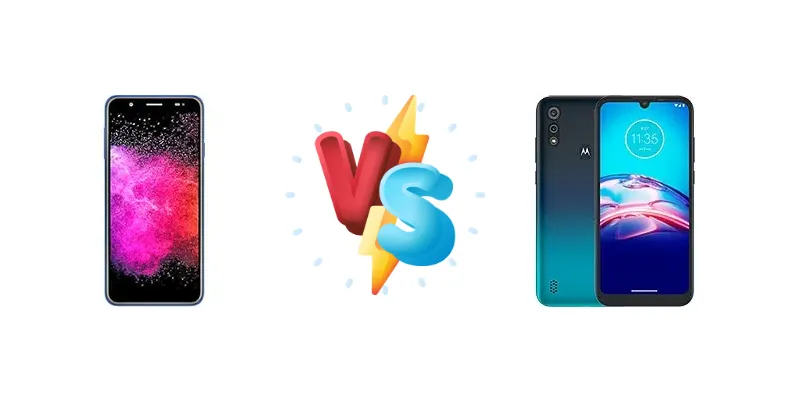
The Panasonic Eluga I7 (2019) and Motorola Moto E6s (2020) represent the lower end of the smartphone market, often sought by first-time buyers or those needing a reliable secondary device. While both aim for affordability, they differ significantly in their internal hardware, impacting performance and user experience. This comparison dissects those differences to help you choose the best option for your needs.
🏆 Quick Verdict
For the average user, the Motorola Moto E6s is the superior choice. Its Mediatek Helio P22 chipset, with its octa-core CPU clocked at 2.0 GHz, provides a noticeable performance boost over the Panasonic Eluga I7’s quad-core 1.5 GHz processor, making it better suited for multitasking and app responsiveness. While both are entry-level, the E6s offers more for the money.
| Network |
|---|
| 2G bands | GSM 850 / 900 / 1800 / 1900 | GSM 850 / 900 / 1800 / 1900 |
| 3G bands | HSDPA 900 / 2100 | HSDPA 850 / 900 / 1900 / 2100 |
| 4G bands | 1, 3, 5, 8, 40, 41 | 1, 3, 5, 7, 8, 20, 38, 40, 41 |
| Speed | HSPA 42.2/11.5 Mbps, LTE Cat4 150/50 Mbps | HSPA, LTE |
| Technology | GSM / HSPA / LTE | GSM / HSPA / LTE |
| Launch |
|---|
| Announced | 2019, June. Released 2019, July | 2020, March 17. Released 2020, April 27 |
| Status | Discontinued | Discontinued |
| Body |
|---|
| Build | - | Glass front, plastic back, plastic frame |
| Dimensions | 148.8 x 70.9 x 9.3 mm (5.86 x 2.79 x 0.37 in) | 155.6 x 73 x 8.5 mm (6.13 x 2.87 x 0.33 in) |
| SIM | Nano-SIM + Micro-SIM | · Nano-SIM· Nano-SIM + Nano-SIM |
| Weight | 168 g (5.93 oz) | 160 g (5.64 oz) |
| | - | Water-repellent coating |
| Display |
|---|
| Resolution | 720 x 1440 pixels, 18:9 ratio (~295 ppi density) | 720 x 1560 pixels, 19.5:9 ratio (~282 ppi density) |
| Size | 5.45 inches, 76.7 cm2 (~72.7% screen-to-body ratio) | 6.1 inches, 91.3 cm2 (~80.4% screen-to-body ratio) |
| Type | IPS LCD | IPS LCD |
| Platform |
|---|
| CPU | Quad-core 1.5 GHz | Octa-core 2.0 GHz Cortex-A53 |
| Chipset | - | Mediatek MT6762 Helio P22 (12 nm) |
| GPU | - | PowerVR GE8320 |
| OS | Android 9.0 (Pie) | Android 9.0 (Pie) |
| Memory |
|---|
| Card slot | microSDXC (dedicated slot) | microSDXC (dedicated slot) |
| Internal | 16GB 2GB RAM | 32GB 2GB RAM, 32GB 4GB RAM, 64GB 2GB RAM, 64GB 4GB RAM |
| | - | eMMC 5.1 |
| Main Camera |
|---|
| Dual | - | 13 MP, f/2.2, 1/3.1", 1.12µm, PDAF
Auxiliary lens |
| Features | LED flash, HDR, panorama | LED flash, HDR, panorama |
| Single | 8 MP, f/2.0, 1.12 µm, AF | 5 MP, AF |
| Video | 1080p@30fps | 1080p@30fps |
| Selfie camera |
|---|
| Features | LED flash | HDR , panorama |
| Single | 8 MP, f/2.0, 1/4.0", 1.12µm | 5 MP, f/2.2, 1.12µm |
| Video | - | 1080p@30fps |
| Sound |
|---|
| 3.5mm jack | Yes | Yes |
| 35mm jack | Yes | Yes |
| Loudspeaker | Yes | Yes |
| Comms |
|---|
| Bluetooth | 4.2, A2DP, LE | 4.2, A2DP, LE |
| NFC | No | No |
| Positioning | GPS | GPS, GLONASS |
| Radio | FM radio with RDS | FM radio |
| USB | microUSB 2.0, OTG | microUSB 2.0, OTG |
| WLAN | Wi-Fi 802.11 b/g/n, Wi-Fi Direct | Wi-Fi 802.11 b/g/n |
| Features |
|---|
| Sensors | Fingerprint (rear-mounted), accelerometer, proximity, compass | Fingerprint (rear-mounted), accelerometer, proximity |
| Battery |
|---|
| Stand-by | - | Up to 288 h (3G) |
| Talk time | - | Up to 10 h (3G) |
| Type | Li-Ion 4000 mAh, non-removable | Li-Po 3000 mAh, removable |
| Misc |
|---|
| Colors | Black, Gold, Blue | Peacock Blue, Sunrise Red |
| Models | - | XT2053, XT2053-2 |
| Price | About 9990 INR | About 240 EUR |
| SAR | - | 0.36 W/kg (head) 1.08 W/kg (body) |
Panasonic Eluga I7 (2019)
- Potentially lower price point
- Simpler user experience
- May be more readily available in certain regions
- Significantly slower processor
- Likely inferior display quality
- Outdated hardware
Motorola Moto E6s (2020)
- Faster and more responsive performance
- More efficient processor
- Newer hardware with potential software updates
- May be slightly more expensive
- Still an entry-level device with limitations
- Camera quality is still basic
Display Comparison
Neither device is known for display prowess. Given the context data, we can assume both utilize LCD panels, common in this price bracket. The Eluga I7’s display specifications are unavailable, but its 2019 release suggests a lower peak brightness and potentially wider bezels compared to the E6s. The E6s, being a newer device, likely benefits from slight improvements in color calibration, though neither will approach the vibrancy of OLED displays found in higher-end phones.
Camera Comparison
Without detailed camera specifications, a direct comparison is difficult. However, it’s safe to assume both phones feature basic camera setups geared towards casual photography. The Eluga I7 likely has a lower resolution main sensor and lacks advanced features like phase detection autofocus. The E6s, while still entry-level, benefits from the Helio P22’s image signal processor (ISP), potentially offering slightly better image quality and faster processing. The prevalence of 2MP macro lenses on both devices suggests limited utility; these sensors typically produce low-quality images.
Performance
The core difference lies in the chipset. The Motorola Moto E6s’s Mediatek MT6762 Helio P22 (12nm) is a significant upgrade over the Panasonic Eluga I7’s quad-core 1.5 GHz processor. The Helio P22’s octa-core configuration and higher clock speed translate to faster app loading times, smoother multitasking, and improved gaming performance. The 12nm manufacturing process also contributes to better power efficiency, potentially extending battery life under load. The Eluga I7 will struggle with demanding applications, while the E6s offers a more fluid experience.
Battery Life
Battery capacity details are missing for both devices. However, the Moto E6s’s more efficient Helio P22 chipset likely results in better real-world battery life, even if the capacity is similar to the Eluga I7. The E6s also benefits from being a newer device, meaning the battery itself is less likely to have degraded. Charging speeds are also likely to be similar – slow, given the budget nature of both phones. Expect several hours for a full charge.
Buying Guide
Buy the Panasonic Eluga I7 (2019) if you prioritize simplicity and a potentially lower price point, and your smartphone usage is limited to basic tasks like calls, texts, and light web browsing. Buy the Motorola Moto E6s (2020) if you prefer a more responsive experience, enjoy occasional gaming, or anticipate using multiple apps simultaneously. The E6s’s more powerful processor makes it a better all-rounder.
Frequently Asked Questions
❓ Will the Motorola Moto E6s handle popular games like PUBG Mobile?
While the Moto E6s can *run* PUBG Mobile, expect to play at the lowest graphics settings and potentially experience frame rate drops. The Helio P22 isn't a gaming powerhouse, but it's significantly better than the Eluga I7's processor for this purpose. The Eluga I7 will likely struggle to provide a playable experience.
❓ How does the Mediatek Helio P22 in the Moto E6s compare to the processor in the Panasonic Eluga I7 for everyday tasks like browsing and social media?
The Helio P22 offers a much smoother experience for everyday tasks. App loading times will be faster, scrolling will be less laggy, and multitasking will be more responsive. The Eluga I7’s quad-core processor will feel noticeably slower, especially when switching between apps or loading complex web pages.
❓ Is the camera on either phone suitable for taking clear photos in low-light conditions?
Neither phone excels in low-light photography. Both likely have small sensors and lack optical image stabilization (OIS). Expect noisy and blurry images in dimly lit environments. The Moto E6s might offer slightly better results due to the Helio P22’s ISP, but don’t expect flagship-level performance.