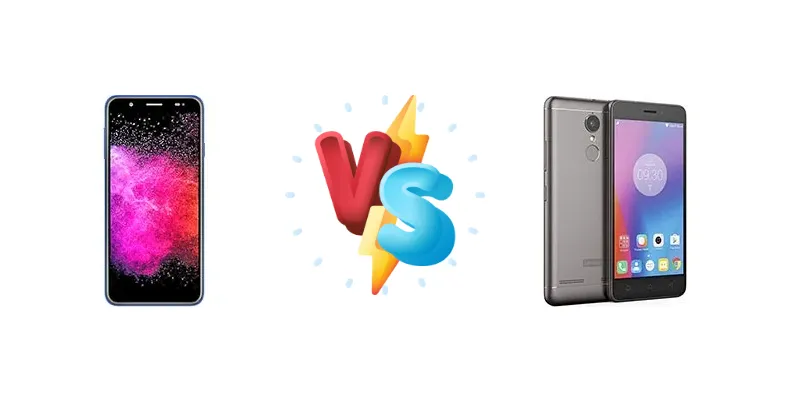
The Panasonic Eluga I7 (2019) and Lenovo K6 Power represent distinct approaches to the budget smartphone market. The Eluga I7, released in 2019, focuses on a streamlined experience with a quad-core processor, while the K6 Power, leveraging Qualcomm's Snapdragon 430, aims for multi-tasking prowess with its octa-core configuration. This comparison dissects their strengths and weaknesses to determine which device delivers the best value.
🏆 Quick Verdict
For the average user prioritizing multi-tasking and slightly better responsiveness, the Lenovo K6 Power emerges as the winner. Its octa-core processor and Qualcomm chipset provide a noticeable performance edge over the Eluga I7’s quad-core CPU, despite the slightly lower clock speed. However, the Eluga I7 may appeal to those seeking a simpler, potentially more power-efficient experience.
| Network |
|---|
| 2G bands | GSM 850 / 900 / 1800 / 1900 | GSM 850 / 900 / 1800 / 1900 - SIM 1 & SIM 2 (dual-SIM model only) |
| 3G bands | HSDPA 900 / 2100 | HSDPA 850 / 900 / 1900 / 2100 |
| 4G bands | 1, 3, 5, 8, 40, 41 | 1, 3, 5, 7, 8, 20, 38, 40, 41 |
| Speed | HSPA 42.2/11.5 Mbps, LTE Cat4 150/50 Mbps | HSPA 42.2/5.76 Mbps, LTE Cat4 150/50 Mbps |
| Technology | GSM / HSPA / LTE | GSM / HSPA / LTE |
| Launch |
|---|
| Announced | 2019, June. Released 2019, July | 2016, September. Released 2016, November |
| Status | Discontinued | Discontinued |
| Body |
|---|
| Build | - | Glass front, aluminum back, aluminum frame |
| Dimensions | 148.8 x 70.9 x 9.3 mm (5.86 x 2.79 x 0.37 in) | 141.9 x 70.3 x 9.3 mm (5.59 x 2.77 x 0.37 in) |
| SIM | Nano-SIM + Micro-SIM | · Nano-SIM· Nano-SIM + Nano-SIM |
| Weight | 168 g (5.93 oz) | 145 g (5.11 oz) |
| Display |
|---|
| Resolution | 720 x 1440 pixels, 18:9 ratio (~295 ppi density) | 1080 x 1920 pixels, 16:9 ratio (~441 ppi density) |
| Size | 5.45 inches, 76.7 cm2 (~72.7% screen-to-body ratio) | 5.0 inches, 68.9 cm2 (~69.1% screen-to-body ratio) |
| Type | IPS LCD | IPS LCD |
| Platform |
|---|
| CPU | Quad-core 1.5 GHz | Octa-core 1.4 GHz Cortex-A53 |
| Chipset | - | Qualcomm MSM8937 Snapdragon 430 (28 nm) |
| GPU | - | Adreno 505 |
| OS | Android 9.0 (Pie) | Android 6.0 (Marshmallow), upgradable to 7.0 (Nougat) |
| Memory |
|---|
| Card slot | microSDXC (dedicated slot) | microSDXC (uses shared SIM slot) |
| Internal | 16GB 2GB RAM | 16GB 2GB RAM, 32GB 3GB RAM |
| | - | eMMC 5.1 |
| Main Camera |
|---|
| Features | LED flash, HDR, panorama | LED flash, HDR, panorama |
| Single | 8 MP, f/2.0, 1.12 µm, AF | 13 MP, PDAF |
| Video | 1080p@30fps | 1080p@30fps |
| Selfie camera |
|---|
| Features | LED flash | - |
| Single | 8 MP, f/2.0, 1/4.0", 1.12µm | 8 MP |
| Video | - | 1080p@30fps |
| Sound |
|---|
| 3.5mm jack | Yes | Yes |
| 35mm jack | Yes | Yes |
| Loudspeaker | Yes | Yes, with stereo speakers |
| Comms |
|---|
| Bluetooth | 4.2, A2DP, LE | 4.2, A2DP, LE |
| NFC | No | No |
| Positioning | GPS | GPS |
| Radio | FM radio with RDS | FM radio |
| USB | microUSB 2.0, OTG | microUSB 2.0 |
| WLAN | Wi-Fi 802.11 b/g/n, Wi-Fi Direct | Wi-Fi 802.11 b/g/n |
| Features |
|---|
| Sensors | Fingerprint (rear-mounted), accelerometer, proximity, compass | Fingerprint (rear-mounted), accelerometer, gyro, proximity, compass |
| Battery |
|---|
| Stand-by | - | Up to 649 h (3G) |
| Talk time | - | Up to 50 h (2G) / Up to 33 h (3G) |
| Type | Li-Ion 4000 mAh, non-removable | Li-Po 4000 mAh, non-removable |
| Misc |
|---|
| Colors | Black, Gold, Blue | Silver, Gold, Dark Grey |
| Models | - | K33a42 |
| Price | About 9990 INR | About 170 EUR |
| Tests |
|---|
| Performance | - |
GFXBench: 2.4fps (ES 3.1 onscreen) |
Panasonic Eluga I7 (2019)
- Potentially simpler user experience due to fewer cores.
- May offer slightly better standby battery life.
- Likely more affordable upfront cost.
- Significantly lower performance in multi-tasking scenarios.
- Lacks the benefits of a dedicated chipset.
- Potentially slower app loading times.
Lenovo K6 Power
- Octa-core processor provides smoother performance.
- Qualcomm Snapdragon 430 offers optimized power efficiency.
- Better image processing capabilities due to the ISP.
- May have slightly shorter battery life during heavy usage.
- Potentially higher upfront cost.
- More complex software optimization required.
Display Comparison
Neither device's display specifications are provided, so a direct comparison is limited. However, given the Eluga I7's 2019 release, it likely features a standard IPS LCD panel. The K6 Power, being a Qualcomm-based device, may have benefitted from optimizations within the Snapdragon 430's display engine. Users should expect similar viewing angles and color reproduction, but the K6 Power *might* offer slightly better brightness and contrast due to chipset-level enhancements. Bezels are likely substantial on both devices, typical for this price segment.
Camera Comparison
Without specific camera sensor details, a detailed comparison is challenging. However, it’s reasonable to assume both devices feature entry-level camera systems. The Lenovo K6 Power, benefiting from Qualcomm’s image signal processor (ISP) within the Snapdragon 430, likely offers slightly better image processing capabilities, particularly in low-light conditions. The ISP handles noise reduction and dynamic range more effectively than a software-based solution on the Eluga I7. Any 2MP macro or depth sensors on either device should be considered marketing features with limited real-world utility.
Performance
The Lenovo K6 Power’s Qualcomm MSM8937 Snapdragon 430, with its octa-core Cortex-A53 configuration at 1.4 GHz, represents a significant architectural advantage over the Panasonic Eluga I7’s quad-core 1.5 GHz processor. While the Eluga I7 boasts a higher clock speed, the Snapdragon 430’s eight cores allow for parallel processing, resulting in smoother performance during multi-tasking and app switching. The 28nm manufacturing process of the Snapdragon 430, while not cutting-edge, is mature and provides a balance between power efficiency and performance. The Eluga I7’s processor, lacking a dedicated chipset, likely relies more heavily on the CPU for all tasks, potentially leading to bottlenecks. This benefits users who frequently use multiple apps simultaneously.
Battery Life
Battery capacity isn't specified for either device. However, the Snapdragon 430’s 28nm process, while not the most efficient, is generally more power-optimized than a comparable processor without a dedicated chipset. The Eluga I7’s quad-core processor *could* offer slightly better standby battery life due to fewer active cores, but the K6 Power’s more efficient chipset is likely to provide longer active usage. Charging wattage is also unknown, making it difficult to assess 0-100% charging times. The K6 Power’s Qualcomm Quick Charge support (if present) would give it a significant advantage.
Buying Guide
Buy the Panasonic Eluga I7 (2019) if you need a basic smartphone for essential tasks like calls, texts, and light web browsing, and prioritize simplicity over raw performance. Buy the Lenovo K6 Power if you prefer a device capable of handling more demanding applications, moderate multi-tasking, and occasional gaming, and value the benefits of an octa-core processor and a dedicated chipset.
Frequently Asked Questions
❓ Will the Lenovo K6 Power struggle with popular social media apps like Facebook and Instagram?
The Lenovo K6 Power, with its octa-core processor and Snapdragon 430 chipset, should handle Facebook and Instagram without significant issues. While not a high-end device, the K6 Power has sufficient processing power for these commonly used applications. However, running multiple apps simultaneously may cause some slowdown.
❓ Is the Panasonic Eluga I7 suitable for playing casual games like Candy Crush or Subway Surfers?
The Panasonic Eluga I7 can likely handle casual games like Candy Crush or Subway Surfers, but performance may be limited. The quad-core processor may struggle with more demanding graphics or complex gameplay. Expect lower frame rates and potential lag compared to devices with more powerful processors.
❓ Does the Lenovo K6 Power support 4G LTE connectivity for faster data speeds?
Yes, the Qualcomm Snapdragon 430 chipset in the Lenovo K6 Power includes a 4G LTE modem, enabling faster data speeds and improved connectivity compared to older 3G networks. This is crucial for streaming videos, browsing the web, and using data-intensive applications.