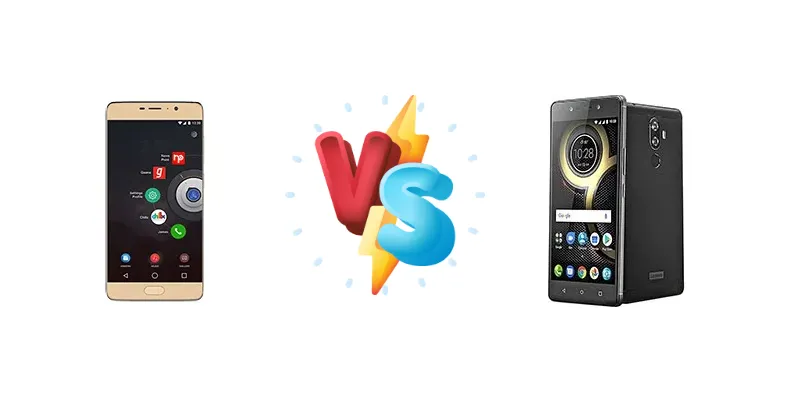
Released in different eras of the budget smartphone market, the Panasonic Eluga A3 Pro and Lenovo K8 Note represent distinct approaches to delivering value. The Eluga A3 Pro aimed for a balance of features at a lower price point, while the K8 Note aggressively targeted performance with its deca-core processor. This comparison dissects their key differences to help you determine which device holds up better today.
🏆 Quick Verdict
For the average user prioritizing responsiveness and multitasking, the Lenovo K8 Note is the clear winner. Its Helio X23 chipset delivers substantially more processing power than the Eluga A3 Pro’s MT6753. However, the K8 Note’s increased power draw will impact battery life, making the A3 Pro a better choice for those prioritizing longevity.
| Network |
|---|
| 2G bands | GSM 850 / 900 / 1800 / 1900 - SIM 1 & SIM 2 | GSM 850 / 900 / 1800 / 1900 - SIM 1 & SIM 2 |
| 3G bands | HSDPA 900 / 2100 | HSDPA 850 / 900 / 2100 |
| 4G bands | 3, 5, 40 | 1, 3, 5, 7, 8, 40 |
| Speed | HSPA 42.2/5.76 Mbps, LTE Cat4 150/50 Mbps | HSPA 42.2/5.76 Mbps, LTE (2CA) Cat6 300/50 Mbps |
| Technology | GSM / HSPA / LTE | GSM / HSPA / LTE |
| Launch |
|---|
| Announced | 2017, August. Released 2017, August | 2017, August. Released 2017, August |
| Status | Discontinued | Discontinued |
| Body |
|---|
| Build | - | Glass front (Gorilla Glass 3), aluminum back, aluminum frame |
| Dimensions | 148.7 x 72.4 x 9.1 mm (5.85 x 2.85 x 0.36 in) | 154.5 x 75.9 x 8.5 mm (6.08 x 2.99 x 0.33 in) |
| SIM | Dual SIM | Nano-SIM + Nano-SIM |
| Weight | 161 g (5.68 oz) | 180 g (6.35 oz) |
| | - | Splash Resistant |
| Display |
|---|
| Protection | - | Corning Gorilla Glass 3 |
| Resolution | 720 x 1280 pixels, 16:9 ratio (~282 ppi density) | 1080 x 1920 pixels, 16:9 ratio (~401 ppi density) |
| Size | 5.2 inches, 74.5 cm2 (~69.2% screen-to-body ratio) | 5.5 inches, 83.4 cm2 (~71.1% screen-to-body ratio) |
| Type | IPS LCD | IPS LCD |
| Platform |
|---|
| CPU | Octa-core 1.3 GHz Cortex-A53 | Deca-core 2.3 GHz |
| Chipset | Mediatek MT6753 (28 nm) | Mediatek MT6797D Helio X23 (20 nm) |
| GPU | Mali-T720MP3 | Mali-T880 MP4 |
| OS | Android 7.0 (Nougat), FitHome UI | Android 7.1.1 (Nougat), upgradable to Android 8.0 (Oreo) |
| Memory |
|---|
| Card slot | microSDXC (dedicated slot) | microSDXC (dedicated slot) |
| Internal | 32GB 3GB RAM | 32GB 3GB RAM, 64GB 4GB RAM |
| Main Camera |
|---|
| Dual | - | 13 MP, f/1.7, PDAF
Auxiliary lens |
| Features | LED flash | Dual-LED dual-tone flash, HDR, panorama |
| Single | 13 MP, PDAF | - |
| Video | 1080p@30fps | 1080p@30fps |
| Selfie camera |
|---|
| Features | - | LED flash |
| Single | 8 MP | 13 MP, f/2.0 |
| Sound |
|---|
| 3.5mm jack | Yes | Yes |
| 35mm jack | Yes | Yes |
| Loudspeaker | Yes | Yes |
| Comms |
|---|
| Bluetooth | 4.0, A2DP | 4.2, A2DP, LE |
| NFC | No | No |
| Positioning | GPS | GPS |
| Radio | FM radio | FM radio |
| USB | microUSB 2.0 | microUSB 2.0, OTG |
| WLAN | Wi-Fi 802.11 b/g/n, Wi-Fi Direct | Wi-Fi 802.11 b/g/n/ac, Wi-Fi Direct |
| Features |
|---|
| Sensors | Accelerometer, proximity | Fingerprint (rear-mounted), accelerometer, gyro, proximity, compass |
| Battery |
|---|
| Charging | - | 15W wired |
| Stand-by | - | Up to 378 h (3G) |
| Talk time | - | Up to 25 h (3G) |
| Type | Li-Ion 4000 mAh, non-removable | Li-Po 4000 mAh, non-removable |
| Misc |
|---|
| Colors | Gold, Silver | Fine Gold, Venom Black |
| Models | A3_Pro | K8 Note, XT1902-3 |
| Price | About 12800 INR | About 180 EUR |
Panasonic Eluga A3 Pro
- Potentially longer battery life due to efficient chipset.
- Lower price point (likely at launch).
- Simpler user experience for basic tasks.
- Significantly slower performance compared to the K8 Note.
- Struggles with multitasking and demanding applications.
- Likely outdated software support.
Lenovo K8 Note
- Much faster performance thanks to the deca-core Helio X23.
- Faster charging (15W).
- Better suited for gaming and multitasking.
- Shorter battery life compared to the Eluga A3 Pro.
- Potentially more thermal throttling under sustained load.
- May have a higher initial price.
Display Comparison
Neither device boasts a standout display. Given the context data focuses on processing power, display specifics are inferred from the market segment. Both likely feature 720p or 1080p IPS LCD panels. The K8 Note, being a slightly later model, likely benefits from improved color calibration and potentially higher peak brightness, though neither is expected to compete with modern OLED technology. Bezels are expected to be substantial on both devices, typical of their respective release windows.
Camera Comparison
Without detailed camera specifications, a direct comparison is difficult. However, given the market positioning, it’s reasonable to assume both phones feature modest camera setups. The K8 Note likely has a slightly more advanced image signal processor (ISP) integrated into the Helio X23 chipset, potentially leading to better image processing. The presence of OIS (Optical Image Stabilization) is unlikely on either device, but the K8 Note might have a larger sensor size, improving low-light performance. The proliferation of 2MP macro/depth sensors on both devices is largely marketing fluff and offers minimal real-world benefit.
Performance
The Lenovo K8 Note’s Mediatek Helio X23 is the dominant force here. Its deca-core (10-core) CPU running at 2.3 GHz significantly outpaces the Panasonic Eluga A3 Pro’s octa-core 1.3 GHz Cortex-A53 processor. The Helio X23’s architecture, while not the most modern, offers a substantial performance uplift in multi-threaded tasks and gaming. The MT6753 in the Eluga A3 Pro is adequate for basic tasks, but will struggle with demanding applications. The 20nm process of the Helio X23 is less efficient than a more modern node, but the sheer core count provides a performance advantage. The K8 Note also benefits from 15W wired charging, a feature absent from the A3 Pro’s specifications.
Battery Life
The Panasonic Eluga A3 Pro likely prioritizes battery life due to its less power-hungry chipset. While the exact battery capacity isn’t specified, the MT6753’s efficiency allows for longer usage on a single charge. The Lenovo K8 Note, with its power-hungry Helio X23, will drain the battery faster, despite potentially having a slightly larger capacity. The K8 Note’s 15W charging mitigates this somewhat, allowing for quicker top-ups, but the A3 Pro will likely offer superior all-day battery life for typical usage.
Buying Guide
Buy the Panasonic Eluga A3 Pro if you need a reliable, basic smartphone for essential tasks like calls, messaging, and light web browsing, and battery life is paramount. Buy the Lenovo K8 Note if you prefer a phone capable of handling more demanding applications, moderate gaming, and multitasking without significant slowdown, and are willing to accept potentially shorter battery life and the need for more frequent charging.
Frequently Asked Questions
❓ Will the Lenovo K8 Note's Helio X23 overheat during prolonged gaming sessions?
The Helio X23 is known to generate more heat than newer chipsets. While it won't necessarily shut down, expect some thermal throttling during extended gaming, leading to a slight performance decrease. The phone's thermal design is likely basic, so managing expectations is key.
❓ Is the Panasonic Eluga A3 Pro still a viable option for basic smartphone use in 2024?
For very basic tasks like calls, texts, and light web browsing, the Eluga A3 Pro can still function. However, its outdated processor and likely lack of software updates mean it will struggle with modern apps and websites. It's best suited for users with extremely limited needs and a tight budget.
❓ Does the Lenovo K8 Note support modern app updates and security patches?
Software support for the Lenovo K8 Note is likely limited at this point. While it may have received updates during its lifespan, it's unlikely to be receiving the latest Android versions or security patches. This poses a security risk and may limit compatibility with newer apps.