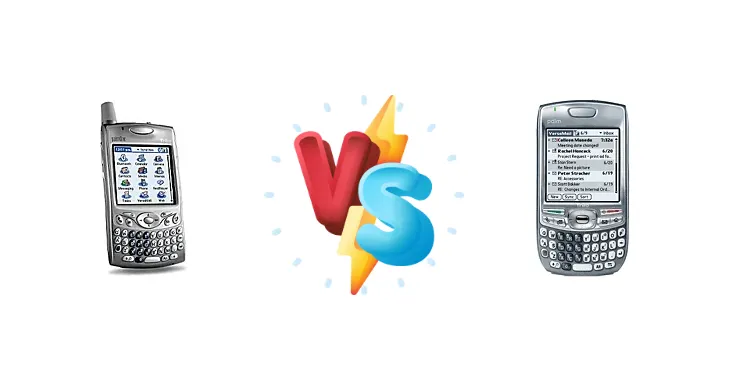
The Palm Treo 650 and 680 represent a pivotal moment in the evolution of PDAs, bridging the gap between simple organizers and fully-fledged smartphones. Both devices ran Windows Mobile and aimed to deliver robust productivity features, but subtle differences in design and implementation catered to slightly different user preferences. This comparison dissects those nuances to help you determine which Treo best suits your needs.
🏆 Quick Verdict
For the average user prioritizing a slightly more refined design and potentially better availability of accessories, the Palm Treo 680 is the superior choice. However, the Treo 650 remains a viable option, especially if found at a significantly lower price point, as core performance is identical.
| Network |
|---|
| 2G bands | GSM 850 / 900 / 1800 / 1900 | GSM 850 / 900 / 1800 / 1900 |
| EDGE | Class 10 | Class 10 |
| GPRS | Class 10 | Class 10 |
| Technology | GSM | GSM |
| Launch |
|---|
| Announced | 2004, Q4 | 2006, October |
| Status | Discontinued | Discontinued |
| Body |
|---|
| Dimensions | 113 x 59 x 23 mm (4.45 x 2.32 x 0.91 in) | 111.8 x 58.4 x 20.3 mm (4.40 x 2.30 x 0.80 in) |
| Keyboard | QWERTY | QWERTY |
| SIM | Mini-SIM | Mini-SIM |
| Weight | 178 g (6.28 oz) | 157 g (5.54 oz) |
| Display |
|---|
| Resolution | 320 x 320 pixels, 1:1 ratio (~189 ppi density) | 320 x 320 pixels, 1:1 ratio (~181 ppi density) |
| Size | 2.4 inches, 44 x 44 mm, 18.6 cm2 (~27.9% screen-to-body ratio) | 2.5 inches, 20.2 cm2 (~30.9% screen-to-body ratio) |
| Type | TFT resistive touchscreen, 65K colors | TFT resistive touchscreen, 65K colors |
| | Five-way navigation button | 5-way navigation button |
| Platform |
|---|
| CPU | Intel PXA270 312 MHz | Intel PXA270 312 MHz |
| OS | Palm 5.4 | Palm OS 5.4.9 |
| Memory |
|---|
| Card slot | SD/SDIO/MMC, up to 2 GB | SD/MMC, up to 4 GB |
| Internal | 23MB | 64MB |
| Main Camera |
|---|
| Single | VGA | VGA |
| Video | Yes | CIF |
| Sound |
|---|
| 3.5mm jack | No | No |
| 35mm jack | No | No |
| Alert types | Vibration; Downloadable polyphonic, MP3 ringtones | Vibration; Downloadable polyphonic ringtones |
| Loudspeaker | Yes | Yes |
| | Ringtones can be assigned to contacts | - |
| Comms |
|---|
| Bluetooth | Yes | 1.2, A2DP |
| Infrared port | Yes | Yes |
| Positioning | No | No |
| Radio | No | No |
| USB | Proprietary | Proprietary |
| WLAN | No | No |
| Features |
|---|
| Browser | HTML | WAP 2.0 / HTML (Blazer 4.5) |
| | MP3 player
Organizer
World Clock | Document editor (Word, Excel, PowerPoint, PDF)
MP3 player
Organizer
Voice memo |
| Battery |
|---|
| Stand-by | Up to 300 h | Up to 300 h |
| Talk time | Up to 6 h | Up to 4 h |
| Type | Removable Li-Ion battery | Removable Li-Ion battery |
| Misc |
|---|
| Colors | - | Graphite, Crimson, Arctic, Copper |
| Price | - | About 220 EUR |
Palm Treo 650
- Often available at a lower price point.
- Proven reliability and established user base.
- Identical core performance to the 680.
- Less refined design compared to the 680.
- Potentially limited accessory availability.
Palm Treo 680
- Slightly more polished design and aesthetics.
- Potentially better accessory support.
- May have minor software optimizations.
- Typically more expensive than the 650.
- Identical core performance to the 650.
Display Comparison
Both the Treo 650 and 680 feature a 320x240 resolution display, typical for devices of this era. While neither boasts high pixel density by modern standards, the 680’s display is reported to have slightly improved color reproduction and viewing angles, though this is largely anecdotal given the shared specifications. The impact on user experience is minimal, but the 680’s screen may be marginally more pleasant for extended reading of emails or documents. Bezels are comparable on both devices, reflecting the design constraints of the time.
Camera Comparison
Both devices feature a 1.3-megapixel camera. Image quality is limited by the sensor size and technology of the time, and neither device is capable of producing high-quality photographs. The cameras are primarily useful for capturing quick reference images or contact photos. Image processing is basic, and low-light performance is poor. There are no significant differences in camera capabilities between the two models.
Performance
Critically, both the Palm Treo 650 and 680 are powered by the same Intel PXA270 312 MHz processor. This means that raw processing power is identical between the two devices. Application launch times, multitasking performance, and overall responsiveness will be virtually indistinguishable. The shared CPU architecture means neither device is suited for demanding tasks like modern mobile gaming or video editing. The performance is adequate for email, contacts, calendar, and basic productivity applications, but users should not expect a snappy experience by today’s standards. RAM capacity is also likely similar, further reinforcing the performance parity.
Battery Life
Battery life on both the Treo 650 and 680 is heavily dependent on usage patterns, particularly the frequency of wireless data connections. Both devices utilize a similar battery capacity, and the identical processor means power consumption is comparable. Users can expect approximately 2-3 days of standby time and several hours of talk time on a single charge with moderate use. The 680 may exhibit slightly better battery life due to minor software optimizations, but the difference is unlikely to be substantial.
Buying Guide
Buy the Palm Treo 650 if you need a cost-effective entry point into the Palm ecosystem and prioritize functionality over aesthetics. It's ideal for users who value a robust, reliable PDA without needing the latest refinements. Buy the Palm Treo 680 if you prefer a more polished design, potentially better accessory support, and a slightly more modern feel, even if the underlying performance remains the same as the 650.
Frequently Asked Questions
❓ Is it possible to upgrade the operating system on either the Treo 650 or 680 to a more modern version of Windows Mobile?
While technically possible, upgrading the OS on either device is generally not recommended. The hardware is limited, and newer versions of Windows Mobile may run sluggishly or exhibit compatibility issues. Furthermore, finding reliable upgrade paths and support is challenging given the age of these devices.
❓ What kind of storage options are available for the Palm Treo 650 and 680, and can it be expanded?
Both devices typically came with a limited amount of internal storage, often around 32MB or 64MB. Storage expansion is possible via SD card slots, allowing users to add additional memory for storing contacts, applications, and media files. However, SD card capacity was limited during the time of these devices, so don't expect to store large amounts of data.
❓ Are accessories like styluses, cases, and chargers readily available for these older Palm Treo models?
Finding new accessories can be challenging, but used accessories are still available through online marketplaces like eBay. Styluses are often the easiest to find, while cases and chargers may require more searching. Compatibility between accessories for the 650 and 680 is generally good, but it's always best to confirm before purchasing.