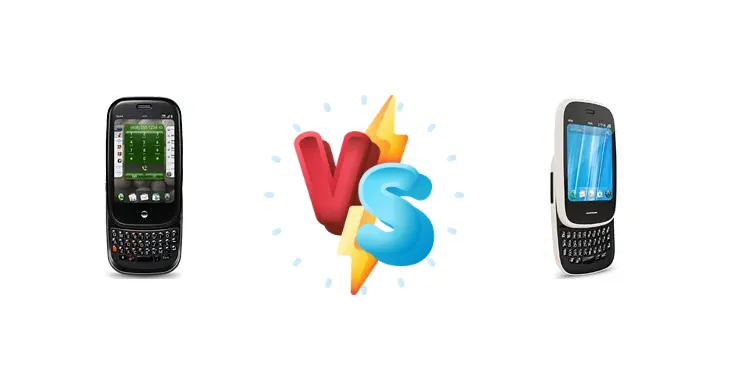
The Palm Pre and HP Veer 4G represent a fascinating period in smartphone history – a time when webOS offered a compelling alternative to iOS and Android. Both devices prioritized compact form factors, but differed significantly in their internal hardware and connectivity options. This comparison revisits these webOS pioneers to determine which one holds up better today.
🏆 Quick Verdict
For the average user seeking a glimpse into webOS history, the HP Veer 4G is the slightly better choice. Its 800 MHz Scorpion processor offers a noticeable performance boost over the Pre’s 600 MHz Cortex-A8, and the inclusion of 4G connectivity provides a more modern experience, despite the age of both devices.
| Network |
|---|
| 2G bands | GSM 850 / 900 / 1800 / 1900 | GSM 850 / 900 / 1800 / 1900 |
| 3G bands | HSDPA 850 / 1900 / 2100 | HSDPA 850 / 1900 / 2100 |
| Speed | HSPA 3.6/0.384 Mbps | HSPA 14.4/5.76 Mbps |
| Technology | GSM / HSPA | GSM / HSPA |
| Launch |
|---|
| Announced | 2009, Februray. Released 2009, October | 2011, May. Released 2011, May 15 |
| Status | Discontinued | Discontinued |
| Body |
|---|
| Dimensions | 100.5 x 59.5 x 16.9 mm (3.96 x 2.34 x 0.67 in) | 84 x 54.5 x 15.1 mm (3.31 x 2.15 x 0.59 in) |
| Keyboard | QWERTY | QWERTY |
| SIM | Mini-SIM | Mini-SIM |
| Weight | 133 g (4.69 oz) | 103 g (3.63 oz) |
| Display |
|---|
| Resolution | 320 x 480 pixels, 3:2 ratio (~186 ppi density) | 320 x 400 pixels (~197 ppi density) |
| Size | 3.1 inches, 28.6 cm2 (~47.9% screen-to-body ratio) | 2.6 inches, 21.3 cm2 (~46.5% screen-to-body ratio) |
| Type | TFT | TFT, 256K colors |
| Platform |
|---|
| CPU | 600 MHz Cortex-A8 | 800 MHz Scorpion |
| Chipset | - | Qualcomm MSM7230 |
| GPU | PowerVR SGX | Adreno 205 |
| OS | Palm webOS | HP webOS 2.1 |
| Memory |
|---|
| Card slot | No | No |
| Internal | 8GB 256MB RAM | 8GB (6.1GB user available) |
| Main Camera |
|---|
| Features | LED flash | fixed focus |
| Single | 3.15 MP | 5 MP |
| Video | No | Yes |
| Sound |
|---|
| 3.5mm jack | Yes | No |
| 35mm jack | Yes | No |
| Loudspeaker | Yes | Yes |
| Comms |
|---|
| Bluetooth | 2.1, A2DP (headset support only) | 2.1, A2DP |
| Positioning | GPS | GPS, A-GPS |
| Radio | No | No |
| USB | microUSB | microUSB 2.0 |
| WLAN | Wi-Fi 802.11 b/g | Wi-Fi 802.11 b/g/n |
| Features |
|---|
| Browser | WAP 2.0 / HTML | HTML, Adobe Flash |
| Sensors | Accelerometer | Accelerometer, proximity |
| | - | AT&T dedicated applications
MP3/WAV/eAAC+ player
MP4/H.264 player
Organizer
Document viewer
Voice memo/dial
Predictive text input |
| Battery |
|---|
| Charging | Wireless | - |
| Stand-by | Up to 300 h | Up to 300 h |
| Talk time | Up to 5 h | Up to 5 h |
| Type | Removable Li-Ion 1150 mAh battery | Removable Li-Ion 910 mAh battery |
| Misc |
|---|
| Colors | Black | White, black |
| Price | About 180 EUR | About 320 EUR |
| SAR | 0.92 W/kg (head) 0.94 W/kg (body) | - |
| Tests |
|---|
| Audio quality |
Noise -95.7dB / Crosstalk -53.9dB | - |
| Camera |
Photo | - |
| Loudspeaker |
Voice 71dB / Noise 68dB / Ring 80dB | - |
Palm Pre
- Iconic design and build quality
- Wireless charging capability
- Pioneering webOS interface
- Slower processor compared to Veer 4G
- Lacks 4G connectivity
HP Veer 4G
- Faster 800 MHz processor
- 4G connectivity for data access
- Slightly more modern feature set
- Less distinctive design
- Still limited by aging hardware
Display Comparison
Neither device boasts a particularly impressive display by today’s standards. Specifics regarding panel technology (IPS, TFT) and resolution are unavailable, but both prioritized compactness over screen real estate. The lack of detailed display specs makes a direct comparison difficult, but the Veer 4G’s slightly larger size likely afforded a marginally better viewing experience. Bezels were substantial on both, typical of the era.
Camera Comparison
Both the Palm Pre and HP Veer 4G feature a basic photo camera, but detailed specifications are limited. Given the era, image quality would be subpar by modern standards. The absence of details like sensor size or aperture makes a meaningful comparison impossible. It’s safe to assume both cameras were adequate for casual snapshots but lacked the capabilities for serious photography.
Performance
The HP Veer 4G’s Qualcomm MSM7230 chipset, featuring an 800 MHz Scorpion CPU, represents a clear upgrade over the Palm Pre’s 600 MHz Cortex-A8. While both are ARM-based, the Scorpion architecture offered improved performance per clock cycle. This translates to snappier application loading and smoother multitasking on the Veer 4G. The Pre’s processor, while innovative for its time, would struggle more with modern web browsing and app demands. RAM specifications are unavailable for either device, but likely limited by the standards of 2009-2011.
Battery Life
Battery capacity details are unavailable for either device. However, given their compact size, battery life was likely a significant limitation. The Veer 4G’s 4G connectivity would have placed a greater strain on the battery compared to the Pre, potentially offsetting any gains from a slightly larger battery (if present). Wireless charging on the Palm Pre offered a convenient charging solution, but wouldn’t necessarily extend overall battery life.
Buying Guide
Buy the Palm Pre if you prioritize wireless charging and a unique, iconic design, and are interested in experiencing the original webOS vision. Buy the HP Veer 4G if you value slightly improved performance and the benefit of 4G connectivity for basic data tasks, making it marginally more usable in a modern context.
Frequently Asked Questions
❓ Is the webOS on either device still functional in 2024?
While the official webOS servers have been discontinued, dedicated communities have maintained limited functionality through unofficial servers and homebrew development. Expect a compromised experience with limited app availability and potential security vulnerabilities.
❓ Can I use the Palm Pre or HP Veer 4G on modern 4G/LTE networks?
The HP Veer 4G supports 4G, but its compatibility with modern LTE bands is limited. It may connect to older 4G networks, but performance will likely be slow and unreliable. The Palm Pre lacks 4G entirely and is limited to 3G or slower data speeds.
❓ What kind of apps are available for these devices?
The official webOS App Catalog is no longer accessible. However, enthusiasts have preserved a library of apps and continue to develop new ones through homebrew efforts. The app selection is extremely limited compared to iOS or Android.