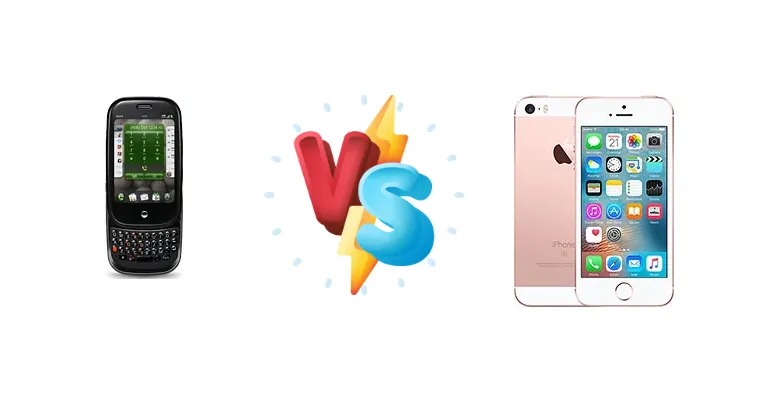
The Palm Pre and Apple iPhone SE represent distinct philosophies in the compact smartphone space. The Pre, released in 2009, was a revolutionary device showcasing the innovative webOS, while the iPhone SE (2016) brought Apple’s iOS ecosystem to a smaller form factor and more accessible price point. This comparison revisits these devices, analyzing their strengths and weaknesses in a modern context.
🏆 Quick Verdict
For the average user in 2024, the Apple iPhone SE emerges as the more practical choice. Its Apple A9 chipset delivers significantly better performance than the Palm Pre’s 600 MHz Cortex-A8, and the 73-hour endurance rating provides a substantial battery life advantage. While the Pre’s wireless charging was ahead of its time, the SE’s overall usability and software support are superior.
| Network |
|---|
| 2G bands | GSM 850 / 900 / 1800 / 1900 | GSM 850 / 900 / 1800 / 1900 - A1662, A1723 |
| 3G bands | HSDPA 850 / 1900 / 2100 | HSDPA 800 / 850 / 900 / 1700(AWS) / 1900 / 2100 - A1662, A1723 |
| 4G bands | - | 1, 2, 3, 4, 5, 8, 12, 13, 17, 18, 19, 20, 25, 26, 29 - A1662 |
| Speed | HSPA 3.6/0.384 Mbps | HSPA, LTE Cat4 150/50 Mbps |
| Technology | GSM / HSPA | GSM / CDMA / HSPA / EVDO / LTE |
| | - | 1, 2, 3, 4, 5, 7, 8, 12, 17, 18, 19, 20, 25, 26, 28, 38, 39, 40, 41 - A1723 |
| Launch |
|---|
| Announced | 2009, Februray. Released 2009, October | 2016, March 21. Released 2016, March 31 |
| Status | Discontinued | Discontinued |
| Body |
|---|
| Build | - | Glass front (Corning-made glass), aluminum back, aluminum frame |
| Dimensions | 100.5 x 59.5 x 16.9 mm (3.96 x 2.34 x 0.67 in) | 123.8 x 58.6 x 7.6 mm (4.87 x 2.31 x 0.30 in) |
| Keyboard | QWERTY | - |
| SIM | Mini-SIM | Nano-SIM |
| Weight | 133 g (4.69 oz) | 113 g (3.99 oz) |
| | - | Apple Pay (Visa, MasterCard, AMEX certified) |
| Display |
|---|
| Resolution | 320 x 480 pixels, 3:2 ratio (~186 ppi density) | 640 x 1136 pixels, 16:9 ratio (~326 ppi density) |
| Size | 3.1 inches, 28.6 cm2 (~47.9% screen-to-body ratio) | 4.0 inches, 44.1 cm2 (~60.8% screen-to-body ratio) |
| Type | TFT | IPS LCD |
| Platform |
|---|
| CPU | 600 MHz Cortex-A8 | Dual-core 1.84 GHz Twister |
| Chipset | - | Apple A9 (14 nm) |
| GPU | PowerVR SGX | PowerVR GT7600 (six-core graphics) |
| OS | Palm webOS | iOS 9.3.2, upgradable to iOS 15.8.5 |
| Memory |
|---|
| Card slot | No | No |
| Internal | 8GB 256MB RAM | 16GB 2GB RAM, 32GB 2GB RAM, 64GB 2GB RAM, 128GB 2GB RAM |
| | - | NVMe |
| Main Camera |
|---|
| Features | LED flash | Dual-LED dual-tone flash, HDR |
| Single | 3.15 MP | 12 MP, f/2.2, 29mm (standard), 1/3.0", 1.22µm, PDAF |
| Video | No | 4K@30fps, 1080p@30/60fps, 1080p@120fps, 720p@240fps |
| Selfie camera |
|---|
| Features | - | Face detection, HDR, panorama |
| Single | - | 1.2 MP, f/2.4, 31mm (standard) |
| Video | - | 720p@30fps |
| | No | - |
| Sound |
|---|
| 3.5mm jack | Yes | Yes |
| 35mm jack | Yes | Yes |
| Loudspeaker | Yes | Yes |
| | - | 16-bit/44.1kHz audio
|
| Comms |
|---|
| Bluetooth | 2.1, A2DP (headset support only) | 4.2, A2DP, LE |
| NFC | - | Yes (Apple Pay only) |
| Positioning | GPS | GPS, GLONASS |
| Radio | No | No |
| USB | microUSB | Lightning, USB 2.0 |
| WLAN | Wi-Fi 802.11 b/g | Wi-Fi 802.11 a/b/g/n/ac, hotspot |
| Features |
|---|
| Browser | WAP 2.0 / HTML | - |
| Sensors | Accelerometer | Fingerprint (front-mounted), accelerometer, gyro, proximity, compass |
| Battery |
|---|
| Charging | Wireless | - |
| Stand-by | Up to 300 h | Up to 240 h (3G) |
| Talk time | Up to 5 h | Up to 14 h (3G) |
| Type | Removable Li-Ion 1150 mAh battery | Li-Po 1624 mAh, non-removable (6.21 Wh) |
| Misc |
|---|
| Colors | Black | Space Gray, Silver, Gold, Rose Gold |
| Models | - | A1662, A1723, A1724, iPhone8,4 |
| Price | About 180 EUR | About 140 EUR |
| SAR | 0.92 W/kg (head) 0.94 W/kg (body) | 1.17 W/kg (head) 1.19 W/kg (body) |
| SAR EU | - | 0.72 W/kg (head) 0.97 W/kg (body) |
| Tests |
|---|
| Audio quality |
Noise -95.7dB / Crosstalk -53.9dB |
Noise -93.0dB / Crosstalk -72.9dB |
| Battery life | - |
Endurance rating 73h
|
| Camera |
Photo |
Photo / Video |
| Display | - |
Contrast ratio: 804:1 (nominal), 3.681 (sunlight) |
| Loudspeaker |
Voice 71dB / Noise 68dB / Ring 80dB |
Voice 66dB / Noise 65dB / Ring 69dB
|
| Performance | - |
Basemark OS II 2.0: 2163 |
Palm Pre
- Pioneering webOS operating system
- Innovative gesture-based interface
- Wireless charging (ahead of its time)
- Significantly slower processor
- Limited app ecosystem
- Outdated software and security
Apple iPhone SE
- Powerful Apple A9 chipset
- Long battery life (73h endurance)
- iOS ecosystem and software support
- Smaller display size
- Relatively basic design
- Older chipset compared to current flagships
Display Comparison
The iPhone SE boasts a contrast ratio of 804:1 (nominal) and 3.681 (sunlight), indicating good visibility even in bright conditions. The Palm Pre’s display specifications are not provided, but given its age, it likely suffers from lower brightness and contrast. The SE’s display technology, while not cutting-edge by today’s standards, offers a more modern viewing experience. The contrast ratio difference suggests the SE will be more readable outdoors.
Camera Comparison
Both devices feature a photo camera, but the iPhone SE expands on this with video recording capabilities. The SE’s camera benefits from Apple’s image signal processing, resulting in better image quality and dynamic range. Without specific details on the Palm Pre’s camera sensor size or aperture, it’s reasonable to assume the iPhone SE offers a more versatile and capable camera system, particularly for video capture. The inclusion of video recording on the SE is a key differentiator.
Performance
The Apple iPhone SE’s dual-core 1.84 GHz Twister processor, built on a 14nm process, represents a significant leap in performance over the Palm Pre’s 600 MHz Cortex-A8. The A9 chipset’s architecture is far more efficient, allowing for smoother multitasking and more demanding applications. While the Pre was innovative for its time, the SE’s processing power is demonstrably superior, impacting everything from app launch times to web browsing speed. The 14nm process also contributes to better thermal management, preventing significant throttling under load.
Battery Life
The iPhone SE’s endurance rating of 73 hours is a standout feature, indicating excellent battery life. The Palm Pre’s battery life is not specified, but given its age and processor, it’s likely significantly lower. The SE’s efficient A9 chip and optimized iOS software contribute to its impressive battery performance. Furthermore, the Palm Pre’s wireless charging, while innovative for its time, doesn’t compensate for a potentially smaller battery capacity and less efficient processor.
Buying Guide
Buy the Palm Pre if you're a collector interested in experiencing a pivotal moment in mobile operating system history and appreciate the unique gesture-based interface of webOS. Buy the Apple iPhone SE if you prioritize a responsive user experience, a capable camera for both photos and videos, and long-term software support within the Apple ecosystem. The SE is the better daily driver.
Frequently Asked Questions
❓ Is the Palm Pre still usable as a daily driver in 2024?
While technically functional, the Palm Pre is not recommended as a daily driver. Its outdated software, limited app ecosystem, and slow processor make it impractical for modern use. Security updates are also non-existent, posing a significant risk.
❓ Does the iPhone SE support current iOS updates?
The original iPhone SE (2016) supports iOS 16, the latest major iOS version it can run. This ensures continued security updates and access to a wide range of apps, making it a viable option for users who prefer a smaller form factor.
❓ How does the Palm Pre's webOS compare to iOS in terms of usability?
webOS was innovative for its time, featuring a card-based multitasking system and gesture controls. However, iOS offers a more refined and intuitive user experience, with a larger app ecosystem and better integration with other Apple devices. iOS is generally considered more user-friendly for the average consumer.