
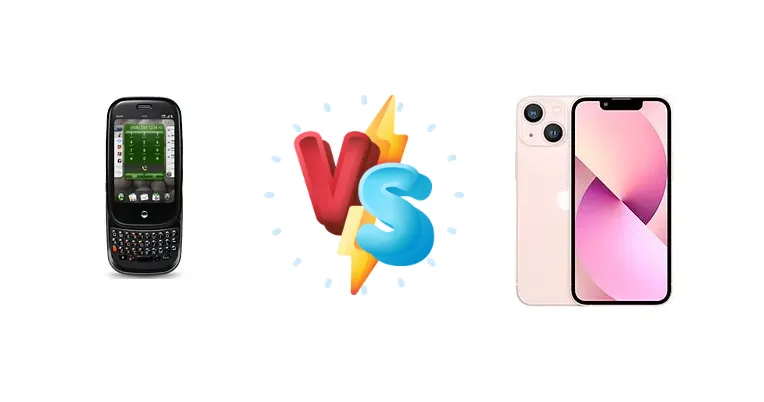
iPhone 13 mini vs. Palm Pre: A Tale of Two Compacts
| Phones Images | |||||
|---|---|---|---|---|---|
|
🏆 Quick Verdict
For the vast majority of users, the Apple iPhone 13 mini is the clear winner. Its A15 Bionic chip delivers vastly superior performance, its camera system is far more capable, and its modern features like 5G connectivity and a high-brightness display offer a significantly better user experience. The Palm Pre remains a fascinating historical artifact, but it simply cannot compete with contemporary technology.
| PHONES | ||
|---|---|---|
| Phone Names | Palm Pre | Apple iPhone 13 mini |
| Network | ||
|---|---|---|
| 2G bands | GSM 850 / 900 / 1800 / 1900 | GSM 850 / 900 / 1800 / 1900 |
| 3G bands | HSDPA 850 / 1900 / 2100 | HSDPA 850 / 900 / 1700(AWS) / 1900 / 2100 |
| 4G bands | - | 1, 2, 3, 4, 5, 7, 8, 12, 13, 17, 18, 19, 20, 25, 26, 28, 30, 32, 34, 38, 39, 40, 41, 42, 46, 48, 66 - A2628, A2629, A2630 |
| 5G bands | - | 1, 2, 3, 5, 7, 8, 12, 20, 25, 28, 29, 30, 38, 40, 41, 48, 66, 71, 77, 78, 79 Sub6/mmWave - A2628 |
| Speed | HSPA 3.6/0.384 Mbps | HSPA, LTE, 5G, EV-DO Rev.A 3.1 Mbps |
| Technology | GSM / HSPA | GSM / CDMA / HSPA / EVDO / LTE / 5G |
| - | 1, 2, 3, 5, 7, 8, 12, 20, 25, 28, 30, 38, 40, 41, 48, 66, 77, 78, 79 SA/NSA/Sub6 - A2629, A2630 | |
| Launch | ||
|---|---|---|
| Announced | 2009, Februray. Released 2009, October | 2021, September 14 |
| Status | Discontinued | Available. Released 2021, September 24 |
| Body | ||
|---|---|---|
| Build | - | Glass front, glass back, aluminum frame |
| Dimensions | 100.5 x 59.5 x 16.9 mm (3.96 x 2.34 x 0.67 in) | 131.5 x 64.2 x 7.7 mm (5.18 x 2.53 x 0.30 in) |
| Keyboard | QWERTY | - |
| SIM | Mini-SIM | · Nano-SIM + eSIM· Nano-SIM + Nano-SIM |
| Weight | 133 g (4.69 oz) | 141 g (4.97 oz) |
| - | IP68 dust/water resistant (up to 6m for 30 min) Apple Pay (Visa, MasterCard, AMEX certified) | |
| Display | ||
|---|---|---|
| Protection | - | Ceramic Shield glass |
| Resolution | 320 x 480 pixels, 3:2 ratio (~186 ppi density) | 1080 x 2340 pixels, 19.5:9 ratio (~476 ppi density) |
| Size | 3.1 inches, 28.6 cm2 (~47.9% screen-to-body ratio) | 5.4 inches, 71.9 cm2 (~85.1% screen-to-body ratio) |
| Type | TFT | Super Retina XDR OLED, HDR10, Dolby Vision, 800 nits (HBM), 1200 nits (peak) |
| Platform | ||
|---|---|---|
| CPU | 600 MHz Cortex-A8 | Hexa-core (2x3.23 GHz Avalanche + 4x1.82 GHz Blizzard) |
| Chipset | - | Apple A15 Bionic (5 nm) |
| GPU | PowerVR SGX | Apple GPU (4-core graphics) |
| OS | Palm webOS | iOS 15, upgradable to iOS 26.1 |
| Memory | ||
|---|---|---|
| Card slot | No | No |
| Internal | 8GB 256MB RAM | 128GB 4GB RAM, 256GB 4GB RAM, 512GB 4GB RAM |
| - | NVMe | |
| Main Camera | ||
|---|---|---|
| Dual | - | 12 MP, f/1.6, 26mm (wide), 1/1.9", 1.7µm, dual pixel PDAF, sensor-shift OIS 12 MP, f/2.4, 120˚, 13mm (ultrawide), 1/3.4", 1.0µm |
| Features | LED flash | Dual-LED dual-tone flash, HDR (photo/panorama) |
| Single | 3.15 MP | 12 MP, f/2.2, 23mm (wide), 1/3.6" SL 3D, (depth/biometrics sensor) |
| Video | No | 4K@24/25/30/60fps, 1080p@25/30/60/120/240fps, HDR, Dolby Vision HDR (up to 60fps), stereo sound rec. |
| Selfie camera | ||
|---|---|---|
| Features | - | HDR |
| Single | - | 12 MP, f/2.2, 23mm (wide), 1/3.6", 1.0µm SL 3D, (depth/biometrics sensor) |
| Video | - | 4K@24/25/30/60fps, 1080p@25/30/60/120fps, gyro-EIS |
| No | - | |
| Sound | ||
|---|---|---|
| 3.5mm jack | Yes | No |
| 35mm jack | Yes | No |
| Loudspeaker | Yes | Yes, with stereo speakers |
| Comms | ||
|---|---|---|
| Bluetooth | 2.1, A2DP (headset support only) | 5.0, A2DP, LE |
| NFC | - | Yes |
| Positioning | GPS | GPS, GLONASS, GALILEO, BDS, QZSS |
| Radio | No | No |
| USB | microUSB | Lightning, USB 2.0 |
| WLAN | Wi-Fi 802.11 b/g | Wi-Fi 802.11 a/b/g/n/ac/6, dual-band, hotspot |
| Features | ||
|---|---|---|
| Browser | WAP 2.0 / HTML | - |
| Sensors | Accelerometer | Face ID, accelerometer, gyro, proximity, compass, barometer |
| - | Ultra Wideband (UWB) support | |
| Battery | ||
|---|---|---|
| Charging | Wireless | Wired, PD2.0, 50% in 30 min 15W wireless (MagSafe) 15W wireless (Qi2) - requires iOS 17.2 update |
| Stand-by | Up to 300 h | - |
| Talk time | Up to 5 h | - |
| Type | Removable Li-Ion 1150 mAh battery | Li-Ion 2438 mAh (9.34 Wh) |
| Misc | ||
|---|---|---|
| Colors | Black | Starlight, Midnight, Blue, Pink, Red, Green |
| Models | - | A2628, A2481, A2626, A2629, A2630, iphone14,4 |
| Price | About 180 EUR | € 299.00 / $ 240.00 / £ 244.89 |
| SAR | 0.92 W/kg (head) 0.94 W/kg (body) | 1.19 W/kg (head) 1.19 W/kg (body) |
| SAR EU | - | 0.97 W/kg (head) 0.98 W/kg (body) |
| Tests | ||
|---|---|---|
| Audio quality | Noise -95.7dB / Crosstalk -53.9dB | - |
| Battery life | - | Endurance rating 75h |
| Camera | Photo | Photo / Video |
| Display | - | Contrast ratio: Infinite (nominal) |
| Loudspeaker | Voice 71dB / Noise 68dB / Ring 80dB | -25.9 LUFS (Very good) |
| Performance | - | AnTuTu: 772512 (v9) GeekBench: 4681 (v5.1) GFXBench: 60fps (ES 3.1 onscreen) |
Palm Pre
- Innovative webOS operating system
- Pioneering gesture-based interface
- Early adoption of wireless charging
- Outdated processor and performance
- Limited camera capabilities
- Lack of modern features (5G, high-resolution display)
Apple iPhone 13 mini
- Powerful A15 Bionic chip
- Excellent camera system with advanced features
- Long battery life and fast charging
- Smaller screen size may not suit all users
- Relatively expensive compared to older devices
- Lightning port instead of USB-C
Display Comparison
The iPhone 13 mini boasts a significantly more advanced display. Its measured peak brightness of 831 nits dwarfs what the Palm Pre likely offered (specifications are unavailable, but early smartphone displays were considerably dimmer). The iPhone's infinite (nominal) contrast ratio, indicative of an OLED panel, provides richer blacks and more vibrant colors compared to the Pre’s likely LCD. While the Pre offered a usable display for its time, the iPhone 13 mini’s display is optimized for outdoor visibility and media consumption.
Camera Comparison
Both devices feature photo capabilities, but the iPhone 13 mini’s camera system is far more sophisticated. While the Pre’s camera specs are limited to 'Photo', the iPhone 13 mini offers both photo and video recording with advanced features like Cinematic mode and Photographic Styles. The iPhone’s image processing pipeline, leveraging the A15 Bionic’s Neural Engine, delivers superior image quality, dynamic range, and low-light performance. The Pre’s camera would likely produce noticeably less detailed and vibrant images.
Performance
The performance gap is immense. The Palm Pre’s 600 MHz Cortex-A8 processor is dwarfed by the Apple A15 Bionic’s hexa-core configuration (2x3.23 GHz Avalanche + 4x1.82 GHz Blizzard) built on a 5nm process. The A15 Bionic’s architecture allows for significantly faster app loading, smoother multitasking, and the ability to handle demanding tasks like video editing and gaming with ease. The Pre, while innovative for its time, would struggle with even basic modern applications. The A15’s efficiency also contributes to better battery life despite the smaller form factor.
Battery Life
The iPhone 13 mini achieves an endurance rating of 75 hours, demonstrating impressive battery life for its size. While the Palm Pre’s battery capacity is unknown, its older processor and less efficient display likely resulted in significantly shorter battery life. The iPhone 13 mini also benefits from faster charging capabilities: wired charging with PD2.0 (50% in 30 minutes) and 15W wireless charging via MagSafe and Qi2 (requiring iOS 17.2). The Palm Pre offered wireless charging, but it was slower and less standardized than modern wireless charging solutions.
Buying Guide
Buy the Palm Pre if you're a collector of mobile history, fascinated by early smartphone operating systems like webOS, or specifically desire a device for retro tech experimentation. Buy the Apple iPhone 13 mini if you prioritize performance, a high-quality camera, long-term software support, and a seamless modern smartphone experience in a genuinely pocketable form factor.