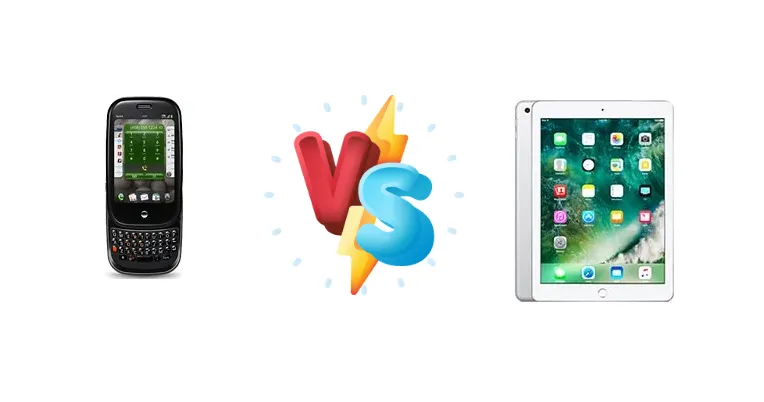
The Palm Pre and the Apple iPad 9.7 (2017) represent vastly different approaches to mobile computing. The Pre, released in 2009, aimed to redefine smartphone interaction with its innovative webOS, while the iPad, even in its 2017 iteration, solidified Apple’s dominance in the tablet space with iPadOS. This comparison isn't about raw power, but about contrasting philosophies and how their underlying hardware choices shaped their respective experiences.
🏆 Quick Verdict
For the average user today, the Apple iPad 9.7 (2017) is the more practical choice. While the Palm Pre was groundbreaking for its time, the iPad’s significantly more powerful Apple A9 chipset and larger screen offer a far broader range of functionality and continued software support. The Pre’s niche appeal is limited by its age and limited app ecosystem.
| Network |
|---|
| 2G bands | GSM 850 / 900 / 1800 / 1900 | GSM 850 / 900 / 1800 / 1900 |
| 3G bands | HSDPA 850 / 1900 / 2100 | HSDPA 800 / 850 / 900 / 1700(AWS) / 1900 / 2100 |
| 4G bands | - | 1, 2, 3, 4, 5, 7, 8, 12, 13, 17, 18, 19, 20, 25, 26, 28, 29, 38, 39, 40, 41 |
| Speed | HSPA 3.6/0.384 Mbps | HSPA 42.2/5.76 Mbps, LTE Cat4 150/50 Mbps, EV-DO Rev.A 3.1 Mbps |
| Technology | GSM / HSPA | GSM / CDMA / HSPA / EVDO / LTE |
| | - | CDMA2000 1xEV-DO |
| Launch |
|---|
| Announced | 2009, Februray. Released 2009, October | 2017, March. Released 2017, March |
| Status | Discontinued | Discontinued |
| Body |
|---|
| Build | - | Glass front, aluminum back, aluminum frame |
| Dimensions | 100.5 x 59.5 x 16.9 mm (3.96 x 2.34 x 0.67 in) | 240 x 169.5 x 7.5 mm (9.45 x 6.67 x 0.30 in) |
| Keyboard | QWERTY | - |
| SIM | Mini-SIM | Nano-SIM + eSIM |
| Weight | 133 g (4.69 oz) | 469 g (Wi-Fi) / 478 g (LTE) (1.03 lb) |
| Display |
|---|
| Protection | - | Scratch-resistant glass, oleophobic coating |
| Resolution | 320 x 480 pixels, 3:2 ratio (~186 ppi density) | 1536 x 2048 pixels, 4:3 ratio (~264 ppi density) |
| Size | 3.1 inches, 28.6 cm2 (~47.9% screen-to-body ratio) | 9.7 inches, 291.4 cm2 (~71.6% screen-to-body ratio) |
| Type | TFT | IPS LCD |
| Platform |
|---|
| CPU | 600 MHz Cortex-A8 | Dual-core 1.84 GHz (Twister) |
| Chipset | - | Apple A9 (14 nm) |
| GPU | PowerVR SGX | PowerVR GT7600 (six-core graphics) |
| OS | Palm webOS | iOS 10.3, upgradable to iPadOS 16.7.12 |
| Memory |
|---|
| Card slot | No | No |
| Internal | 8GB 256MB RAM | 32GB 2GB RAM, 128GB 2GB RAM |
| Main Camera |
|---|
| Features | LED flash | HDR |
| Single | 3.15 MP | 8 MP, f/2.4, 31mm (standard), 1.12µm, AF |
| Video | No | 1080p@30fps, 720p@120fps, HDR, stereo sound rec. |
| Selfie camera |
|---|
| Features | - | Face detection, HDR, panorama |
| Single | - | 1.2 MP, f/2.2, 31mm (standard) |
| Video | - | 720p@30fps |
| | No | - |
| Sound |
|---|
| 3.5mm jack | Yes | Yes |
| 35mm jack | Yes | Yes |
| Loudspeaker | Yes | Yes, with stereo speakers |
| Comms |
|---|
| Bluetooth | 2.1, A2DP (headset support only) | 4.2, A2DP, EDR, LE |
| NFC | - | No |
| Positioning | GPS | GPS, GLONASS (Wi‑Fi + Cellular model only) |
| Radio | No | No |
| USB | microUSB | Lightning, USB 2.0 |
| WLAN | Wi-Fi 802.11 b/g | Wi-Fi 802.11 a/b/g/n/ac, dual-band, hotspot |
| Features |
|---|
| Browser | WAP 2.0 / HTML | - |
| Sensors | Accelerometer | Fingerprint (front-mounted), accelerometer, gyro, compass, barometer |
| Battery |
|---|
| Charging | Wireless | - |
| Stand-by | Up to 300 h | - |
| Talk time | Up to 5 h | Up to 10 h (multimedia) |
| Type | Removable Li-Ion 1150 mAh battery | Li-Po 8827 mAh, non-removable (32.9 Wh) |
| Misc |
|---|
| Colors | Black | Silver, Gold, Space Gray |
| Models | - | A1822, A1823, iPad6,11, iPad6,12 |
| Price | About 180 EUR | About 390 EUR |
| SAR | 0.92 W/kg (head) 0.94 W/kg (body) | 1.18 W/kg (body) |
| SAR EU | - | 0.99 W/kg (body) |
| Tests |
|---|
| Audio quality |
Noise -95.7dB / Crosstalk -53.9dB | - |
| Camera |
Photo | - |
| Loudspeaker |
Voice 71dB / Noise 68dB / Ring 80dB | - |
Palm Pre
- Innovative webOS operating system
- Truly pocketable form factor
- Wireless charging capability
- Outdated processor and limited performance
- Limited app ecosystem and software support
- Small screen size
Apple iPad 9.7 (2017)
- Powerful Apple A9 chipset
- Large 9.7-inch display
- Access to a vast app library
- No wireless charging
- Larger and less portable than the Palm Pre
- Older iPad model, limited future software updates
Display Comparison
The Palm Pre’s display specifications are not provided, but given its 2009 release, it likely featured a resistive touchscreen with a relatively low resolution compared to the iPad 9.7 (2017). The iPad boasts a 9.7-inch display, a significant size difference. While the iPad’s panel technology isn’t cutting-edge (lacking features like LTPO), its IPS LCD provides wider viewing angles and better color accuracy than the Pre’s likely display. The larger screen size of the iPad is a major advantage for tasks like video playback and document editing.
Camera Comparison
Both devices feature a photo camera, but details are limited. The Palm Pre’s camera was a basic feature for its era. The iPad 9.7 (2017) likely has a more capable camera, though it was never a primary focus for Apple’s tablets. Without specific sensor sizes or apertures, it’s difficult to make a precise comparison, but the iPad’s image signal processor (ISP) integrated into the A9 chipset would provide superior image processing capabilities, resulting in better image quality.
Performance
The core difference lies in the processors. The Palm Pre’s 600 MHz Cortex-A8 processor, while innovative for its time, is dwarfed by the Apple iPad 9.7 (2017)’s Apple A9 (14nm) chipset with dual-core 1.84 GHz (Twister) CPUs. The A9’s 14nm fabrication process provides significantly better power efficiency and thermal performance, allowing for sustained higher clock speeds. This translates to a dramatically faster and more responsive experience on the iPad, especially when multitasking or running demanding applications. The A9’s architecture is also far more advanced, offering superior instruction set efficiency.
Battery Life
Battery capacity details for the Palm Pre are unavailable. The iPad 9.7 (2017) offers a substantial battery life advantage due to its larger capacity and the power efficiency of the A9 chipset. The Palm Pre does offer wireless charging, a feature not present on the iPad 9.7 (2017). However, the convenience of wireless charging is offset by the iPad’s significantly longer runtime between charges. The A9’s efficient power management allows for extended use, making it more suitable for travel or long periods away from a power outlet.
Buying Guide
Buy the Palm Pre if you’re a collector of mobile history, fascinated by innovative (but ultimately unsuccessful) operating systems like webOS, and prioritize a truly pocketable form factor. Buy the Apple iPad 9.7 (2017) if you need a versatile tablet for media consumption, light productivity, and access to a vast app library, and value long-term software support and a larger display.
Frequently Asked Questions
❓ Is the Palm Pre still usable as a daily driver in 2024?
While technically functional, the Palm Pre is not practical as a daily driver. Its outdated hardware, limited app support, and lack of security updates make it unsuitable for modern use cases. It's best suited for collectors or those interested in experiencing a piece of mobile history.
❓ Can I install modern apps on the Palm Pre?
No. The Palm Pre runs webOS, which is no longer actively developed. While there are some community efforts to port apps, the selection is extremely limited and compatibility is often poor. The iPad 9.7 (2017) has a much larger and actively maintained app ecosystem.
❓ Does the Apple A9 chip in the iPad 9.7 (2017) struggle with modern iPadOS versions?
The A9 is showing its age with newer iPadOS versions, and performance can be sluggish with demanding tasks or multitasking. However, it remains capable of handling most everyday tasks like web browsing, email, and video playback. Apple has optimized iPadOS to run on older hardware, but it's not as smooth as on newer iPads.