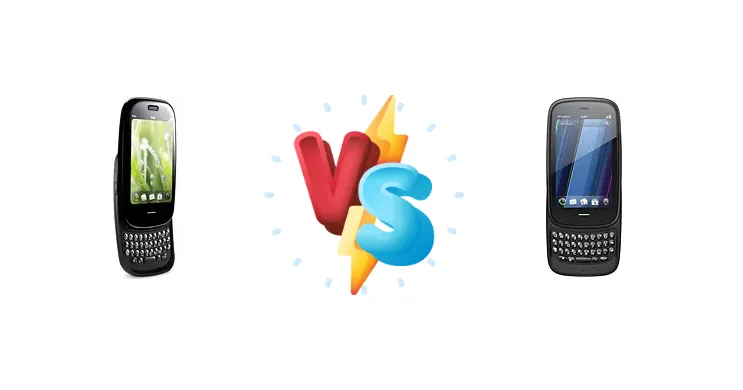
The Palm Pre Plus and HP Pre 3 represent pivotal moments in webOS history. The Pre Plus refined the original Pre’s design and added wireless charging, while the Pre 3 aimed to deliver a more powerful experience with Qualcomm’s Snapdragon platform. This comparison dissects the core differences between these two devices, focusing on performance, efficiency, and the overall user experience.
🏆 Quick Verdict
For the average user prioritizing responsiveness and a modern experience, the HP Pre 3 is the clear winner. Its 1.4 GHz Snapdragon S2 chipset provides a significant performance uplift over the Pre Plus’s 600 MHz Cortex-A8, translating to smoother multitasking and faster app loading times. However, the Pre Plus’s wireless charging remains a unique advantage.
| Network |
|---|
| 2G bands | GSM 850 / 900 / 1800 / 1900 | GSM 850 / 900 / 1800 / 1900 |
| 3G bands | HSDPA 2100 | HSDPA 900 / 1900 / 2100 |
| Speed | HSPA 3.6/0.384 Mbps | HSPA 7.2/5.76 Mbps |
| Technology | GSM / HSPA | GSM / HSPA |
| | HSDPA 850 / 1900 - for AT&T | - |
| Launch |
|---|
| Announced | 2010, March. Released 2010, May | 2011, February. Released 2011, August |
| Status | Discontinued | Discontinued |
| Body |
|---|
| Dimensions | 100.5 x 59.5 x 16.9 mm (3.96 x 2.34 x 0.67 in) | 111 x 64 x 16 mm (4.37 x 2.52 x 0.63 in) |
| Keyboard | QWERTY | QWERTY |
| SIM | Mini-SIM | Mini-SIM |
| Weight | 138 g (4.87 oz) | 156 g (5.50 oz) |
| Display |
|---|
| Resolution | 320 x 480 pixels, 3:2 ratio (~186 ppi density) | 480 x 800 pixels, 5:3 ratio (~261 ppi density) |
| Size | 3.1 inches, 28.6 cm2 (~47.9% screen-to-body ratio) | 3.58 inches, 36.5 cm2 (~51.4% screen-to-body ratio) |
| Type | TFT | TFT |
| Platform |
|---|
| CPU | 600 MHz Cortex-A8 | 1.4 GHz Scorpion |
| Chipset | - | Qualcomm MSM8255 Snapdragon S2 |
| GPU | PowerVR SGX | Adreno 205 |
| OS | Palm webOS 1.3.5 | HP webOS 2.2 |
| Memory |
|---|
| Card slot | No | No |
| Internal | 16GB 512MB RAM | 8GB 512MB RAM |
| Main Camera |
|---|
| Features | LED flash | LED flash |
| Single | 3.15 MP | 5 MP, AF |
| Video | Yes | 720p |
| Selfie camera |
|---|
| Single | - | VGA |
| | No | - |
| Sound |
|---|
| 3.5mm jack | Yes | Yes |
| 35mm jack | Yes | Yes |
| Loudspeaker | Yes | Yes |
| Comms |
|---|
| Bluetooth | 2.1, A2DP | 2.1, A2DP, EDR |
| Positioning | GPS, A-GPS | GPS, A-GPS |
| Radio | No | No |
| USB | microUSB 2.0 | microUSB 2.0 |
| WLAN | Wi-Fi 802.11 b/g | Wi-Fi 802.11 a/b/g/n, dual-band |
| Features |
|---|
| Browser | WAP 2.0 / HTML | HTML, Adobe Flash |
| Sensors | Accelerometer | Accelerometer, proximity, compass |
| | - | MP3/WAV/eAAC+ player
MP4/H.264 player
Organizer
Document viewer
Voice memo/dial
Predictive text input |
| Battery |
|---|
| Charging | Wireless | - |
| Stand-by | Up to 350 h (2G) / - (3G) | Up to 300 h |
| Talk time | Up to 4 h (2G) / Up to 4 h (3G) | Up to 5 h |
| Type | Removable Li-Ion 1150 mAh battery | Removable Li-Ion 1230 mAh battery |
| Misc |
|---|
| Colors | Black | Black |
| Price | About 170 EUR | About 350 EUR |
Palm Pre Plus
- Compact and lightweight design
- Wireless charging capability
- Unique webOS gesture navigation
- Significantly slower processor
- Limited multitasking capabilities
- Potentially shorter battery life
HP Pre 3
- Faster Snapdragon S2 processor
- Improved multitasking performance
- More responsive user interface
- Lacks wireless charging
- Larger size compared to Pre Plus
- May experience slightly reduced battery life under heavy load
Display Comparison
Both devices share a similar 3.1-inch display size, but detailed specifications regarding resolution and panel technology are limited. However, the focus here isn't display quality, but rather the impact of processing power on UI rendering. The Pre 3’s faster processor will contribute to smoother scrolling and animations, even if the panel itself is comparable. Bezels were a hallmark of the era, and both devices feature noticeable bezels around the display.
Camera Comparison
Detailed camera specifications for both devices are scarce. Given the era, both likely featured relatively low-resolution cameras. The focus wasn’t on high megapixel counts, but on basic image capture for social sharing. The Pre 3’s more powerful image signal processor (ISP) within the Snapdragon S2 chipset *could* translate to slightly better image processing, such as improved noise reduction and color accuracy, but the difference is likely minimal. We can assume both devices would struggle in low-light conditions.
Performance
The core difference lies in the chipset. The Palm Pre Plus utilizes a 600 MHz Cortex-A8 processor, a capable chip for its time, but significantly outpaced by the HP Pre 3’s Qualcomm MSM8255 Snapdragon S2 featuring a 1.4 GHz Scorpion CPU. This represents a substantial clock speed increase and a move to a more modern architecture. The Snapdragon S2’s Adreno 200 GPU also provides a significant boost in graphics performance, enabling smoother UI transitions and potentially better performance in early mobile games. The Pre 3 benefits from a more efficient architecture, potentially leading to better battery life despite the increased processing power.
Battery Life
Battery capacity details are unavailable for both devices. However, the HP Pre 3’s more efficient Snapdragon S2 chipset likely offers better battery life despite potentially having a similar capacity to the Pre Plus. The Pre Plus’s key advantage is its wireless charging capability, offering a convenient alternative to traditional cable charging. While charging speeds via cable are unknown for both, the Pre 3’s faster processor could lead to quicker data transfer speeds during a wired charge.
Buying Guide
Buy the Palm Pre Plus if you value portability and wireless charging above all else. Its compact size and inductive charging capability make it ideal for users who prioritize convenience and a minimalist lifestyle. Buy the HP Pre 3 if you need a more capable smartphone for demanding tasks like web browsing, email, and light gaming. The Snapdragon S2 chipset delivers a noticeably faster and more fluid experience, making it a better choice for power users.
Frequently Asked Questions
❓ Will the HP Pre 3 run modern web applications smoothly?
While the Snapdragon S2 was a significant step up for its time, modern web applications are far more demanding. The HP Pre 3 will likely struggle with complex websites and web apps, experiencing noticeable slowdowns and rendering issues. It's best suited for simpler web browsing experiences.
❓ Is the wireless charging on the Palm Pre Plus still functional today?
Yes, the wireless charging on the Palm Pre Plus should still function if you have a compatible wireless charging pad. However, the charging speed will be significantly slower than modern wireless charging standards. It's a convenient feature, but not a particularly fast one.
❓ Can I install Android on either the Palm Pre Plus or HP Pre 3?
While there have been attempts to port Android to webOS devices, the process is complex and often results in an unstable and incomplete experience. Full Android compatibility is not officially supported on either device, and requires significant technical expertise.