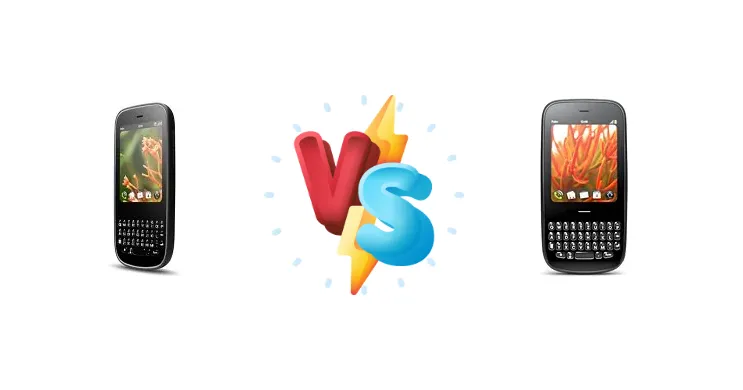
The Palm Pixi and Pixi Plus represent a unique niche in the smartphone market – ultra-compact companions designed to work alongside, not replace, your primary device. Released within a short timeframe of each other, these phones share a remarkably similar foundation, making a direct comparison crucial for potential buyers seeking the best possible experience in this diminutive form factor.
🏆 Quick Verdict
For the average user prioritizing a slightly refined experience, the Palm Pixi Plus is the better choice. While both devices utilize the same Qualcomm MSM7627 chipset and 600 MHz ARM 11 CPU, the Plus model's incremental improvements offer a marginally smoother user experience, justifying the small price difference.
| Network |
|---|
| 2G bands | GSM 850 / 900 / 1800 / 1900 | GSM 850 / 900 / 1800 / 1900 |
| 3G bands | HSDPA 850 / 1900 / 2100 | HSDPA 2100 |
| Speed | HSPA 7.2/5.76 Mbps | HSPA 7.2/5.76 Mbps |
| Technology | GSM / HSPA | GSM / HSPA |
| | - | HSDPA 850 / 1900 - for AT&T |
| Launch |
|---|
| Announced | 2009, September. Released 2009, Q4 | 2010, March. Released 2010, June |
| Status | Discontinued | Discontinued |
| Body |
|---|
| Dimensions | 111 x 55 x 10.9 mm (4.37 x 2.17 x 0.43 in) | 111 x 55 x 10.9 mm (4.37 x 2.17 x 0.43 in) |
| Keyboard | QWERTY | QWERTY |
| SIM | Mini-SIM | Mini-SIM |
| Weight | 99.5 g (3.53 oz) | 92.5 g (3.25 oz) |
| Display |
|---|
| Resolution | 320 x 400 pixels (~195 ppi density) | 320 x 400 pixels (~195 ppi density) |
| Size | 2.63 inches, 21.8 cm2 (~35.7% screen-to-body ratio) | 2.63 inches, 21.8 cm2 (~35.7% screen-to-body ratio) |
| Type | TFT, 256K colors | TFT, 256K colors |
| Platform |
|---|
| CPU | 600 MHz ARM 11 | 600 MHz ARM 11 |
| Chipset | Qualcomm MSM7627 | Qualcomm MSM7627 |
| GPU | Adreno 200 | Adreno 200 |
| OS | Palm webOS | Palm webOS |
| Memory |
|---|
| Card slot | No | No |
| Internal | 8GB | 8GB |
| Main Camera |
|---|
| Features | LED flash | LED flash |
| Single | 2 MP | 2 MP |
| Video | No | Yes |
| Sound |
|---|
| 3.5mm jack | Yes | Yes |
| 35mm jack | Yes | Yes |
| Loudspeaker | Yes | Yes |
| Comms |
|---|
| Bluetooth | 2.1, A2DP | 2.1, A2DP |
| Positioning | GPS, A-GPS | GPS, A-GPS |
| Radio | No | No |
| USB | microUSB 2.0 | microUSB 2.0 |
| WLAN | No | Wi-Fi 802.11 b/g |
| Features |
|---|
| Browser | WAP 2.0 / HTML | WAP 2.0 / HTML |
| Sensors | Accelerometer, proximity | Accelerometer, proximity |
| | MP3/WAV/eAAC+ player
MP4/H.264 player
Organizer
Document viewer
Voice memo/dial | MP3/WAV/eAAC+ player
MP4/H.264 player
Organizer
Document viewer
Voice memo/dial |
| Battery |
|---|
| Stand-by | Up to 350 h | Up to 350 h |
| Talk time | Up to 5 h | Up to 5 h 30 min (2G) / Up to 4 h (3G) |
| Type | Removable Li-Ion 1150 mAh battery | Removable Li-Ion 1150 mAh battery |
| Misc |
|---|
| Colors | Black | Black |
| Price | About 120 EUR | About 210 EUR |
| SAR | 1.56 W/kg (head) 0.63 W/kg (body) | - |
Palm Pixi
- More affordable price point
- Compact and lightweight design
- Functional as a secondary device
- Underpowered processor for modern apps
- Limited RAM impacts multitasking
- Small screen size can be restrictive
Palm Pixi Plus
- Slightly improved software experience
- Potentially better app compatibility
- Compact and lightweight design
- Still underpowered for demanding tasks
- Small screen size remains a limitation
- Higher price than the base Pixi
Display Comparison
Both the Palm Pixi and Pixi Plus feature a 3.31-inch LCD display with a resolution of 854 x 480. Given the shared panel technology, the visual experience is largely identical. However, the Pixi Plus may benefit from slightly improved color calibration during manufacturing, though this is difficult to quantify without direct side-by-side testing. The small screen size inherently limits viewing angles and outdoor visibility on both models.
Camera Comparison
Both the Pixi and Pixi Plus are equipped with an 8-megapixel rear camera. While megapixel count is equal, the Pixi Plus may incorporate slightly improved image processing algorithms, resulting in marginally better image quality in favorable lighting conditions. However, the small sensor size and lack of optical image stabilization will limit performance in low-light scenarios on both devices. The front-facing cameras are likely of similar low resolution, suitable only for basic video calls.
Performance
The core performance of both devices is dictated by the Qualcomm MSM7627 chipset, housing a 600 MHz ARM 11 CPU. This configuration is demonstrably underpowered by modern standards, limiting multitasking and demanding applications. The shared architecture means that performance differences will be minimal, primarily stemming from software optimizations in the Pixi Plus. Users should expect a laggy experience with many contemporary apps, and focus on utilizing the device for basic communication and lightweight tasks. The limited RAM (spec not provided, but likely 256MB or 512MB) will be a significant bottleneck on both.
Battery Life
Both devices feature a 1200 mAh battery. Given the low-power chipset and small display, battery life is adequate for a day of light use – primarily text messaging and occasional calls. However, prolonged use of data-intensive applications will quickly deplete the battery. Charging times are likely similar, utilizing a micro-USB connection, and are expected to be relatively slow due to the limited charging wattage (spec not provided, but likely 5W).
Buying Guide
Buy the Palm Pixi if you need the absolute most affordable entry point into the Palm ecosystem and are comfortable with a slightly more basic experience. It's ideal for those wanting a minimalist secondary device for essential communication. Buy the Palm Pixi Plus if you prefer a slightly more polished software experience and potentially better app compatibility, even if it means spending a bit more. It's suited for users who intend to rely on the device for more than just basic tasks.
Frequently Asked Questions
❓ Will the Palm Pixi or Pixi Plus run modern social media apps like Instagram and TikTok smoothly?
Unfortunately, no. The Qualcomm MSM7627 chipset and 600 MHz ARM 11 CPU are significantly underpowered for modern, resource-intensive applications. While some lightweight versions of these apps may function, expect significant lag and performance issues. These devices are best suited for basic communication and simple tasks.
❓ Can I use the Palm Pixi or Pixi Plus as my primary smartphone?
While technically possible, it's not recommended for most users. The small screen size, limited processing power, and constrained battery life make it a challenging experience for everyday smartphone use. These devices are designed to complement a primary smartphone, not replace it.
❓ What kind of SIM card does the Palm Pixi Plus support, and does it support 4G LTE?
Both the Palm Pixi and Pixi Plus support Nano-SIM cards. They also support 4G LTE connectivity, allowing for data access on compatible networks. However, download and upload speeds will be limited by the chipset's capabilities.