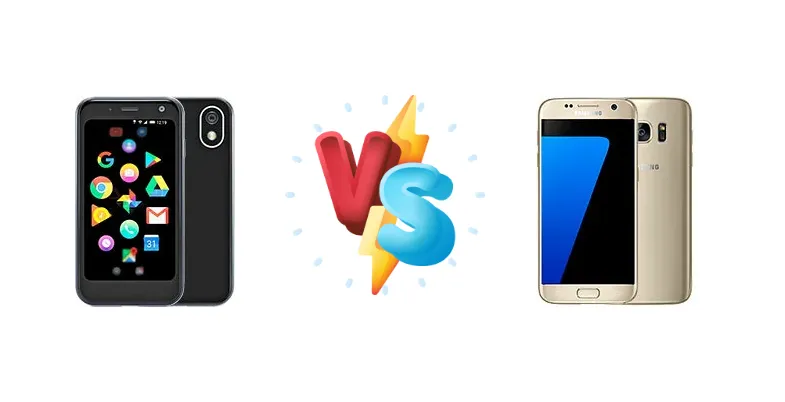
The Palm Phone PVG100 represents a niche desire for extreme portability, while the Samsung Galaxy S7, though released in 2016, remains a surprisingly capable device. This comparison isn't about raw power; it's about understanding the trade-offs between a truly pocketable experience and the features of a former flagship. We'll dissect the hardware to determine which phone best suits your needs in 2024.
🏆 Quick Verdict
For the average user, the Samsung Galaxy S7 offers a significantly more robust experience. Its Exynos 8890 chipset, superior display technology, and established camera system outweigh the Palm Phone's portability advantage. However, the Palm Phone is a compelling option for those prioritizing minimal size above all else.
| Network |
|---|
| 2G bands | GSM 850 / 900 / 1800 / 1900 | GSM 850 / 900 / 1800 / 1900 - SIM 1 & SIM 2 - G930FD |
| 3G bands | HSDPA 850 / 1700(AWS) / 1900 / 2100 | HSDPA 850 / 900 / 1700(AWS) / 1900 / 2100 - G930F, G930FD, G930W8 |
| 4G bands | 2, 4, 5, 12, 13, 17, 66 | 1, 2, 3, 4, 5, 7, 8, 12, 13, 17, 18, 19, 20, 25, 26, 28, 38, 39, 40, 41 - G930F, G930FD |
| Speed | HSPA 42.2/5.76 Mbps, LTE Cat4 150/50 Mbps | HSPA 42.2/5.76 Mbps, LTE (3CA) Cat9 450/50 Mbps |
| Technology | GSM / HSPA / LTE | GSM / HSPA / LTE |
| | - | 1, 2, 3, 4, 5, 7, 8, 12, 13, 17, 18, 19, 20, 25, 29, 30, 38, 39, 40, 41 - G930W8 |
| Launch |
|---|
| Announced | 2018, October. Released 2018, November | 2016, February 21. Released 2016, March 11 |
| Status | Discontinued | Discontinued |
| Body |
|---|
| Build | Glass front (Gorilla Glass 3), glass back (Gorilla Glass 3), aluminum frame | Glass front (Gorilla Glass 4), glass back (Gorilla Glass 4), aluminum frame |
| Dimensions | 96.6 x 50.6 x 7.4 mm (3.80 x 1.99 x 0.29 in) | 142.4 x 69.6 x 7.9 mm (5.61 x 2.74 x 0.31 in) |
| SIM | Nano-SIM | · Nano-SIM (G930F)· Nano-SIM + Nano-SIM (G930FD) |
| Weight | 62.5 g (2.22 oz) | 152 g (5.36 oz) |
| | IP68 dust/water resistant (up to 1m for 30 min) | IP68 dust/water resistant (up to 1.5m for 30 min) |
| Display |
|---|
| Protection | Corning Gorilla Glass 3 | Corning Gorilla Glass 4 |
| Resolution | 720 x 1280 pixels, 16:9 ratio (~445 ppi density) | 1440 x 2560 pixels, 16:9 ratio (~577 ppi density) |
| Size | 3.3 inches, 30.0 cm2 (~61.4% screen-to-body ratio) | 5.1 inches, 71.5 cm2 (~72.1% screen-to-body ratio) |
| Type | IPS LCD | Super AMOLED |
| | - | Always-on display |
| Platform |
|---|
| CPU | Octa-core (4x1.4 GHz & 4x1.1 GHz) | Octa-core (4x2.3 GHz Mongoose & 4x1.6 GHz Cortex-A53) |
| Chipset | Qualcomm MSM8940 Snapdragon 435 (28 nm) | Exynos 8890 Octa (14 nm) |
| GPU | Adreno 505 | Mali-T880 MP12 |
| OS | Android 8.1 (Oreo) | Android 6.0 (Marshmallow), upgradable to Android 8.0 (Oreo), TouchWiz UI |
| Memory |
|---|
| Card slot | No | microSDXC (uses shared SIM slot) - dual SIM model only |
| Internal | 32GB 3GB RAM | 32GB 4GB RAM, 64GB 4GB RAM |
| | eMMC 5.1 | UFS 2.0 |
| Main Camera |
|---|
| Features | LED flash, HDR | LED flash, auto-HDR, panorama |
| Single | 12 MP, AF | 12 MP, f/1.7, 26mm (wide), 1/2.55", 1.4µm, dual pixel PDAF, OIS |
| Video | 720p@30fps | 4K@30fps, 1080p@30fps (gyro-EIS), 1080p@60fps, 720p@240fps, HDR, stereo sound rec., OIS |
| Selfie camera |
|---|
| Features | - | HDR |
| Single | 8 MP | 5 MP, f/1.7, 22mm (wide), 1/4.1", 1.34µm |
| Video | 720p@30fps | 1440p |
| Sound |
|---|
| 3.5mm jack | No | Yes |
| 35mm jack | No | Yes |
| Loudspeaker | Yes, with dual speakers | Yes |
| | - | 24-bit/192kHz audio
|
| Comms |
|---|
| Bluetooth | 4.2, A2DP, LE | 4.2, A2DP, LE, aptX |
| NFC | No | Yes |
| Positioning | GPS, GLONASS | GPS, GLONASS, BDS |
| Radio | No | No |
| USB | USB Type-C 2.0 | microUSB 2.0, OTG |
| WLAN | Wi-Fi 802.11 a/b/g/n, Wi-Fi Direct | Wi-Fi 802.11 a/b/g/n/ac, dual-band, Wi-Fi Direct |
| Features |
|---|
| Sensors | Infrared Face ID, accelerometer, proximity, gyro, compass | Fingerprint (front-mounted), accelerometer, gyro, proximity, compass, barometer, heart rate, SpO2 |
| | - | ANT+
S-Voice natural language commands and dictation
Samsung Pay (Visa, MasterCard certified) |
| Battery |
|---|
| Charging | Wired, 50% in 31 min, 100% in 68 min | 15W wired, QC2
Wireless (Qi) (market dependent) |
| Music play | - | Up to 62 h |
| Talk time | - | Up to 22 h (3G) |
| Type | Li-Ion 800 mAh, non-removable | Li-Ion 3000 mAh, non-removable |
| Misc |
|---|
| Colors | Gold, Titanium | Black, White, Gold, Silver, Pink Gold |
| Models | PVG100, PVG100E | SM-G930F, SM-G930A, SM-G930P, SM-G930V, SM-G930T, SM-G930R, SM-G930F, SM-G930FD, SM-G930W8, SM-G930S, SM-G930L, SM-G930K, SM-G9300 |
| Price | About 400 EUR | About 190 EUR |
| SAR | - | 1.40 W/kg (head) 1.59 W/kg (body) |
| SAR EU | 0.98 W/kg (head) | 0.41 W/kg (head) 0.62 W/kg (body) |
| Tests |
|---|
| Audio quality | - |
Noise -92.5dB / Crosstalk -92.7dB |
| Battery life | - |
Endurance rating 80h
|
| Camera | - |
Photo / Video |
| Display | - |
Contrast ratio: Infinite (nominal), 4.376 (sunlight) |
| Loudspeaker | - |
Voice 69dB / Noise 69dB / Ring 71dB
|
| Performance | - |
Basemark OS II 2.0: 2128Basemark X: 32345 |
Palm Phone PVG100
- Extremely compact and pocketable design
- Lightweight and easy to carry
- Fast charging for its size
- Significantly weaker performance than the S7
- Smaller screen size may be limiting
- Likely inferior camera quality
Samsung Galaxy S7
- Powerful Exynos 8890 processor
- Vibrant and high-quality display
- Capable camera system with excellent low-light performance
- Larger and heavier than the Palm Phone
- Battery life, while good, is aging
- Potential for Exynos 8890 thermal throttling
Display Comparison
Both devices feature displays with an 'Infinite' contrast ratio (nominal), and 4.376 sunlight contrast, suggesting similar outdoor visibility. However, the Galaxy S7’s larger size and likely higher peak brightness (data unavailable for Palm) provide a more immersive viewing experience. The Palm Phone’s smaller screen, while contributing to its portability, will feel cramped for media consumption. The S7’s display technology, while not OLED, was considered top-tier for its time, offering accurate color reproduction and wide viewing angles, features not detailed for the Palm Phone.
Camera Comparison
The Samsung Galaxy S7’s camera system, while lacking detailed specifications in the provided data, was renowned for its low-light performance and fast autofocus. Its larger sensor size (compared to what is expected in the Palm Phone) and wider aperture lens would capture more light, resulting in clearer images in challenging conditions. The Palm Phone’s camera, while functional, is likely to be limited by its lower-end sensor and processing capabilities. The presence of 'Photo/Video' capabilities on both is a given, but the S7’s image processing algorithms and features (like Pro mode) offer a far more refined experience.
Performance
The Samsung Galaxy S7’s Exynos 8890, built on a 14nm process, significantly outperforms the Palm Phone’s Snapdragon 435 (28nm). The Exynos utilizes a custom Mongoose core alongside Cortex-A53 cores, achieving peak clock speeds of 2.3 GHz, compared to the Snapdragon 435’s 1.4 GHz and 1.1 GHz configuration. This translates to faster app loading times, smoother multitasking, and the ability to handle more demanding games on the S7. The larger process node of the Snapdragon 435 also implies lower efficiency and potentially more heat generation under load. While the S7's Exynos 8890 is known to have some thermal throttling issues, it still offers a substantial performance advantage.
Battery Life
The Samsung Galaxy S7 boasts an endurance rating of 80 hours, indicating a substantial battery life advantage. While the Palm Phone’s charging times (50% in 31 minutes, 100% in 68 minutes) are respectable, they don’t compensate for a potentially smaller battery capacity (data unavailable). The S7 also supports 15W wired charging with Quick Charge 2.0 and, market-dependent, wireless charging (Qi), offering greater convenience. The S7’s battery endurance suggests a more relaxed user experience, while the Palm Phone may require more frequent charging, especially with moderate to heavy use.
Buying Guide
Buy the Palm Phone PVG100 if you need a secondary device for essential notifications and calls, prioritizing extreme portability and minimal distraction. It's ideal for runners, minimalists, or anyone wanting to disconnect from their primary smartphone. Buy the Samsung Galaxy S7 if you prefer a fully-featured smartphone experience with a capable camera, a vibrant display, and the ability to handle demanding applications, even if it means a larger form factor.
Frequently Asked Questions
❓ Does the Exynos 8890 in the Galaxy S7 overheat during prolonged gaming sessions?
The Exynos 8890 is known to exhibit some thermal throttling under sustained load, particularly during graphically intensive games. While it won't shut down, you may experience a slight drop in frame rates after extended play. However, it's still a capable processor and generally handles most tasks without issue.
❓ Is the Palm Phone PVG100 a suitable primary smartphone for most users?
No, the Palm Phone PVG100 is best suited as a secondary device. Its limited processing power, smaller screen, and potentially shorter battery life make it impractical for users who rely heavily on their smartphones for demanding tasks or media consumption. It excels as a minimalist companion for essential communication.
❓ Can the Samsung Galaxy S7 still receive software updates in 2024?
Officially, Samsung no longer provides software updates for the Galaxy S7. However, the device remains functional with the last official Android version it received. Security updates are no longer available, which is a consideration for security-conscious users.
❓ What are the practical use cases for the Palm Phone's small size?
The Palm Phone's compact size makes it ideal for activities where a larger phone would be cumbersome, such as running, cycling, or attending events where space is limited. It's also a good option for those who want a dedicated device for notifications and calls, minimizing distractions from social media and other apps.