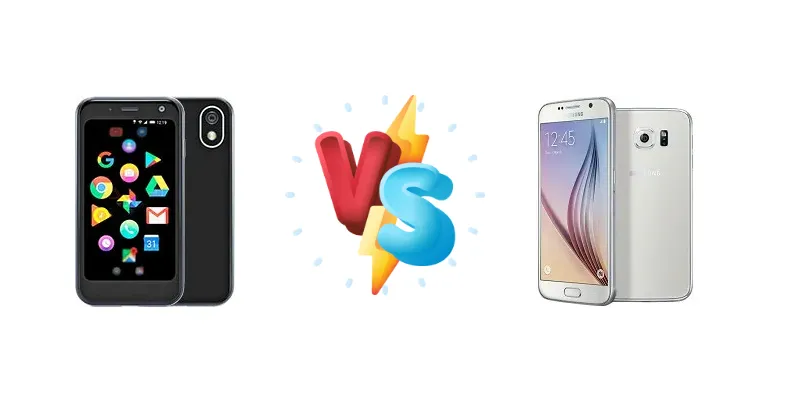
The Palm Phone PVG100 and the Samsung Galaxy S6 represent vastly different eras of Android. The S6, released in 2015, was a flagship defining its time, while the Palm Phone, launched in 2018, aimed for a niche as an ultra-compact companion device. This comparison isn't about raw power, but about understanding where each phone still holds value in today's market.
🏆 Quick Verdict
For the average user in 2024, the Samsung Galaxy S6 offers a more complete experience. While the Palm Phone’s portability is appealing, the S6’s superior processing power, camera capabilities, and established ecosystem outweigh the Palm’s diminutive size and lower price point.
| Network |
|---|
| 2G bands | GSM 850 / 900 / 1800 / 1900 | GSM 850 / 900 / 1800 / 1900 |
| 3G bands | HSDPA 850 / 1700(AWS) / 1900 / 2100 | HSDPA 850 / 900 / 1900 / 2100 |
| 4G bands | 2, 4, 5, 12, 13, 17, 66 | 1, 2, 3, 4, 5, 7, 8, 12, 17, 18, 19, 20, 26 |
| Speed | HSPA 42.2/5.76 Mbps, LTE Cat4 150/50 Mbps | HSPA 42.2/5.76 Mbps, LTE Cat6 300/50 Mbps |
| Technology | GSM / HSPA / LTE | GSM / HSPA / LTE |
| Launch |
|---|
| Announced | 2018, October. Released 2018, November | 2015, March 01. Released 2015, April |
| Status | Discontinued | Discontinued |
| Body |
|---|
| Build | Glass front (Gorilla Glass 3), glass back (Gorilla Glass 3), aluminum frame | Glass front (Gorilla Glass 4), glass back (Gorilla Glass 4), aluminum frame |
| Dimensions | 96.6 x 50.6 x 7.4 mm (3.80 x 1.99 x 0.29 in) | 143.4 x 70.5 x 6.8 mm (5.65 x 2.78 x 0.27 in) |
| SIM | Nano-SIM | Nano-SIM |
| Weight | 62.5 g (2.22 oz) | 138 g (4.87 oz) |
| | IP68 dust/water resistant (up to 1m for 30 min) | - |
| Display |
|---|
| Protection | Corning Gorilla Glass 3 | Corning Gorilla Glass 4 |
| Resolution | 720 x 1280 pixels, 16:9 ratio (~445 ppi density) | 1440 x 2560 pixels, 16:9 ratio (~577 ppi density) |
| Size | 3.3 inches, 30.0 cm2 (~61.4% screen-to-body ratio) | 5.1 inches, 71.5 cm2 (~70.7% screen-to-body ratio) |
| Type | IPS LCD | Super AMOLED |
| Platform |
|---|
| CPU | Octa-core (4x1.4 GHz & 4x1.1 GHz) | Octa-core (4x2.1 GHz Cortex-A57 & 4x1.5 GHz Cortex-A53) |
| Chipset | Qualcomm MSM8940 Snapdragon 435 (28 nm) | Exynos 7420 Octa (14 nm) |
| GPU | Adreno 505 | Mali-T760MP8 |
| OS | Android 8.1 (Oreo) | Android 5.0.2 (Lollipop), upgradable to Android 8.0 (Oreo), TouchWiz UI |
| Memory |
|---|
| Card slot | No | No |
| Internal | 32GB 3GB RAM | 32GB 3GB RAM, 64GB 3GB RAM, 128GB 3GB RAM |
| | eMMC 5.1 | UFS 2.0 |
| Main Camera |
|---|
| Features | LED flash, HDR | LED flash, auto-HDR, panorama |
| Single | 12 MP, AF | 16 MP, f/1.9, 28mm (wide), 1/2.6", 1.12µm, AF, OIS |
| Video | 720p@30fps | 4K@30fps, 1080p@30/60fps, 720p@120fps, HDR, stereo sound rec., OIS, gyro-EIS |
| Selfie camera |
|---|
| Features | - | HDR |
| Single | 8 MP | 5 MP, f/1.9, 22mm (wide), 1/4.1", 1.34µm |
| Video | 720p@30fps | 1440p@30fps |
| Sound |
|---|
| 3.5mm jack | No | Yes |
| 35mm jack | No | Yes |
| Loudspeaker | Yes, with dual speakers | Yes |
| | - | 24-bit/192kHz audio
|
| Comms |
|---|
| Bluetooth | 4.2, A2DP, LE | 4.1, A2DP, LE, aptX |
| Infrared port | - | Yes |
| NFC | No | Yes |
| Positioning | GPS, GLONASS | GPS, GLONASS, BDS |
| Radio | No | No |
| USB | USB Type-C 2.0 | microUSB 2.0, OTG |
| WLAN | Wi-Fi 802.11 a/b/g/n, Wi-Fi Direct | Wi-Fi 802.11 a/b/g/n/ac, dual-band, Wi-Fi Direct |
| Features |
|---|
| Sensors | Infrared Face ID, accelerometer, proximity, gyro, compass | Fingerprint (front-mounted), accelerometer, gyro, proximity, compass, barometer, heart rate, SpO2 |
| | - | ANT+
S-Voice natural language commands and dictation
Samsung Pay (Visa, MasterCard certified) |
| Battery |
|---|
| Charging | Wired, 50% in 31 min, 100% in 68 min | 15W wired
Wireless (Qi) (market dependent) |
| Music play | - | Up to 49 h |
| Talk time | - | Up to 17 h (3G) |
| Type | Li-Ion 800 mAh, non-removable | Li-Ion 2550 mAh, non-removable |
| Misc |
|---|
| Colors | Gold, Titanium | White Pearl, Black Sapphire, Gold Platinum, Blue Topaz |
| Models | PVG100, PVG100E | SM-G9200, SM-G9208, SM-G9208/SS, SM-G9209, SM-G920A, SM-G920F, SM-G920FD, SM-G920I, SM-G920S, SM-G920T, SM-G920K, SC-05G, SM-G920L, SM-G920, SM-G920R7 |
| Price | About 400 EUR | About 240 EUR |
| SAR | - | 1.15 W/kg (head) 1.16 W/kg (body) |
| SAR EU | 0.98 W/kg (head) | 0.38 W/kg (head) 0.50 W/kg (body) |
| Tests |
|---|
| Audio quality | - |
Noise -95.6dB / Crosstalk -94.5dB |
| Battery life | - | Endurance rating 73h |
| Camera | - |
Photo / Video |
| Display | - |
Contrast ratio: Infinite (nominal), 4.124 (sunlight) |
| Loudspeaker | - |
Voice 68dB / Noise 66dB / Ring 73dB |
| Performance | - |
Basemark OS II 2.0: 1641Basemark X: 22752 |
Palm Phone PVG100
- Extremely compact and portable
- Affordable price point
- Fast charging (68 minutes to full)
- Underpowered processor
- Small display limits usability
- Likely inferior camera quality
Samsung Galaxy S6
- Powerful Exynos 7420 processor
- Larger, higher-quality display
- Superior camera capabilities
- Aging battery technology
- No longer receives software updates
- Larger size less convenient for one-handed use
Display Comparison
Both devices feature displays with an 'Infinite' contrast ratio (nominal), and a 4.124 contrast ratio in sunlight, suggesting similar outdoor visibility. However, the S6’s larger 5.1-inch display offers a significantly more comfortable viewing experience than the Palm’s 3.3-inch screen. While the Palm’s smaller size is its defining feature, it comes at the cost of usability for media consumption and detailed tasks. The S6’s display technology, while not explicitly stated, was a leading panel for its time, likely offering superior color accuracy and brightness compared to the Palm’s more basic display.
Camera Comparison
While both phones offer photo and video capabilities, the Samsung Galaxy S6 holds a clear advantage. The S6’s camera system, though details are limited in the provided data, was renowned for its image quality and features at launch. The Palm Phone’s camera specifications are not provided, but given its budget-oriented nature, it likely features a lower-resolution sensor and less sophisticated image processing. The S6’s likely inclusion of Optical Image Stabilization (OIS) further enhances its low-light performance and video stability, features likely absent on the Palm.
Performance
The Samsung Galaxy S6’s Exynos 7420 Octa-core processor, built on a 14nm process, demonstrably outperforms the Palm Phone’s Qualcomm MSM8940 Snapdragon 435 (28nm). The S6’s CPU configuration – 4x2.1 GHz Cortex-A57 & 4x1.5 GHz Cortex-A53 – provides significantly more processing power for demanding applications and multitasking. The 28nm fabrication process of the Snapdragon 435 results in lower efficiency and potentially more heat generation compared to the S6’s 14nm Exynos chip. This translates to smoother performance and less throttling on the S6, especially during prolonged use. The Palm is adequate for basic tasks, but will struggle with modern, resource-intensive apps.
Battery Life
The Samsung Galaxy S6 boasts an endurance rating of 73 hours, indicating respectable battery life for its time. The Palm Phone’s battery capacity is not specified, but its smaller size suggests a significantly smaller battery. While the Palm Phone charges to 50% in 31 minutes and 100% in 68 minutes, the S6 offers 15W wired charging and, market-dependent, wireless (Qi) charging. The S6’s larger battery and potentially more efficient processor contribute to its longer endurance, despite the Palm’s faster charging speed. The S6’s wireless charging adds convenience, a feature the Palm lacks.
Buying Guide
Buy the Palm Phone PVG100 if you prioritize extreme portability and need a secondary device for minimal tasks like notifications and quick messaging. It’s ideal for those who want to disconnect from a larger phone without being completely unreachable. Buy the Samsung Galaxy S6 if you prefer a more traditional smartphone experience with a capable camera, faster performance for apps and multitasking, and a larger, more immersive display. It’s a better choice for users who rely on their phone for daily productivity and entertainment.
Frequently Asked Questions
❓ Does the Exynos 7420 in the Galaxy S6 suffer from overheating during prolonged gaming?
While the Exynos 7420 was known to generate some heat under sustained load, its thermal management was generally effective for its time. Modern gaming titles may push the chip to its limits, resulting in some throttling, but it’s unlikely to cause significant performance issues or shutdowns. The 14nm process helps mitigate heat compared to the Palm's 28nm chip.
❓ Is the Palm Phone’s small size practical for everyday use, or is it more of a novelty?
The Palm Phone’s size is its defining characteristic, and its practicality depends on individual needs. It excels as a secondary device for essential tasks like calls, texts, and notifications. However, its small screen can be frustrating for tasks like browsing the web, typing long messages, or using apps that require a lot of screen real estate. It's best suited for users who prioritize portability above all else.
❓ Given the age of the Samsung Galaxy S6, are there concerns about battery health and software support?
The Samsung Galaxy S6 is no longer receiving official software updates, which poses a security risk. The battery, being several years old, is likely degraded and may not hold a charge as well as it did when new. Replacing the battery is possible, but adds to the overall cost of ownership. Users should be aware of these limitations before purchasing.