
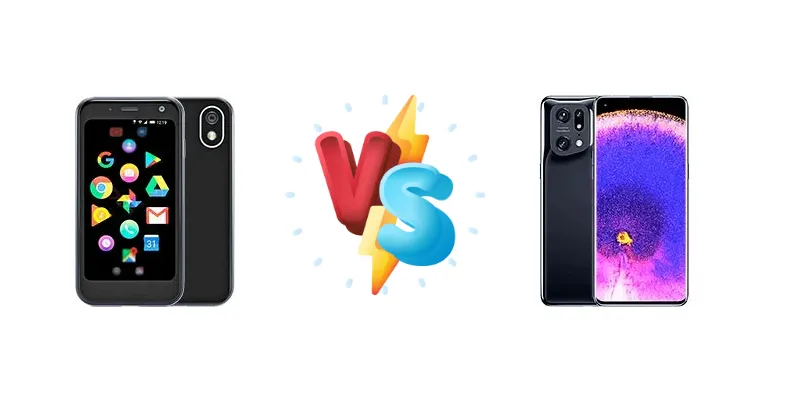
Palm Phone vs. Oppo Find X5 Pro: A David and Goliath Smartphone Showdown
| Phones Images | |||||
|---|---|---|---|---|---|
|
🏆 Quick Verdict
For the average user, the Oppo Find X5 Pro is the clear winner. Its Snapdragon 8 Gen 1 (or Dimensity 9000 in China) delivers vastly superior performance, a significantly better camera experience, and faster charging. However, the Palm Phone carves out a niche for those prioritizing extreme portability above all else.
| PHONES | ||
|---|---|---|
| Phone Names | Palm Phone PVG100 | Oppo Find X5 Pro |
| Network | ||
|---|---|---|
| 2G bands | GSM 850 / 900 / 1800 / 1900 | GSM 850 / 900 / 1800 / 1900 |
| 3G bands | HSDPA 850 / 1700(AWS) / 1900 / 2100 | HSDPA 800 / 850 / 900 / 1700(AWS) / 1900 / 2100 |
| 4G bands | 2, 4, 5, 12, 13, 17, 66 | 1, 2, 3, 4, 5, 7, 8, 12, 13, 17, 18, 19, 20, 25, 26, 28, 32, 34, 38, 39, 40, 41, 42, 66 - Global |
| 5G bands | - | 1, 2, 3, 5, 7, 8, 12, 13, 18, 20, 25, 26, 28, 38, 40, 41, 66, 77, 78, 79 SA/NSA - Global |
| Speed | HSPA 42.2/5.76 Mbps, LTE Cat4 150/50 Mbps | HSPA, LTE, 5G |
| Technology | GSM / HSPA / LTE | GSM / CDMA / HSPA / CDMA2000 / LTE / 5G |
| - | 1, 2, 3, 5, 8, 20, 28, 38, 41, 66, 77, 78, 79 SA/NSA - China | |
| Launch | ||
|---|---|---|
| Announced | 2018, October. Released 2018, November | 2022, February 24 |
| Status | Discontinued | Available. Released 2022, March 14 |
| Body | ||
|---|---|---|
| Build | Glass front (Gorilla Glass 3), glass back (Gorilla Glass 3), aluminum frame | Glass front (Gorilla Glass Victus), ceramic back or eco leather back, aluminum frame |
| Dimensions | 96.6 x 50.6 x 7.4 mm (3.80 x 1.99 x 0.29 in) | 163.7 x 73.9 x 8.5 or 8.8 mm |
| SIM | Nano-SIM | Nano-SIM + eSIM |
| Weight | 62.5 g (2.22 oz) | 218 g or 195 g (6.88 oz) |
| IP68 dust/water resistant (up to 1m for 30 min) | IP68 dust/water resistant (up to 1.5m for 30 min) | |
| Display | ||
|---|---|---|
| Protection | Corning Gorilla Glass 3 | Corning Gorilla Glass Victus |
| Resolution | 720 x 1280 pixels, 16:9 ratio (~445 ppi density) | 1440 x 3216 pixels, 20:9 ratio (~525 ppi density) |
| Size | 3.3 inches, 30.0 cm2 (~61.4% screen-to-body ratio) | 6.7 inches, 108.4 cm2 (~89.6% screen-to-body ratio) |
| Type | IPS LCD | LTPO2 AMOLED, 1B colors, 120Hz, HDR10+, BT.2020, 500 nits (typ), 800 nits (HBM), 1300 nits (peak) |
| Platform | ||
|---|---|---|
| CPU | Octa-core (4x1.4 GHz & 4x1.1 GHz) | Octa-core (1x3.00 GHz Cortex-X2 & 3x2.50 GHz Cortex-A710 & 4x1.80 GHz Cortex-A510) - GlobalOcta-core (1x3.05 GHz Cortex-X2 & 3x2.85 GHz Cortex-A710 & 4x1.80 GHz Cortex-A510) - China |
| Chipset | Qualcomm MSM8940 Snapdragon 435 (28 nm) | Qualcomm SM8450 Snapdragon 8 Gen 1 (4 nm) - GlobalMediatek Dimensity 9000 (4 nm) - China |
| GPU | Adreno 505 | Adreno 730 - GlobalMali-G710 MC10 - China |
| OS | Android 8.1 (Oreo) | Android 12, upgradable to Android 14, ColorOS 14 |
| Memory | ||
|---|---|---|
| Card slot | No | No |
| Internal | 32GB 3GB RAM | 256GB 8GB RAM, 256GB 12GB RAM, 512GB 12GB RAM |
| eMMC 5.1 | UFS 3.1 | |
| Main Camera | ||
|---|---|---|
| Features | LED flash, HDR | Hasselblad Color Calibration, color spectrum sensor, LED flash, HDR, panorama |
| Single | 12 MP, AF | 32 MP, f/2.4, 21mm (wide), 1/2.74", 0.8µm |
| Triple | - | 50 MP, f/1.7, 25mm (wide), 1/1.56", 1.0µm, multi-directional PDAF, OIS (3-axis sensor-shift, 2-axis lens-shift) 13 MP, f/2.4, 52mm (telephoto), 1/3.4", 2x optical zoom, PDAF 50 MP, f/2.2, 15mm, 110˚ (ultrawide), 1/1.56", 1.0µm, multi-directional PDAF |
| Video | 720p@30fps | 4K@30/60fps, 1080p@30/60/240fps; gyro-EIS; HDR, 10‑bit video |
| Selfie camera | ||
|---|---|---|
| Features | - | Panorama |
| Single | 8 MP | 32 MP, f/2.4, 21mm (wide), 1/2.74", 0.8µm |
| Video | 720p@30fps | 1080p@30fps, gyro-EIS |
| Sound | ||
|---|---|---|
| 3.5mm jack | No | No |
| 35mm jack | No | No |
| Loudspeaker | Yes, with dual speakers | Yes, with stereo speakers |
| Comms | ||
|---|---|---|
| Bluetooth | 4.2, A2DP, LE | 5.2, A2DP, LE, aptX HD |
| NFC | No | Yes |
| Positioning | GPS, GLONASS | GPS (L1), GLONASS (L1), BDS (B1I+B1c), GALILEO (E1+E5a), QZSS (L1) |
| Radio | No | No |
| USB | USB Type-C 2.0 | USB Type-C 3.1, OTG |
| WLAN | Wi-Fi 802.11 a/b/g/n, Wi-Fi Direct | Wi-Fi 802.11 a/b/g/n/ac/6e, dual-band, Wi-Fi Direct |
| Features | ||
|---|---|---|
| Sensors | Infrared Face ID, accelerometer, proximity, gyro, compass | Fingerprint (under display, optical), accelerometer, gyro, proximity, compass |
| - | Oppo Find X5 Pro Dimensity model has no MariSilicon X image chip, 5-axis OIS and Hasselblad’s color calibration | |
| Battery | ||
|---|---|---|
| Charging | Wired, 50% in 31 min, 100% in 68 min | 80W wired, PD, 50% in 12 min 50W wireless, 100% in 47 min 10W reverse wireless |
| Type | Li-Ion 800 mAh, non-removable | Li-Po 5000 mAh |
| Misc | ||
|---|---|---|
| Colors | Gold, Titanium | Ceramic Black, Ceramic White, Blue (eco leather) |
| Models | PVG100, PVG100E | PFEM10, CPH2305, PFFM20 |
| Price | About 400 EUR | € 449.00 / $ 430.24 / £ 1,049.00 |
| SAR EU | 0.98 W/kg (head) | - |
| Tests | ||
|---|---|---|
| Battery life | - | Endurance rating 101h |
| Camera | - | Photo / Video |
| Display | - | Contrast ratio: Infinite (nominal) |
| Loudspeaker | - | -24.7 LUFS (Very good) |
| Performance | - | AnTuTu: 1012896 (v9) GeekBench: 3433 (v5.1) GFXBench: 44fps (ES 3.1 onscreen) |
Palm Phone PVG100
- Extremely compact and pocketable
- Affordable price point
- Useful as a secondary, minimalist device
- Significantly underpowered processor
- Limited camera capabilities
- Slow charging speeds
Oppo Find X5 Pro
- Flagship-level performance
- Excellent camera system
- Ultra-fast charging (wired and wireless)
- Large size may not suit all users
- Higher price tag
- Can be overkill for basic tasks
Display Comparison
The Oppo Find X5 Pro’s display dominates with a measured peak brightness of 762 nits, offering excellent visibility even in direct sunlight. While the Palm Phone’s display specs are unavailable, its smaller size inherently limits its potential for immersive viewing. The Find X5 Pro’s infinite (nominal) contrast ratio suggests a high-quality panel, likely OLED, providing deep blacks and vibrant colors. The Palm Phone, given its price point, likely utilizes a less advanced LCD panel. The Find X5 Pro’s larger screen is better suited for media consumption and gaming.
Camera Comparison
Both devices feature photo/video capabilities, but the Oppo Find X5 Pro is expected to deliver a far superior imaging experience. While specific sensor details are missing for both, the Find X5 Pro benefits from a flagship-level image signal processor (ISP) within the Snapdragon 8 Gen 1/Dimensity 9000. This enables advanced features like improved low-light performance, faster autofocus, and more sophisticated image processing. The Palm Phone’s camera is likely limited by its older chipset and lower-quality sensor. The Find X5 Pro’s camera system is geared towards enthusiasts and casual users alike, offering versatility and high-quality results.
Performance
The performance gap is substantial. The Oppo Find X5 Pro, powered by the Snapdragon 8 Gen 1 (Global) or Dimensity 9000 (China) built on a 4nm process, offers a massive leap in processing power compared to the Palm Phone’s 28nm Snapdragon 435. The Find X5 Pro’s octa-core CPU, featuring Cortex-X2 and A710 cores, is designed for demanding applications and multitasking. The Palm Phone’s CPU, while octa-core, relies on older, less efficient core designs. This translates to significantly slower app loading times, less responsive multitasking, and an inability to handle graphically intensive games on the Palm Phone. The 4nm fabrication process of the Find X5 Pro’s chipset also contributes to better thermal efficiency, reducing throttling during sustained workloads.
Battery Life
The Oppo Find X5 Pro boasts impressive charging capabilities: 80W wired (50% in 12 minutes, 100% unspecified), 50W wireless (100% in 47 minutes), and 10W reverse wireless. The Palm Phone’s charging, while wired, takes significantly longer – 50% in 31 minutes and 100% in 68 minutes. Both phones have an endurance rating of 101h, suggesting similar battery life despite the Palm Phone's smaller capacity. However, the Find X5 Pro’s faster charging mitigates any potential battery anxiety, allowing for quick top-ups throughout the day.
Buying Guide
Buy the Palm Phone PVG100 if you need a truly pocketable secondary device for essential notifications, quick tasks, and minimalist communication. It’s ideal for users who want to disconnect from the constant demands of a larger smartphone. Buy the Oppo Find X5 Pro if you prioritize a premium experience with top-tier performance, a versatile camera system, and fast charging – a device capable of handling demanding tasks and providing a rich multimedia experience.