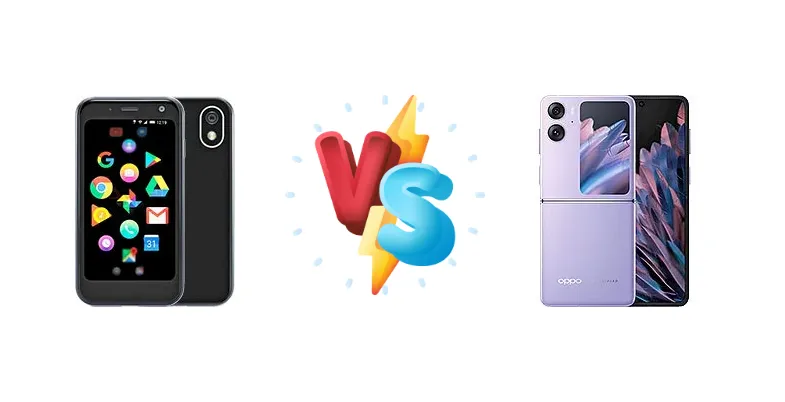
The smartphone landscape is dominated by large-screen devices, but a niche market persists for compact phones and a growing interest in foldable designs. This comparison pits the ultra-portable Palm Phone PVG100 against the innovative Oppo Find N2 Flip, exploring whether a pocketable classic can compete with a modern, foldable experience.
🏆 Quick Verdict
For most users, the Oppo Find N2 Flip is the superior device. Its significantly more powerful Mediatek Dimensity 9000+ chipset, brighter 1039 nit display, and 97-hour endurance rating outweigh the Palm’s extreme portability. However, the Palm remains a compelling option for those prioritizing minimal size above all else.
| Network |
|---|
| 2G bands | GSM 850 / 900 / 1800 / 1900 | GSM 850 / 900 / 1800 / 1900 |
| 3G bands | HSDPA 850 / 1700(AWS) / 1900 / 2100 | HSDPA 800 / 850 / 900 / 1700(AWS) / 1900 / 2100 |
| 4G bands | 2, 4, 5, 12, 13, 17, 66 | 1, 2, 3, 4, 5, 7, 8, 12, 17, 18, 19, 20, 25, 26, 28, 32, 38, 39, 40, 41, 66 - International |
| 5G bands | - | 1, 2, 3, 5, 7, 8, 12, 20, 25, 28, 38, 40, 41, 66, 77, 78, 79 SA/NSA - International |
| Speed | HSPA 42.2/5.76 Mbps, LTE Cat4 150/50 Mbps | HSPA, LTE, 5G |
| Technology | GSM / HSPA / LTE | GSM / CDMA / HSPA / LTE / 5G |
| | - | 1, 3, 5, 8, 28, 41, 77, 78, 79 SA/NSA - China |
| Launch |
|---|
| Announced | 2018, October. Released 2018, November | 2022, December 15 |
| Status | Discontinued | Available. Released 2022, December 23 |
| Body |
|---|
| Build | Glass front (Gorilla Glass 3), glass back (Gorilla Glass 3), aluminum frame | Plastic front (unfolded), plastic back (unfolded), aluminum frame |
| Dimensions | 96.6 x 50.6 x 7.4 mm (3.80 x 1.99 x 0.29 in) | Unfolded: 166.2 x 75.2 x 7.5 mm Folded: 85.5 x 75.2 x 16 mm |
| SIM | Nano-SIM | · Nano-SIM + eSIM· Nano-SIM + Nano-SIM |
| Weight | 62.5 g (2.22 oz) | 191 g (6.74 oz) |
| | IP68 dust/water resistant (up to 1m for 30 min) | - |
| Display |
|---|
| Protection | Corning Gorilla Glass 3 | - |
| Resolution | 720 x 1280 pixels, 16:9 ratio (~445 ppi density) | 1080 x 2520 pixels, 21:9 ratio (~403 ppi density) |
| Size | 3.3 inches, 30.0 cm2 (~61.4% screen-to-body ratio) | 6.8 inches, 108.0 cm2 (~86.4% screen-to-body ratio) |
| Type | IPS LCD | Foldable LTPO AMOLED, 120Hz, HDR10+, 1200 nits (HBM), 1600 nits (peak) |
| | - | Cover display:
AMOLED, Corning Gorilla Glass 5
3.26 inches, 382 x 720 pixels, 250 PPI
800 nits (HBM), 900 nits (peak) |
| Platform |
|---|
| CPU | Octa-core (4x1.4 GHz & 4x1.1 GHz) | Octa-core (1x3.20 GHz Cortex-X2 & 3x2.85 GHz Cortex-A710 & 4x1.80 GHz Cortex-A510) |
| Chipset | Qualcomm MSM8940 Snapdragon 435 (28 nm) | Mediatek Dimensity 9000+ (4 nm) |
| GPU | Adreno 505 | Mali-G710 MC10 |
| OS | Android 8.1 (Oreo) | Android 13, up to 4 major Android upgrades, ColorOS 14 |
| Memory |
|---|
| Card slot | No | No |
| Internal | 32GB 3GB RAM | 256GB 8GB RAM, 256GB 12GB RAM, 512GB 16GB RAM |
| | eMMC 5.1 | UFS 3.1 |
| Main Camera |
|---|
| Dual | - | 50 MP, f/1.8, 23mm (wide), 1/1.56", 1.0µm, multi-directional PDAF
8 MP, f/2.2, 112˚, (ultrawide) |
| Features | LED flash, HDR | Color spectrum sensor, LED flash, HDR, panorama |
| Single | 12 MP, AF | 32 MP, f/2.4, 22mm (wide), 1/2.74", 0.8µm, AF |
| Video | 720p@30fps | 4K@30fps, 1080p@30/60/240fps |
| Selfie camera |
|---|
| Features | - | HDR, panorama |
| Single | 8 MP | 32 MP, f/2.4, 22mm (wide), 1/2.74", 0.8µm, AF |
| Video | 720p@30fps | 1080p@30fps |
| Sound |
|---|
| 3.5mm jack | No | No |
| 35mm jack | No | No |
| Loudspeaker | Yes, with dual speakers | Yes, with stereo speakers |
| Comms |
|---|
| Bluetooth | 4.2, A2DP, LE | 5.3, A2DP, LE, aptX HD |
| NFC | No | Yes |
| Positioning | GPS, GLONASS | GPS (L1+L5), GLONASS (G1), BDS (B1I+B1c+B2a), GALILEO (E1+E5a), QZSS (L1+L5) |
| Radio | No | No |
| USB | USB Type-C 2.0 | USB Type-C 2.0, OTG |
| WLAN | Wi-Fi 802.11 a/b/g/n, Wi-Fi Direct | Wi-Fi 802.11 a/b/g/n/ac/6, tri-band |
| Features |
|---|
| Sensors | Infrared Face ID, accelerometer, proximity, gyro, compass | Fingerprint (side-mounted), accelerometer, dual gyro, dual proximity, compass |
| Battery |
|---|
| Charging | Wired, 50% in 31 min, 100% in 68 min | 44W wired, 50% in 23 min
Reverse wired |
| Type | Li-Ion 800 mAh, non-removable | Li-Po 4300 mAh |
| Misc |
|---|
| Colors | Gold, Titanium | Astral Black, Moonlit Purple, Gold |
| Models | PVG100, PVG100E | CPH2437, PGT110 |
| Price | About 400 EUR | About 490 EUR |
| SAR EU | 0.98 W/kg (head) | - |
| Tests |
|---|
| Battery life | - |
Endurance rating 97h
|
| Camera | - |
Photo / Video |
| Display | - |
Contrast ratio: Infinite (nominal) |
| Loudspeaker | - |
-25.0 LUFS (Very good)
|
| Performance | - |
AnTuTu: 773574 (v9)
GeekBench: 3265 (v5.1)
GFXBench: 59fps (ES 3.1 onscreen) |
Palm Phone PVG100
- Extremely compact and pocketable
- Simple and minimalist design
- Affordable price point
- Outdated processor and limited performance
- Low display brightness and resolution (assumed)
- Slow charging speeds
Oppo Find N2 Flip
- Powerful Mediatek Dimensity 9000+ chipset
- Bright and vibrant foldable display
- Fast 44W charging and long battery life
- Higher price tag
- Larger and heavier than the Palm
- Foldable display crease may be noticeable
Display Comparison
The Oppo Find N2 Flip boasts a significantly more advanced display, reaching a measured peak brightness of 1039 nits. This is crucial for outdoor visibility, a weakness of the Palm Phone PVG100, which lacks detailed display specifications. While the Oppo’s foldable nature introduces a crease, it offers a much larger usable screen real estate. The Oppo’s infinite (nominal) contrast ratio suggests a superior viewing experience compared to the likely lower contrast ratio of the Palm’s display. The foldable form factor also allows for unique use cases, like flex mode, unavailable on the Palm.
Camera Comparison
Both devices feature photo and video capabilities, but the Oppo Find N2 Flip is expected to offer a far more refined experience. While specific sensor details are missing, Oppo’s history suggests a focus on image quality and computational photography. The Palm Phone’s aging Snapdragon 435 likely lacks the image signal processor (ISP) capabilities to compete. The Oppo’s larger sensor size (likely) and advanced image processing will result in better low-light performance and dynamic range. The Palm’s camera is likely adequate for basic snapshots, but won’t deliver the same level of detail or versatility.
Performance
The performance gap between these devices is immense. The Oppo Find N2 Flip’s Mediatek Dimensity 9000+ (4nm) is a flagship-level chipset, featuring a Cortex-X2 prime core clocked at 3.20 GHz, alongside Cortex-A710 and A510 cores. This contrasts sharply with the Palm Phone PVG100’s Qualcomm MSM8940 Snapdragon 435 (28nm), an entry-level SoC with an octa-core CPU clocked at a maximum of 1.4 GHz. The 4nm fabrication process of the Dimensity 9000+ offers significantly better power efficiency and thermal performance, meaning sustained performance is far superior. The Palm will struggle with modern multitasking and demanding applications.
Battery Life
The Oppo Find N2 Flip achieves an impressive 97-hour endurance rating, indicating excellent battery life despite its foldable form factor. Its 44W wired charging allows for a 50% charge in just 23 minutes, and it also supports reverse wired charging. The Palm Phone PVG100, while having a smaller battery (spec not provided), takes considerably longer to charge – 31 minutes for 50% and 68 minutes for a full charge. The Oppo’s faster charging and superior efficiency make it the clear winner in this category.
Buying Guide
Buy the Palm Phone PVG100 if you absolutely need the smallest possible smartphone for minimalist carry, or as a secondary device for specific tasks where size is paramount. Buy the Oppo Find N2 Flip if you prioritize a larger, high-quality display, significantly faster performance for demanding apps and games, and a more versatile camera system, even if it means a larger footprint.
Frequently Asked Questions
❓ Is the Oppo Find N2 Flip’s crease noticeable during everyday use?
While the crease is present, Oppo has minimized its visibility through engineering advancements. Most users report that it becomes less noticeable after a short adjustment period and doesn't significantly detract from the viewing experience. It's best to view the device in person if crease visibility is a major concern.
❓ Can the Palm Phone PVG100 handle demanding games like PUBG Mobile?
The Palm Phone PVG100’s Snapdragon 435 chipset is not designed for demanding games. While it may be able to run PUBG Mobile at the lowest settings, expect significant frame rate drops and a generally poor gaming experience. It’s better suited for less graphically intensive tasks.
❓ Does the Oppo Find N2 Flip support wireless charging?
No, the Oppo Find N2 Flip does not support wireless charging. It relies on its 44W wired charging and reverse wired charging capabilities for power replenishment.
❓ Is the Palm Phone PVG100 a good choice as a primary phone for most users?
Generally, no. The Palm Phone PVG100’s outdated processor and limited features make it unsuitable as a primary device for most users. It’s best suited as a secondary phone for specific purposes, such as minimalist carry or as a dedicated device for calls and messaging.