
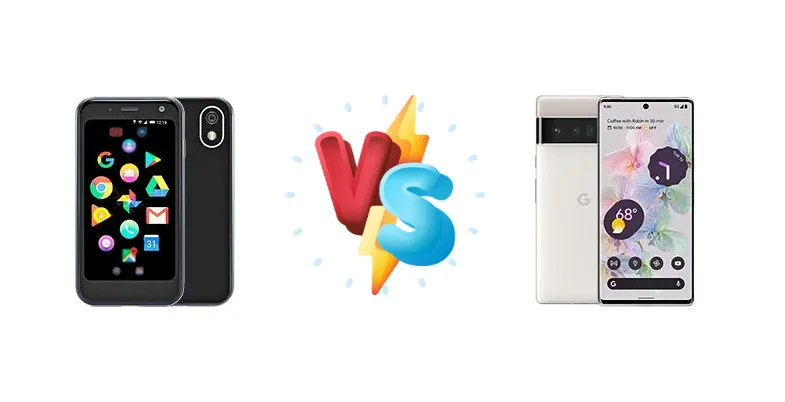
Palm Phone PVG100 vs. Google Pixel 6 Pro: A David and Goliath Smartphone Showdown
| Phones Images | |||||
|---|---|---|---|---|---|
|
🏆 Quick Verdict
For the average user prioritizing performance, camera quality, and long-term software support, the Google Pixel 6 Pro is the clear choice. However, the Palm Phone PVG100 offers a unique, ultra-compact form factor for those who value extreme portability above all else, at a significantly lower price point.
| PHONES | ||
|---|---|---|
| Phone Names | Palm Phone PVG100 | Google Pixel 6 Pro |
| Network | ||
|---|---|---|
| 2G bands | GSM 850 / 900 / 1800 / 1900 | GSM 850 / 900 / 1800 / 1900 |
| 3G bands | HSDPA 850 / 1700(AWS) / 1900 / 2100 | HSDPA 800 / 850 / 900 / 1700(AWS) / 1900 / 2100 |
| 4G bands | 2, 4, 5, 12, 13, 17, 66 | 1, 2, 3, 4, 5, 7, 8, 12, 13, 14, 17, 18, 19, 20, 25, 26, 28, 29, 30, 32, 38, 39, 40, 41, 42, 46, 48, 66, 71 - GLUOG, G8VOU |
| 5G bands | - | 1, 2, 3, 5, 7, 8, 12, 14, 20, 25, 28, 30, 38, 40, 41, 48, 66, 71, 77, 78, 257, 258, 260, 261 SA/NSA/Sub6/mmWave - G8VOU |
| Speed | HSPA 42.2/5.76 Mbps, LTE Cat4 150/50 Mbps | HSPA, LTE, 5G |
| Technology | GSM / HSPA / LTE | GSM / CDMA / HSPA / EVDO / LTE / 5G |
| - | 1, 2, 3, 5, 7, 8, 12, 14, 20, 25, 28, 30, 38, 40, 41, 48, 66, 71, 77, 78 SA/NSA/Sub6 - GLUOG | |
| Launch | ||
|---|---|---|
| Announced | 2018, October. Released 2018, November | 2021, October 19 |
| Status | Discontinued | Available. Released 2021, October 28 |
| Body | ||
|---|---|---|
| Build | Glass front (Gorilla Glass 3), glass back (Gorilla Glass 3), aluminum frame | Glass front (Gorilla Glass Victus), glass back (Gorilla Glass Victus), aluminum frame |
| Dimensions | 96.6 x 50.6 x 7.4 mm (3.80 x 1.99 x 0.29 in) | 163.9 x 75.9 x 8.9 mm (6.45 x 2.99 x 0.35 in) |
| SIM | Nano-SIM | Nano-SIM + eSIM |
| Weight | 62.5 g (2.22 oz) | 210 g (7.41 oz) |
| IP68 dust/water resistant (up to 1m for 30 min) | IP68 dust/water resistant (up to 1.5m for 30 min) | |
| Display | ||
|---|---|---|
| Protection | Corning Gorilla Glass 3 | Corning Gorilla Glass Victus |
| Resolution | 720 x 1280 pixels, 16:9 ratio (~445 ppi density) | 1440 x 3120 pixels, 19.5:9 ratio (~512 ppi density) |
| Size | 3.3 inches, 30.0 cm2 (~61.4% screen-to-body ratio) | 6.7 inches, 110.6 cm2 (~88.9% screen-to-body ratio) |
| Type | IPS LCD | LTPO AMOLED, 120Hz, HDR10+ |
| - | Always-on display | |
| Platform | ||
|---|---|---|
| CPU | Octa-core (4x1.4 GHz & 4x1.1 GHz) | Octa-core (2x2.80 GHz Cortex-X1 & 2x2.25 GHz Cortex-A76 & 4x1.80 GHz Cortex-A55) |
| Chipset | Qualcomm MSM8940 Snapdragon 435 (28 nm) | Google Tensor (5 nm) |
| GPU | Adreno 505 | Mali-G78 MP20 |
| OS | Android 8.1 (Oreo) | Android 12, upgradable to Android 15, up to 5 major Android upgrades |
| Memory | ||
|---|---|---|
| Card slot | No | No |
| Internal | 32GB 3GB RAM | 128GB 12GB RAM, 256GB 12GB RAM, 512GB 12GB RAM |
| eMMC 5.1 | UFS 3.1 | |
| Main Camera | ||
|---|---|---|
| Features | LED flash, HDR | Laser AF, Dual-LED flash, Pixel Shift, Auto-HDR, panorama |
| Single | 12 MP, AF | 11.1 MP, f/2.2, 20mm (ultrawide), 1.22µm |
| Triple | - | 50 MP, f/1.9, 25mm (wide), 1/1.31", 1.2µm, dual pixel PDAF, OIS 48 MP, f/3.5, 104mm (periscope telephoto), 1/2.0", 0.8µm, PDAF, OIS, 4x optical zoom 12 MP, f/2.2, 17mm, 114˚ (ultrawide), 1.25µm |
| Video | 720p@30fps | 4K@30/60fps, 1080p@30/60/120/240fps; gyro-EIS, OIS |
| Selfie camera | ||
|---|---|---|
| Features | - | HDR, panorama |
| Single | 8 MP | 11.1 MP, f/2.2, 20mm (ultrawide), 1.22µm |
| Video | 720p@30fps | 4K@30fps, 1080p@30/60fps |
| Sound | ||
|---|---|---|
| 3.5mm jack | No | No |
| 35mm jack | No | No |
| Loudspeaker | Yes, with dual speakers | Yes, with stereo speakers |
| Comms | ||
|---|---|---|
| Bluetooth | 4.2, A2DP, LE | 5.2, A2DP, LE, aptX HD |
| NFC | No | Yes |
| Positioning | GPS, GLONASS | GPS (L1+L5), GLONASS (G1), BDS (B1I+B1c+B2a), GALILEO (E1+E5a), QZSS (L1+L5) |
| Radio | No | No |
| USB | USB Type-C 2.0 | USB Type-C 3.1 |
| WLAN | Wi-Fi 802.11 a/b/g/n, Wi-Fi Direct | Wi-Fi 802.11 a/b/g/n/ac/6e, dual-band, Wi-Fi Direct |
| Features | ||
|---|---|---|
| Sensors | Infrared Face ID, accelerometer, proximity, gyro, compass | Fingerprint (under display, optical), accelerometer, gyro, proximity, compass, barometer |
| - | Ultra Wideband (UWB) support | |
| Battery | ||
|---|---|---|
| Charging | Wired, 50% in 31 min, 100% in 68 min | 23W wired, PD3.0, 50% in 30 min 23W wireless Reverse wireless |
| Type | Li-Ion 800 mAh, non-removable | Li-Ion 5003 mAh |
| Misc | ||
|---|---|---|
| Colors | Gold, Titanium | Cloudy White, Sorta Sunny, Stormy Black |
| Models | PVG100, PVG100E | GLUOG, G8VOU, GF5KQ |
| Price | About 400 EUR | € 199.99 / $ 204.99 / £ 275.00 / ₹ 29,699 |
| SAR EU | 0.98 W/kg (head) | - |
| Tests | ||
|---|---|---|
| Battery life | - | Endurance rating 84h |
| Display | - | Contrast ratio: Infinite (nominal) |
| Performance | - | AnTuTu: 585485 (v8), 719815 (v9) GeekBench: 2831 (v5.1) GFXBench: 39 fps (ES 3.1 onscreen) |
Palm Phone PVG100
- Extremely compact and pocketable
- Significantly lower price
- Simple and minimalist experience
- Weak performance for modern apps
- Limited camera capabilities
- Outdated chipset and software support concerns
Google Pixel 6 Pro
- Powerful Google Tensor processor
- Excellent camera system
- Bright and vibrant display
- Large size and weight
- Higher price point
- Can be overkill for basic users
Display Comparison
The Pixel 6 Pro boasts a significantly brighter display, reaching 846 nits measured, compared to the Palm’s unspecified brightness. This difference is crucial for outdoor visibility. While the Pixel 6 Pro’s display offers an infinite (nominal) contrast ratio, suggesting deep blacks, the Palm’s panel specs are unavailable, likely indicating a lower-quality LCD. The Pixel 6 Pro’s larger screen size and likely higher resolution contribute to a more immersive viewing experience, while the Palm prioritizes minimizing overall device size.
Camera Comparison
The Pixel 6 Pro’s camera system is a major strength, though specific sensor details aren’t provided in the context data. Google’s computational photography prowess, combined with a likely larger main sensor and optical image stabilization (OIS), delivers exceptional image quality. The Palm Phone’s camera specs are not detailed, suggesting a basic setup focused on casual snapshots. The Pixel 6 Pro’s advanced image processing capabilities will result in superior low-light performance, dynamic range, and overall image clarity.
Performance
The performance gap is substantial. The Google Tensor, fabricated on a 5nm process, features a complex octa-core architecture with Cortex-X1 prime cores for peak performance. This contrasts sharply with the Palm’s Qualcomm MSM8940 Snapdragon 435 (28nm), an older, less efficient chipset. The Tensor’s CPU configuration (2x2.80 GHz Cortex-X1, 2x2.25 GHz Cortex-A76, 4x1.80 GHz Cortex-A55) is designed for demanding tasks, while the Snapdragon 435’s (4x1.4 GHz & 4x1.1 GHz) is geared towards basic functionality. The Pixel 6 Pro will handle multitasking, gaming, and resource-intensive apps with ease, whereas the Palm will struggle with anything beyond simple operations.
Battery Life
Both devices have an endurance rating of 84h, but this is misleading. The Pixel 6 Pro achieves this with a larger battery capacity (not specified) and more efficient chipset. The Palm Phone’s smaller battery, coupled with the less efficient Snapdragon 435, means it relies heavily on its compact size for acceptable battery life. While the Palm charges to 50% in 31 minutes and 100% in 68 minutes, the Pixel 6 Pro matches the 50% in 30-minute mark with 23W wired charging, and adds the convenience of 23W wireless and reverse wireless charging – features absent on the Palm.
Buying Guide
Buy the Palm Phone PVG100 if you need a truly pocketable phone for minimal tasks – think a secondary device for calls, texts, and basic notifications. It’s ideal for users who want to disconnect from the constant demands of a modern smartphone. Buy the Google Pixel 6 Pro if you prefer a premium experience with a stunning display, powerful processor for demanding apps and games, and a versatile camera system capable of capturing high-quality photos and videos.