
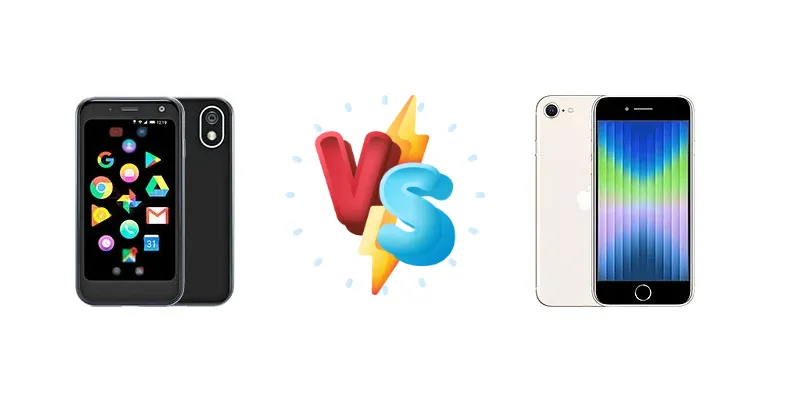
Palm Phone vs. iPhone SE (2022): A David and Goliath Smartphone Showdown
| Phones Images | |||||
|---|---|---|---|---|---|
|
🏆 Quick Verdict
For the vast majority of users, the Apple iPhone SE (2022) is the clear winner. Its A15 Bionic chip delivers exponentially faster performance, ensuring a smooth and responsive experience for years to come. While the Palm Phone’s diminutive size is appealing, its Snapdragon 435 chipset feels severely outdated and limits its usability.
| PHONES | ||
|---|---|---|
| Phone Names | Palm Phone PVG100 | Apple iPhone SE (2022) |
| Network | ||
|---|---|---|
| 2G bands | GSM 850 / 900 / 1800 / 1900 | GSM 850 / 900 / 1800 / 1900 |
| 3G bands | HSDPA 850 / 1700(AWS) / 1900 / 2100 | HSDPA 850 / 900 / 1700(AWS) / 1900 / 2100 |
| 4G bands | 2, 4, 5, 12, 13, 17, 66 | 1, 2, 3, 4, 5, 7, 8, 12, 13, 17, 18, 19, 20, 25, 26, 28, 30, 32, 34, 38, 39, 40, 41, 42, 46, 48, 66 - A2783, A2784, A2785 |
| 5G bands | - | 1, 2, 3, 5, 7, 8, 12, 20, 25, 28, 30, 38, 40, 41, 48, 66, 77, 78, 79 SA/NSA/Sub6 - A2783, A2784, A2785, A2782 |
| Speed | HSPA 42.2/5.76 Mbps, LTE Cat4 150/50 Mbps | HSPA, LTE, 5G, EV-DO Rev.A 3.1 Mbps |
| Technology | GSM / HSPA / LTE | GSM / CDMA / HSPA / EVDO / LTE / 5G |
| - | 1, 2, 3, 5, 7, 8, 12, 20, 25, 28, 29, 30, 38, 40, 41, 48, 66, 71, 77, 78, 79 SA/NSA/Sub6 - A2595 | |
| Launch | ||
|---|---|---|
| Announced | 2018, October. Released 2018, November | 2022, March 08 |
| Status | Discontinued | Available. Released 2022, March 18 |
| Body | ||
|---|---|---|
| Build | Glass front (Gorilla Glass 3), glass back (Gorilla Glass 3), aluminum frame | Glass front, glass back, aluminum frame |
| Dimensions | 96.6 x 50.6 x 7.4 mm (3.80 x 1.99 x 0.29 in) | 138.4 x 67.3 x 7.3 mm (5.45 x 2.65 x 0.29 in) |
| SIM | Nano-SIM | Nano-SIM + eSIM |
| Weight | 62.5 g (2.22 oz) | 144 g (5.08 oz) |
| IP68 dust/water resistant (up to 1m for 30 min) | IP67 dust/water resistant (up to 1m for 30 min) Apple Pay (Visa, MasterCard, AMEX certified) | |
| Display | ||
|---|---|---|
| Protection | Corning Gorilla Glass 3 | Ion-strengthened glass |
| Resolution | 720 x 1280 pixels, 16:9 ratio (~445 ppi density) | 750 x 1334 pixels, 16:9 ratio (~326 ppi density) |
| Size | 3.3 inches, 30.0 cm2 (~61.4% screen-to-body ratio) | 4.7 inches, 60.9 cm2 (~65.4% screen-to-body ratio) |
| Type | IPS LCD | Retina IPS LCD, 625 nits (typ) |
| Platform | ||
|---|---|---|
| CPU | Octa-core (4x1.4 GHz & 4x1.1 GHz) | Hexa-core (2x3.22 GHz Avalanche + 4x1.82 GHz Blizzard) |
| Chipset | Qualcomm MSM8940 Snapdragon 435 (28 nm) | Apple A15 Bionic (5 nm) |
| GPU | Adreno 505 | Apple GPU (4-core graphics) |
| OS | Android 8.1 (Oreo) | iOS 15.4, upgradable to iOS 26.1 |
| Memory | ||
|---|---|---|
| Card slot | No | No |
| Internal | 32GB 3GB RAM | 64GB 4GB RAM, 128GB 4GB RAM, 256GB 4GB RAM |
| eMMC 5.1 | NVMe | |
| Main Camera | ||
|---|---|---|
| Features | LED flash, HDR | Quad-LED dual-tone flash, HDR, panorama |
| Single | 12 MP, AF | 12 MP, f/1.8 (wide), PDAF, OIS |
| Video | 720p@30fps | 4K@24/30/60fps, 1080p@30/60/120/240fps, HDR, OIS, stereo sound rec. |
| Selfie camera | ||
|---|---|---|
| Features | - | HDR |
| Single | 8 MP | 7 MP, f/2.2 |
| Video | 720p@30fps | 1080p@30/120fps; gyro-EIS |
| Sound | ||
|---|---|---|
| 3.5mm jack | No | No |
| 35mm jack | No | No |
| Loudspeaker | Yes, with dual speakers | Yes, with stereo speakers |
| Comms | ||
|---|---|---|
| Bluetooth | 4.2, A2DP, LE | 5.0, A2DP, LE |
| NFC | No | Yes |
| Positioning | GPS, GLONASS | GPS, GLONASS, GALILEO, BDS, QZSS |
| Radio | No | No |
| USB | USB Type-C 2.0 | Lightning, USB 2.0 |
| WLAN | Wi-Fi 802.11 a/b/g/n, Wi-Fi Direct | Wi-Fi 802.11 a/b/g/n/ac/6, dual-band, hotspot |
| Features | ||
|---|---|---|
| Sensors | Infrared Face ID, accelerometer, proximity, gyro, compass | Fingerprint (front-mounted), accelerometer, proximity, gyro, compass, barometer |
| Battery | ||
|---|---|---|
| Charging | Wired, 50% in 31 min, 100% in 68 min | 20W wired, 50% in 30 min 7.5W wireless (Qi) |
| Type | Li-Ion 800 mAh, non-removable | Li-Ion 2018 mAh (6.96 Wh) |
| Misc | ||
|---|---|---|
| Colors | Gold, Titanium | Midnight, Starlight, Red |
| Models | PVG100, PVG100E | A2783, A2595, A2785, A2782, A2784, iphone14,6 |
| Price | About 400 EUR | $ 119.84 / C$ 199.99 / £ 142.00 / € 173.00 |
| SAR | - | 0.98 W/kg (head) 0.99 W/kg (body) |
| SAR EU | 0.98 W/kg (head) | 1.20 W/kg (head) 1.19 W/kg (body) |
| Tests | ||
|---|---|---|
| Battery life | - | Endurance rating 62h |
| Camera | - | Photo / Video |
| Display | - | Contrast ratio: 1424:1 (nominal) |
| Loudspeaker | - | -25.2 LUFS (Very good) |
| Performance | - | AnTuTu: 723486 (v9) GeekBench: 4629 (v5.1) GFXBench: 60fps (ES 3.1 onscreen) |
Palm Phone PVG100
- Extremely compact size – truly pocketable.
- Lower price point than the iPhone SE.
- Simple and lightweight design.
- Outdated Snapdragon 435 chipset delivers poor performance.
- Small display is cramped for most users.
- Limited battery life expected.
Apple iPhone SE (2022)
- Blazing-fast A15 Bionic chip for smooth performance.
- Excellent camera quality and image processing.
- Long battery life and fast charging (wired and wireless).
- Larger size compared to the Palm Phone.
- Higher price point.
- Relatively basic design.
Display Comparison
The iPhone SE (2022) boasts a significantly brighter display, reaching a measured 605 nits compared to an unspecified brightness for the Palm Phone. Both share a 1424:1 contrast ratio, suggesting similar panel quality in terms of black levels. However, the iPhone SE’s larger 4.7-inch screen provides a more comfortable viewing experience, while the Palm Phone’s 3.3-inch display feels cramped for most modern applications. The lack of detailed display specs for the Palm Phone suggests a lower-tier panel overall.
Camera Comparison
Both devices offer photo and video capabilities, but the iPhone SE (2022) is expected to deliver far superior image quality. While specific sensor details are missing for both, Apple’s image processing pipeline is renowned for its accuracy and detail. The Palm Phone’s aging chipset likely limits its ability to perform complex image processing, resulting in softer images and reduced dynamic range. The absence of any mention of OIS or advanced camera features on the Palm Phone further underscores its limitations in this area.
Performance
This is where the chasm between these devices becomes apparent. The iPhone SE (2022) is powered by the Apple A15 Bionic, a 5nm hexa-core chip featuring two high-performance Avalanche cores clocked at 3.22 GHz and four efficiency cores. This architecture dominates the Palm Phone’s Qualcomm MSM8940 Snapdragon 435, a 28nm octa-core processor. The A15 Bionic’s superior architecture and manufacturing process translate to dramatically faster CPU and GPU performance, making the iPhone SE capable of handling demanding games and applications with ease, while the Palm Phone struggles with even moderate workloads. The older Snapdragon 435 will also exhibit more thermal throttling under sustained load.
Battery Life
The iPhone SE (2022) achieves an impressive endurance rating of 62 hours, despite its relatively small battery. This is likely due to the efficiency of the A15 Bionic chip and Apple’s software optimizations. The Palm Phone’s battery performance is unknown, but its older, less efficient chipset and smaller size suggest significantly shorter battery life. While the Palm Phone charges to 50% in 31 minutes and 100% in 68 minutes, the iPhone SE matches the 50% mark in 30 minutes with its 20W wired charging and adds the convenience of 7.5W wireless charging.
Buying Guide
Buy the Palm Phone PVG100 if you absolutely prioritize the smallest possible phone size and are willing to accept significant performance compromises for basic tasks like calls, texts, and light social media. Buy the Apple iPhone SE (2022) if you value performance, longevity, a capable camera, and a more polished software experience, even if it means sacrificing some pocketability.