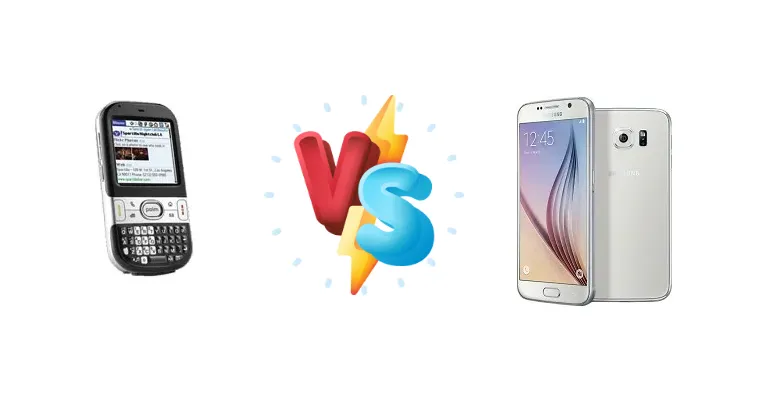
Comparing the Palm Centro and the Samsung Galaxy S6 is akin to examining a pivotal moment in mobile history. The Centro, released in 2007, represented the pinnacle of Palm's PDA-focused approach, while the Galaxy S6, from 2015, embodies the fully realized modern smartphone. This comparison isn't about declaring a 'winner' in the traditional sense, but understanding how far mobile technology has advanced in less than a decade.
🏆 Quick Verdict
For the average user in 2024, the Samsung Galaxy S6 is the clear choice. Its vastly superior processing power, modern operating system, and advanced features like wireless charging and a significantly better camera outweigh the Palm Centro’s compact size and historical significance. However, the Centro remains a fascinating artifact for collectors and enthusiasts.
| Network |
|---|
| 2G bands | GSM 850 / 900 / 1800 / 1900 | GSM 850 / 900 / 1800 / 1900 |
| 3G bands | - | HSDPA 850 / 900 / 1900 / 2100 |
| 4G bands | - | 1, 2, 3, 4, 5, 7, 8, 12, 17, 18, 19, 20, 26 |
| EDGE | Class 10 | - |
| GPRS | Class 10 | - |
| Speed | - | HSPA 42.2/5.76 Mbps, LTE Cat6 300/50 Mbps |
| Technology | GSM | GSM / HSPA / LTE |
| Launch |
|---|
| Announced | 2008, February. Released 2008, March | 2015, March 01. Released 2015, April |
| Status | Discontinued | Discontinued |
| Body |
|---|
| Build | - | Glass front (Gorilla Glass 4), glass back (Gorilla Glass 4), aluminum frame |
| Dimensions | 107.2 x 53.5 x 18.6 mm (4.22 x 2.11 x 0.73 in) | 143.4 x 70.5 x 6.8 mm (5.65 x 2.78 x 0.27 in) |
| Keyboard | QWERTY | - |
| SIM | Mini-SIM | Nano-SIM |
| Weight | 124 g (4.37 oz) | 138 g (4.87 oz) |
| Display |
|---|
| Protection | - | Corning Gorilla Glass 4 |
| Resolution | 320 x 320 pixels, 1:1 ratio (~201 ppi density) | 1440 x 2560 pixels, 16:9 ratio (~577 ppi density) |
| Size | 2.25 inches, 16.3 cm2 (~28.5% screen-to-body ratio) | 5.1 inches, 71.5 cm2 (~70.7% screen-to-body ratio) |
| Type | TFT resistive touchscreen, 65K colors | Super AMOLED |
| | 5-way navigation button | - |
| Platform |
|---|
| CPU | 32-bit Intel XScale PXA270 312 MHz | Octa-core (4x2.1 GHz Cortex-A57 & 4x1.5 GHz Cortex-A53) |
| Chipset | - | Exynos 7420 Octa (14 nm) |
| GPU | - | Mali-T760MP8 |
| OS | Palm OS 5.4.9 | Android 5.0.2 (Lollipop), upgradable to Android 8.0 (Oreo), TouchWiz UI |
| Memory |
|---|
| Card slot | microSDHC (dedicated slot) | No |
| Internal | 64MB | 32GB 3GB RAM, 64GB 3GB RAM, 128GB 3GB RAM |
| | - | UFS 2.0 |
| Main Camera |
|---|
| Features | - | LED flash, auto-HDR, panorama |
| Single | 1.3 MP | 16 MP, f/1.9, 28mm (wide), 1/2.6", 1.12µm, AF, OIS |
| Video | Yes | 4K@30fps, 1080p@30/60fps, 720p@120fps, HDR, stereo sound rec., OIS, gyro-EIS |
| Selfie camera |
|---|
| Features | - | HDR |
| Single | - | 5 MP, f/1.9, 22mm (wide), 1/4.1", 1.34µm |
| Video | - | 1440p@30fps |
| | No | - |
| Sound |
|---|
| 3.5mm jack | No | Yes |
| 35mm jack | No | Yes |
| Alert types | Vibration; Downloadable polyphonic ringtones | - |
| Loudspeaker | Yes | Yes |
| | - | 24-bit/192kHz audio
|
| Comms |
|---|
| Bluetooth | 1.2, A2DP | 4.1, A2DP, LE, aptX |
| Infrared port | Yes | Yes |
| NFC | - | Yes |
| Positioning | No | GPS, GLONASS, BDS |
| Radio | No | No |
| USB | Proprietary | microUSB 2.0, OTG |
| WLAN | No | Wi-Fi 802.11 a/b/g/n/ac, dual-band, Wi-Fi Direct |
| Features |
|---|
| Browser | WAP 2.0 / HTML (Blazer 4.5) | - |
| Sensors | - | Fingerprint (front-mounted), accelerometer, gyro, proximity, compass, barometer, heart rate, SpO2 |
| | Document editor (Word, Excel, Powerpoint, PDF)
MP3 player
Organizer
Voice memo | ANT+
S-Voice natural language commands and dictation
Samsung Pay (Visa, MasterCard certified) |
| Battery |
|---|
| Charging | - | 15W wired
Wireless (Qi) (market dependent) |
| Music play | - | Up to 49 h |
| Stand-by | Up to 300 h | - |
| Talk time | Up to 4 h | Up to 17 h (3G) |
| Type | Removable Li-Ion 1150 mAh battery | Li-Ion 2550 mAh, non-removable |
| Misc |
|---|
| Colors | Obsidian, Glacier, Midnight, Cobalt, Onyx, Electric Blue, Rose, Olive | White Pearl, Black Sapphire, Gold Platinum, Blue Topaz |
| Models | - | SM-G9200, SM-G9208, SM-G9208/SS, SM-G9209, SM-G920A, SM-G920F, SM-G920FD, SM-G920I, SM-G920S, SM-G920T, SM-G920K, SC-05G, SM-G920L, SM-G920, SM-G920R7 |
| Price | About 70 EUR | About 240 EUR |
| SAR | 0.27 W/kg (head) 0.22 W/kg (body) | 1.15 W/kg (head) 1.16 W/kg (body) |
| SAR EU | - | 0.38 W/kg (head) 0.50 W/kg (body) |
| Tests |
|---|
| Audio quality | - |
Noise -95.6dB / Crosstalk -94.5dB |
| Battery life | - | Endurance rating 73h |
| Camera | - |
Photo / Video |
| Display | - |
Contrast ratio: Infinite (nominal), 4.124 (sunlight) |
| Loudspeaker | - |
Voice 68dB / Noise 66dB / Ring 73dB |
| Performance | - |
Basemark OS II 2.0: 1641Basemark X: 22752 |
Palm Centro
- Extremely compact size – easily fits in any pocket.
- Historical significance – a key device in the evolution of mobile computing.
- Simple and focused operating system (Palm OS).
- Outdated processor and limited performance.
- Low-resolution display.
- Limited app availability.
- Poor camera quality.
Samsung Galaxy S6
- Powerful processor and ample RAM for smooth performance.
- High-quality display with excellent contrast and brightness.
- Capable camera for photos and videos.
- Modern operating system (Android) with access to a vast app ecosystem.
- Fast charging and wireless charging capabilities.
- Larger size compared to the Palm Centro.
- Battery life, while good, isn't exceptional by modern standards.
- Plastic build quality (depending on model).
Display Comparison
The Palm Centro’s display specifications are unavailable, but typical of the era, it would have been a small, low-resolution LCD. In contrast, the Samsung Galaxy S6 boasts a significantly superior display with an 'infinite' (nominal) contrast ratio and a 4.124 contrast ratio in sunlight, indicating excellent visibility even outdoors. The S6’s higher pixel density and color accuracy provide a far more immersive and detailed viewing experience. The Centro’s display was primarily functional; the S6’s is designed for media consumption and visual enjoyment.
Camera Comparison
The Palm Centro’s camera capabilities were rudimentary compared to the Samsung Galaxy S6. While both devices offer photo and video recording, the S6’s camera benefits from advancements in sensor technology, image processing, and lens quality. The S6 likely features a larger sensor and wider aperture, resulting in better low-light performance and image detail. The Centro’s camera was primarily for basic snapshots; the S6’s is capable of producing high-quality photos and videos suitable for sharing and archiving.
Performance
The Palm Centro’s 32-bit Intel XScale PXA270 312 MHz processor is dwarfed by the Samsung Galaxy S6’s Exynos 7420 Octa-core (4x2.1 GHz Cortex-A57 & 4x1.5 GHz Cortex-A53) chipset, fabricated on a 14nm process. The Exynos 7420’s octa-core architecture and advanced manufacturing process deliver exponentially faster processing speeds and significantly improved multi-tasking capabilities. The Centro struggled with even basic tasks by today’s standards, while the S6 can handle demanding applications and games. The architectural shift from a single-core 32-bit processor to an octa-core 64-bit processor represents a fundamental leap in performance.
Battery Life
The Palm Centro’s battery life is difficult to assess without specific data, but its smaller size and less power-efficient processor would have resulted in significantly shorter runtimes compared to the Samsung Galaxy S6. The S6’s endurance rating of 73 hours suggests a respectable battery life, further enhanced by its 15W wired charging and optional wireless (Qi) charging. The S6’s battery management features and more efficient processor contribute to longer usage times between charges.
Buying Guide
Buy the Palm Centro if you're a collector of vintage technology, fascinated by the evolution of mobile operating systems, or specifically need an extremely compact device for niche applications. Buy the Samsung Galaxy S6 if you require a fully functional smartphone with access to modern apps, a capable camera, reliable performance for everyday tasks, and features like wireless charging and a vibrant display.
Frequently Asked Questions
❓ Does the Exynos 7420 in the Galaxy S6 still hold up for basic tasks in 2024?
Yes, the Exynos 7420 is still capable of handling everyday tasks like browsing, social media, and messaging without significant issues. While it won't run the latest demanding games at high settings, it provides a perfectly usable experience for less intensive applications.
❓ Is the Palm Centro’s Palm OS still secure to use on a network?
No. Palm OS is extremely outdated and lacks modern security features. Connecting a Palm Centro to the internet poses significant security risks due to vulnerabilities that are no longer patched. It's best used offline for historical purposes.
❓ Can I still find apps for the Palm Centro?
Finding functional apps for the Palm Centro is extremely difficult. The Palm OS app ecosystem has largely disappeared, and compatibility with modern software is non-existent. A limited number of legacy apps may be available through enthusiast communities, but they are often unreliable.
❓ What was the primary advantage of the Palm Centro at its release?
The Palm Centro’s primary advantage was its compact size and integration of PDA features like a calendar, contacts, and task list into a phone. It was a popular choice for business professionals who needed a portable organizer and communication device.