
Oukitel WP56 vs Doogee V30 Pro: A Deep Dive into Rugged Smartphone Performance
| Phones Images | |||||
|---|---|---|---|---|---|
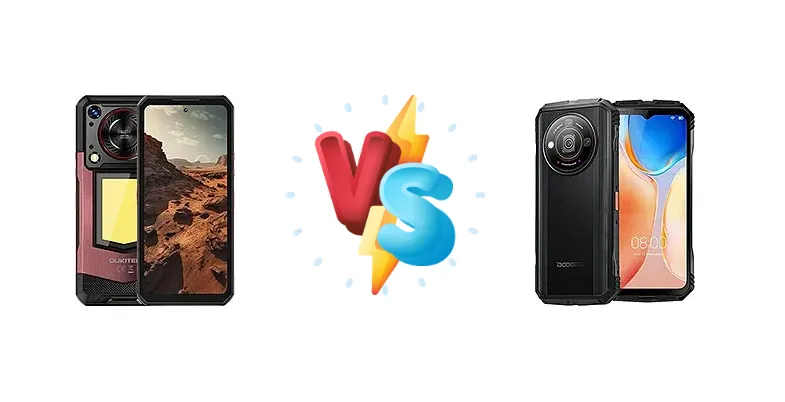
|
🏆 Quick Verdict
For users prioritizing maximum uptime and long-term battery health, the Oukitel WP56 is the clear winner. Its significantly higher battery endurance (153:33h) and 1000 charge cycles outweigh the Doogee V30 Pro’s faster, though less substantial, 33W charging. The performance is identical, making battery life the deciding factor.
| PHONES | ||
|---|---|---|
| Phone Names | Oukitel WP56 | Doogee V30 Pro |
| Network | ||
|---|---|---|
| 2G bands | GSM 850 / 900 / 1800 / 1900 | GSM 850 / 900 / 1800 / 1900 |
| 3G bands | HSDPA 850 / 900 / 1700(AWS) / 1900 / 2100 | HSDPA 800 / 850 / 900 / 1700(AWS) / 1900 / 2100 |
| 4G bands | 1, 2, 3, 4, 5, 7, 8, 12, 17, 18, 19, 20, 25, 26, 28, 34, 38, 39, 40, 41, 66 | 1, 2, 3, 4, 5, 7, 8, 12, 17, 18, 19, 20, 25, 26, 28, 34, 38, 39, 40, 41, 66 |
| 5G bands | 1, 3, 7, 8, 28, 38, 41, 77, 78 SA/NSA | 1, 3, 7, 28, 38, 41, 77, 78, 79 SA/NSA |
| Speed | HSPA, LTE, 5G | HSPA, LTE, 5G |
| Technology | GSM / HSPA / LTE / 5G | GSM / CDMA / HSPA / LTE / 5G |
| Launch | ||
|---|---|---|
| Announced | 2025, August | 2023, October 24 |
| Status | Available. Released 2025, August | Available. Released 2023, November 01 |
| Body | ||
|---|---|---|
| Dimensions | 172.2 x 81 x 15.3 mm (6.78 x 3.19 x 0.60 in) | 178.5 x 83.1 x 17.9 mm (7.03 x 3.27 x 0.70 in) |
| SIM | Nano-SIM + Nano-SIM | Nano-SIM + Nano-SIM |
| Weight | 524 g (1.16 lb) | - |
| Display | ||
|---|---|---|
| Protection | Corning Gorilla Glass 5, Mohs level 5 | Corning Gorilla Glass 5 |
| Resolution | 1080 x 2460 pixels (~395 ppi density) | 1080 x 2408 pixels, 20:9 ratio (~401 ppi density) |
| Size | 6.8 inches, 109.8 cm2 (~78.7% screen-to-body ratio) | 6.58 inches, 104.3 cm2 (~70.3% screen-to-body ratio) |
| Type | IPS LCD, 120Hz, 550 nits | IPS LCD, 120Hz |
| Platform | ||
|---|---|---|
| CPU | Octa-core (2x2.6 GHz Cortex-A78 & 6x2.0 GHz Cortex-A55) | Octa-core (2x2.6 GHz Cortex-A78 & 6x2.0 GHz Cortex-A55) |
| Chipset | Mediatek Dimensity 7050 (6 nm) | Mediatek Dimensity 7050 (6 nm) |
| GPU | Mali-G68 MC4 | Mali-G68 MC4 |
| OS | Android 15 | Android 13 |
| Memory | ||
|---|---|---|
| Card slot | microSDXC (uses shared SIM slot) | microSDXC (uses shared SIM slot) |
| Internal | 512GB 12GB RAM | 512GB 12GB RAM |
| Main Camera | ||
|---|---|---|
| Dual | 108 MP, f/1.9, (wide), 1/1.8", PDAF 2 MP (macro) | - |
| Features | LED flash, HDR, panorama | Dual-LED flash, HDR, panorama |
| Triple | - | 200 MP, f/1.7, (wide), 1/1.4", PDAF 24 MP, f/1.8, (night vision), 2 infrared night vision lights 16 MP, f/2.2, 125˚ (ultrawide) |
| Video | 4K@30fps | 4K@30fps, 1080p@30fps |
| Selfie camera | ||
|---|---|---|
| Single | 32 MP, f/2.2, (wide), 1/2.74" | 32 MP, f/1.8, (wide), 1/2.7" |
| Video | 1080p@30fps | 1080p@30fps |
| Sound | ||
|---|---|---|
| 35mm jack | No | Unspecified |
| Loudspeaker | Yes (128 dB, 3W peak) | Yes, with stereo speakers |
| Comms | ||
|---|---|---|
| Bluetooth | 5.2, A2DP, LE | 5.2, A2DP, LE |
| NFC | Yes | Yes (market/region dependent) |
| Positioning | GPS (L1+L5), GLONASS, GALILEO, BDS | GPS (L1+L5), GLONASS, GALILEO, BDS |
| Radio | FM radio | FM radio |
| USB | USB Type-C 2.0, OTG | USB Type-C 2.0, OTG |
| WLAN | Wi-Fi 802.11 a/b/g/n/ac/6, dual-band | Wi-Fi 802.11 a/b/g/n/ac/6, dual-band |
| Features | ||
|---|---|---|
| Sensors | Fingerprint (side-mounted), accelerometer, gyro, proximity, compass | Fingerprint (side-mounted), accelerometer, gyro, proximity, compass |
| Battery | ||
|---|---|---|
| Charging | 45W wired 18W reverse wired | 33W wired Reverse wired |
| Type | Li-Po 16000 mAh | 10800 mAh |
| Misc | ||
|---|---|---|
| Colors | Black, Red | Black, Orange, Silver |
| Price | - | About 440 EUR |
| EU LABEL | ||
|---|---|---|
| Battery | 153:33h endurance, 1000 cycles | - |
| Energy | Class B | - |
| Free fall | Class A (270 falls) | - |
| Repairability | Class C | - |
Oukitel WP56
- Exceptional battery endurance (153:33h)
- 1000 charge cycle battery lifespan
- 18W reverse wired charging
- Slower wired charging (45W) compared to the Doogee V30 Pro
- Likely less refined camera system
Doogee V30 Pro
- Faster wired charging (33W)
- Potentially more compact design (speculation)
- Rugged build quality
- Significantly lower battery endurance
- Standard battery cycle life
- No reverse wireless charging
Display Comparison
Both the Oukitel WP56 and Doogee V30 Pro are expected to feature similar LCD panels, typical for the rugged segment, prioritizing durability over advanced display tech like LTPO. While specific details like peak brightness and color accuracy are unavailable, the focus is likely on visibility in direct sunlight rather than cinematic color reproduction. Bezels are likely to be substantial on both devices, contributing to their ruggedized design and impact resistance.
Camera Comparison
Camera specifications are not detailed, but the market segment suggests a focus on practicality over photographic excellence. Both phones likely feature a multi-camera setup, but the emphasis will be on a functional main sensor for capturing usable images in various conditions. The presence of a 2MP macro camera on either device is likely a marketing feature with limited real-world utility. Image processing will likely prioritize clarity and dynamic range over artistic effects.
Performance
Both devices are powered by the MediaTek Dimensity 7050 (6nm), featuring an octa-core CPU configuration with 2x2.6 GHz Cortex-A78 and 6x2.0 GHz Cortex-A55 cores. This means identical CPU performance for everyday tasks and gaming. The chipset’s 6nm fabrication process offers a good balance between performance and power efficiency. RAM configuration (likely LPDDR5x) is not specified, but will heavily influence multitasking capabilities. Thermal management will be crucial; while the Dimensity 7050 isn’t a power hog, sustained loads in a rugged chassis could lead to throttling.
Battery Life
This is where the Oukitel WP56 truly shines. Its 153:33h endurance rating significantly surpasses what’s expected from a phone with a similar capacity battery, indicating excellent power optimization. The 1000 charge cycle rating is a major differentiator, promising long-term battery health. The Doogee V30 Pro offers 33W wired charging, which is faster than the WP56’s 45W, but the difference in charging speed is less impactful than the WP56’s superior endurance. The WP56 also offers 18W reverse wired charging, a useful feature for topping up accessories.
Buying Guide
Buy the Oukitel WP56 if you need a phone that can genuinely last for days on a single charge, and value the peace of mind offered by a battery rated for 1000 full charge cycles – ideal for outdoor enthusiasts, travelers, or those working in remote locations. Buy the Doogee V30 Pro if you prefer a slightly quicker top-up time and don't mind potentially replacing the battery sooner, and are less concerned with absolute endurance.