
Oukitel WP56 vs Blackview BV8800: A Deep Dive into Rugged Smartphone Performance
| Phones Images | |||||
|---|---|---|---|---|---|
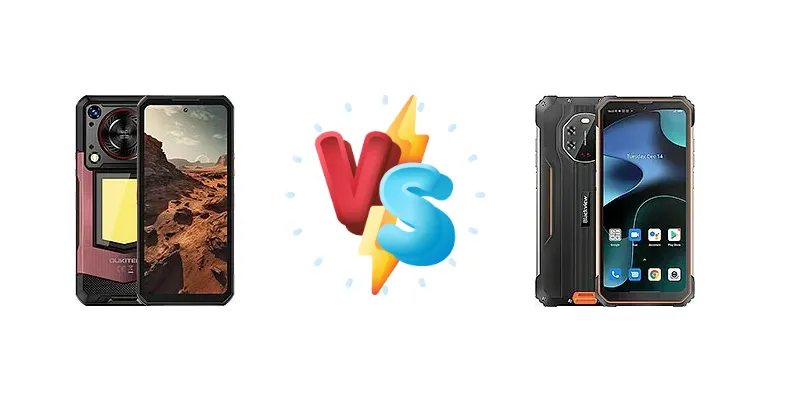
|
🏆 Quick Verdict
For the average user prioritizing long-term performance and battery endurance, the Oukitel WP56 emerges as the winner. Its Dimensity 7050 chipset, built on a 6nm process, offers a significant architectural advantage over the Blackview BV8800’s 12nm Helio G96, translating to better efficiency and sustained performance.
| PHONES | ||
|---|---|---|
| Phone Names | Oukitel WP56 | Blackview BV8800 |
| Network | ||
|---|---|---|
| 2G bands | GSM 850 / 900 / 1800 / 1900 | GSM 850 / 900 / 1800 / 1900 |
| 3G bands | HSDPA 850 / 900 / 1700(AWS) / 1900 / 2100 | HSDPA 800 / 850 / 900 / 1700(AWS) / 1900 / 2100 |
| 4G bands | 1, 2, 3, 4, 5, 7, 8, 12, 17, 18, 19, 20, 25, 26, 28, 34, 38, 39, 40, 41, 66 | 1, 2, 3, 4, 5, 7, 8, 12, 13, 17, 18, 19, 20, 25, 26, 28, 30, 34, 38, 39, 40, 41, 66 |
| 5G bands | 1, 3, 7, 8, 28, 38, 41, 77, 78 SA/NSA | - |
| Speed | HSPA, LTE, 5G | HSPA, LTE |
| Technology | GSM / HSPA / LTE / 5G | GSM / CDMA / HSPA / CDMA2000 / LTE |
| - | CDMA2000 1x | |
| Launch | ||
|---|---|---|
| Announced | 2025, August | 2021, December 24 |
| Status | Available. Released 2025, August | Available. Released 2022, January 10 |
| Body | ||
|---|---|---|
| Dimensions | 172.2 x 81 x 15.3 mm (6.78 x 3.19 x 0.60 in) | 176.2 x 83.5 x 17.7 mm (6.94 x 3.29 x 0.70 in) |
| SIM | Nano-SIM + Nano-SIM | Nano-SIM + Nano-SIM |
| Weight | 524 g (1.16 lb) | 367 g (12.95 oz) |
| - | IP68/IP69K dust/water resistant (up to 1.5m for 30 min) Drop-to-concrete resistance from up to 1.5m MIL-STD-810H compliant | |
| Display | ||
|---|---|---|
| Protection | Corning Gorilla Glass 5, Mohs level 5 | - |
| Resolution | 1080 x 2460 pixels (~395 ppi density) | 1080 x 2408 pixels, 20:9 ratio (~401 ppi density) |
| Size | 6.8 inches, 109.8 cm2 (~78.7% screen-to-body ratio) | 6.58 inches, 104.3 cm2 (~70.9% screen-to-body ratio) |
| Type | IPS LCD, 120Hz, 550 nits | IPS LCD, 90Hz, 480 nits |
| Platform | ||
|---|---|---|
| CPU | Octa-core (2x2.6 GHz Cortex-A78 & 6x2.0 GHz Cortex-A55) | Octa-core (2x2.05 GHz Cortex-A76 & 6x2.0 GHz Cortex-A55) |
| Chipset | Mediatek Dimensity 7050 (6 nm) | Mediatek MT6781 Helio G96 (12 nm) |
| GPU | Mali-G68 MC4 | Mali-G57 MC2 |
| OS | Android 15 | Android 11, Doke-OS 3.0 |
| Memory | ||
|---|---|---|
| Card slot | microSDXC (uses shared SIM slot) | No |
| Internal | 512GB 12GB RAM | 128GB 8GB RAM |
| - | UFS 2.1 | |
| Main Camera | ||
|---|---|---|
| Dual | 108 MP, f/1.9, (wide), 1/1.8", PDAF 2 MP (macro) | - |
| Features | LED flash, HDR, panorama | Dual-LED flash, HDR, panorama |
| Quad | - | 50 MP, f/1.8, (wide), PDAF 8 MP, f/2.2, 117˚ (ultrawide) 20 MP, f/1.8, (IR camera), 2 IR emitters Auxiliary lens |
| Single | - | 16 MP, f/2.0, (wide) |
| Video | 4K@30fps | 1440p@30fps |
| Selfie camera | ||
|---|---|---|
| Single | 32 MP, f/2.2, (wide), 1/2.74" | 16 MP, f/2.0, (wide) |
| Video | 1080p@30fps | 1080p@30fps |
| Sound | ||
|---|---|---|
| 3.5mm jack | - | No |
| 35mm jack | No | No |
| Loudspeaker | Yes (128 dB, 3W peak) | Yes |
| Comms | ||
|---|---|---|
| Bluetooth | 5.2, A2DP, LE | 5.2, A2DP, LE |
| NFC | Yes | Yes |
| Positioning | GPS (L1+L5), GLONASS, GALILEO, BDS | GPS, GLONASS, GALILEO, BDS |
| Radio | FM radio | FM radio |
| USB | USB Type-C 2.0, OTG | USB Type-C 2.0, OTG |
| WLAN | Wi-Fi 802.11 a/b/g/n/ac/6, dual-band | Wi-Fi 802.11 a/b/g/n/ac |
| Features | ||
|---|---|---|
| Sensors | Fingerprint (side-mounted), accelerometer, gyro, proximity, compass | Fingerprint (side-mounted), accelerometer, gyro, proximity, compass, barometer |
| Battery | ||
|---|---|---|
| Charging | 45W wired 18W reverse wired | 33W wired, 31% in 30 min, 100% in 90 min Reverse wired |
| Type | Li-Po 16000 mAh | 8380 mAh |
| Misc | ||
|---|---|---|
| Colors | Black, Red | Black, Orange, Green |
| Price | - | About 350 EUR |
| Tests | ||
|---|---|---|
| Battery life | - | Endurance rating 199h |
| Camera | - | Photo / Video |
| Display | - | Contrast ratio: 1348:1 (nominal) |
| Loudspeaker | - | -29.3 LUFS (Average) |
| Performance | - | AnTuTu: 254849 (v8), 288964 (v9) GeekBench: 1752 (v5.1) GFXBench: 10fps (ES 3.1 onscreen) |
| EU LABEL | ||
|---|---|---|
| Battery | 153:33h endurance, 1000 cycles | - |
| Energy | Class B | - |
| Free fall | Class A (270 falls) | - |
| Repairability | Class C | - |
Oukitel WP56
- Superior chipset efficiency (Dimensity 7050)
- Exceptional battery endurance (153:33h)
- 18W reverse wired charging
- Display specifications are unknown
- Camera details are lacking
Blackview BV8800
- Brighter display (501 nits)
- Faster charging (33W)
- Established brand in the rugged phone market
- Less efficient chipset (Helio G96)
- Lower battery endurance (199h)
- Older processor architecture
Display Comparison
The Blackview BV8800 boasts a measured peak brightness of 501 nits and a 1348:1 contrast ratio, making it more immediately visible in direct sunlight. However, the Oukitel WP56’s display specifications are not provided, leaving its outdoor performance unknown. The identical contrast ratios suggest similar image quality in controlled environments, but the BV8800’s measured brightness gives it a clear advantage for outdoor usability. We'd need to test the WP56 to determine if its panel technology compensates for a potentially lower peak brightness.
Camera Comparison
Both devices list 'Photo / Video' capabilities, but lack specific details regarding sensor size, aperture, or image stabilization. Without this information, a direct comparison is impossible. However, the rugged phone market often prioritizes durability over cutting-edge camera technology, so expectations should be tempered. The presence of a 2MP macro camera on many devices in this segment is often more of a marketing feature than a genuinely useful addition.
Performance
The Oukitel WP56’s Mediatek Dimensity 7050, fabricated on a 6nm process, represents a substantial leap forward in efficiency compared to the Blackview BV8800’s 12nm Helio G96. The Dimensity 7050’s octa-core configuration (2x2.6 GHz Cortex-A78 & 6x2.0 GHz Cortex-A55) offers a more modern CPU architecture than the BV8800’s (2x2.05 GHz Cortex-A76 & 6x2.0 GHz Cortex-A55). This translates to faster application loading times, smoother multitasking, and improved gaming performance, particularly in graphically intensive titles. The 6nm process also means less heat generation, reducing the likelihood of performance throttling during prolonged use.
Battery Life
The Oukitel WP56’s battery endurance rating of 153:33h is significantly higher than the Blackview BV8800’s 199h. This discrepancy is likely due to the more efficient Dimensity 7050 chipset. While the BV8800 charges faster at 33W (100% in 90 minutes, 31% in 30 minutes) compared to the WP56’s 45W, the WP56’s superior endurance means you’ll likely need to charge it less frequently. The WP56 also offers 18W reverse wired charging, a feature not explicitly mentioned for the BV8800, adding to its versatility.
Buying Guide
Buy the Oukitel WP56 if you need a phone that can truly go the distance – its exceptional 153:33h battery endurance and modern chipset are ideal for extended outdoor adventures or demanding work environments. Buy the Blackview BV8800 if you prioritize a brighter display for outdoor visibility and are comfortable with a slightly older chipset that still provides adequate performance for everyday tasks.