
Oukitel WP55 vs. Ulefone Armor 12 5G: A Deep Dive into Rugged Performance
| Phones Images | |||||
|---|---|---|---|---|---|
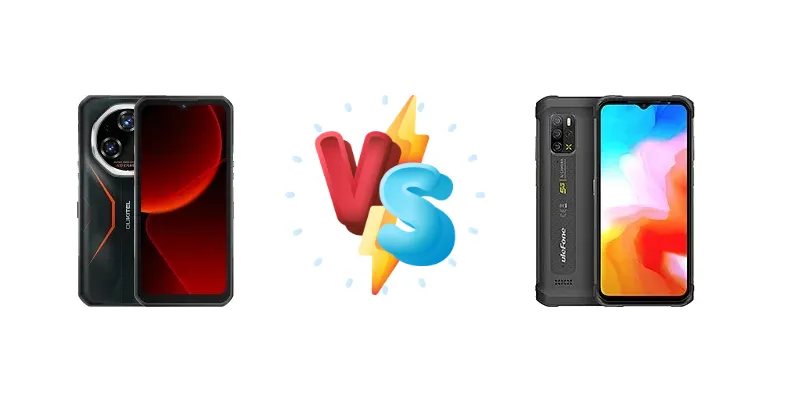
|
🏆 Quick Verdict
For most users prioritizing longevity and sustained performance, the Oukitel WP55 emerges as the winner. Its Dimensity 7025 chipset and exceptional 105:49h battery endurance provide a clear advantage over the Ulefone Armor 12 5G, despite the latter's wireless charging convenience.
| PHONES | ||
|---|---|---|
| Phone Names | Oukitel WP55 | Ulefone Armor 12 5G |
| Network | ||
|---|---|---|
| 2G bands | GSM 850 / 900 / 1800 / 1900 | GSM 850 / 900 / 1800 / 1900 |
| 3G bands | HSDPA 800 / 850 / 900 / 1700(AWS) / 1900 / 2100 | HSDPA 850 / 900 / 1700(AWS) / 1900 / 2100 |
| 4G bands | 1, 2, 3, 4, 5, 7, 8, 12, 13, 17, 18, 19, 20, 25, 26, 28, 34, 38, 39, 40, 41, 66, 71 | 1, 2, 3, 4, 5, 7, 8, 12, 13, 17, 18, 19, 20, 25, 26, 28, 34, 38, 39, 40, 41, 66 |
| 5G bands | 1, 2, 3, 5, 7, 8, 12, 20, 28, 38, 40, 41, 66, 71, 77, 78 SA/NSA | 1, 3, 28, 38, 41, 77, 78 SA/NSA |
| Speed | HSPA, LTE | HSPA, LTE, 5G |
| Technology | GSM / HSPA / LTE / 5G | GSM / CDMA / HSPA / EVDO / LTE / 5G |
| - | CDMA2000 1xEV-DO | |
| Launch | ||
|---|---|---|
| Announced | 2024, December | 2021, August 14 |
| Status | Available. Released 2025, March 15 | Available. Released 2021, August 23 |
| Body | ||
|---|---|---|
| Build | - | Front glass, aluminum back with rubber, aluminum frame |
| Dimensions | 172.2 x 81 x 15.3 mm (6.78 x 3.19 x 0.60 in) | 175.9 x 82.5 x 14.3 mm (6.93 x 3.25 x 0.56 in) |
| SIM | Nano-SIM + Nano-SIM | Nano-SIM + Nano-SIM |
| Weight | 360 g (12.70 oz) | 296 g (10.44 oz) |
| - | IP68 dust/water resistant (up to 1.5m for 30 min) Drop-to-concrete resistance from up to 1.2m MIL-STD-810G compliant | |
| Display | ||
|---|---|---|
| Protection | Corning Gorilla Glass 5, Mohs level 5 | - |
| Resolution | 1080 x 2408 pixels, 20:9 ratio (~400 ppi density) | 720 x 1560 pixels, 19.5:9 ratio (~264 ppi density) |
| Size | 6.6 inches, 104.9 cm2 (~75.2% screen-to-body ratio) | 6.52 inches, 104.4 cm2 (~71.9% screen-to-body ratio) |
| Type | IPS LCD, 120Hz, 450 nits | IPS LCD |
| Platform | ||
|---|---|---|
| CPU | Octa-core (2x2.5 GHz Cortex-A78 & 6x2.0 GHz Cortex-A55) | Octa-core (2x2.2 GHz Cortex-A76 & 6x2.0 GHz Cortex-A55) |
| Chipset | Mediatek Dimensity 7025 (6 nm) | Mediatek Dimensity 700 (7 nm) |
| GPU | IMG BXM-8-256 | Mali-G57 MC2 |
| OS | Android 15 | Android 11 |
| Memory | ||
|---|---|---|
| Card slot | microSDXC (uses shared SIM slot) | microSDXC |
| Internal | 256GB 12GB RAM | 128GB 8GB RAM |
| Main Camera | ||
|---|---|---|
| Features | LED flash, HDR, panorama | Dual-LED flash, HDR, panorama |
| Quad | - | 48 MP, f/1.8, 26mm (wide), 1/2.0", 0.8µm, PDAF 8 MP, f/2.2, (ultrawide) 2 MP (macro) Auxiliary lens |
| Single | - | 16 MP, f/2.2 |
| Triple | 108 MP, f/1.9, (wide), 1/1.8", PDAF 8 MP, f/2.2, (night vision), 1/1.78", AF 2 MP (macro) | - |
| Video | 4K@30fps | 1440p@30fps |
| Selfie camera | ||
|---|---|---|
| Features | - | HDR, panorama |
| Single | 32 MP, f/2.2, (wide), 1/2.74" | 16 MP, f/2.2 |
| Video | 1080p@30fps | 1080p@30fps |
| Sound | ||
|---|---|---|
| 3.5mm jack | - | No |
| 35mm jack | No | No |
| Loudspeaker | Yes | Yes, with dual speakers |
| Comms | ||
|---|---|---|
| Bluetooth | 5.2, A2DP, LE | 5.1, A2DP, LE |
| NFC | Yes | Yes |
| Positioning | GPS, GLONASS, GALILEO, BDS | GPS, GLONASS, GALILEO, BDS |
| Radio | FM radio | Wireless FM radio, RDS |
| USB | USB Type-C 2.0, OTG | USB Type-C 2.0, OTG |
| WLAN | Wi-Fi 802.11 a/b/g/n/ac, dual-band | Wi-Fi 802.11 a/b/g/n/ac, Wi-Fi Direct |
| Features | ||
|---|---|---|
| Sensors | Fingerprint (side-mounted), accelerometer, gyro, proximity, compass | Fingerprint (side-mounted), accelerometer, gyro, proximity, compass, coulombmeter |
| Battery | ||
|---|---|---|
| Charging | 33W wired Reverse wired | 18W wired 15W wireless |
| Type | Li-Po 11000 mAh | Li-Po 5180 mAh |
| Misc | ||
|---|---|---|
| Colors | Black, Orange | Black/Orange, Gray/Black |
| Price | - | About 370 EUR |
| EU LABEL | ||
|---|---|---|
| Battery | 105:49h endurance, 1000 cycles | - |
| Energy | Class B | - |
| Free fall | Class A (270 falls) | - |
| Repairability | Class C | - |
Oukitel WP55
- Superior processing power with the Dimensity 7025
- Exceptional battery life (105:49h endurance)
- Faster wired charging (33W)
- Lacks wireless charging
- Camera specifications are unknown, potentially average
Ulefone Armor 12 5G
- Convenience of 15W wireless charging
- 5G connectivity
- Ruggedized design for durability
- Less powerful Dimensity 700 chipset
- Significantly shorter battery life
- Slower wired charging (18W)
Display Comparison
Neither device's display specifications are provided, so a direct comparison is limited. However, given the price points, we can assume both utilize IPS LCD panels. The focus here shifts to durability – both are ruggedized, implying reinforced glass and robust construction. The absence of details like refresh rate or resolution suggests neither prioritizes a premium visual experience, focusing instead on practicality and resilience.
Camera Comparison
Without detailed camera specifications, a comprehensive comparison is difficult. However, the rugged phone market often prioritizes durability over camera quality. We can assume both devices feature a multi-camera setup, but image quality will likely be adequate rather than exceptional. The absence of information regarding sensor size or optical image stabilization (OIS) suggests neither phone will excel in low-light photography. The focus is likely on capturing functional images for documentation or basic photography, rather than artistic pursuits.
Performance
The Oukitel WP55’s Mediatek Dimensity 7025 (6nm) represents a significant architectural leap over the Ulefone Armor 12 5G’s Dimensity 700 (7nm). The 7025 utilizes Cortex-A78 cores clocked at 2.5 GHz, offering a noticeable performance boost over the Armor 12 5G’s 2.2 GHz Cortex-A76 cores. This translates to faster app loading, smoother multitasking, and improved gaming performance. The 6nm process node further enhances efficiency, contributing to better thermal management and potentially longer sustained performance under load. While both CPUs feature the same Cortex-A55 efficiency cores, the architectural improvements in the 7025 give the WP55 a clear edge.
Battery Life
The Oukitel WP55’s battery endurance of 105:49h is a standout feature, dwarfing what we’d expect from a phone with similar specifications. This is likely due to a combination of the efficient Dimensity 7025 chipset and a large battery capacity (unspecified, but implied to be substantial). The 33W wired charging is respectable, offering a reasonable recharge time. The Ulefone Armor 12 5G, with its 18W wired and 15W wireless charging, offers convenience but sacrifices speed and overall endurance. Wireless charging is a plus for some, but the WP55’s significantly longer runtime makes it the better choice for users who frequently find themselves away from power sources.
Buying Guide
Buy the Oukitel WP55 if you need a phone that can truly go the distance – extended expeditions, demanding work environments, or simply peace of mind knowing you won't be searching for an outlet. Buy the Ulefone Armor 12 5G if you prioritize the convenience of wireless charging and are willing to trade some battery life and processing power for that feature. It's a better fit for users who need 5G connectivity but don't push their phones to the limit for extended periods.