
Oukitel WP55 Ultra vs. Ulefone Power Armor 13: A Deep Dive into Rugged Smartphone Performance
| Phones Images | |||||
|---|---|---|---|---|---|
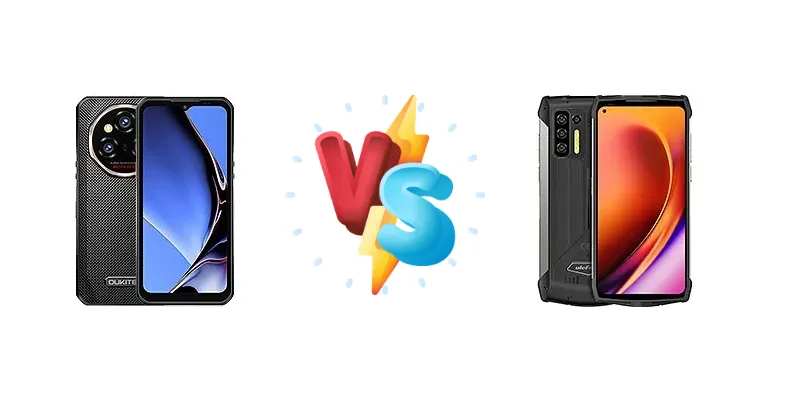
|
🏆 Quick Verdict
For the average user prioritizing longevity and performance, the Oukitel WP55 Ultra is the clear winner. Its Dimensity 7025 chipset and exceptional 105:49h endurance rating significantly outperform the Ulefone Power Armor 13’s Helio G95 and 296h rating, making it ideal for extended off-grid use.
| PHONES | ||
|---|---|---|
| Phone Names | Oukitel WP55 Ultra | Ulefone Power Armor 13 |
| Network | ||
|---|---|---|
| 2G bands | GSM 850 / 900 / 1800 / 1900 | GSM 850 / 900 / 1800 / 1900 |
| 3G bands | HSDPA 800 / 850 / 900 / 1700(AWS) / 1900 / 2100 | HSDPA 850 / 900 / 1700(AWS) / 1900 / 2100 |
| 4G bands | 1, 2, 3, 4, 5, 7, 8, 12, 13, 17, 18, 19, 20, 25, 26, 28, 34, 38, 39, 40, 41, 66, 71 | 1, 2, 3, 4, 5, 7, 8, 12, 13, 17, 18, 19, 20, 25, 26, 28, 38, 40, 66 |
| 5G bands | 1, 2, 3, 5, 7, 8, 12, 20, 25, 28, 34, 38, 39, 40, 41, 48, 66, 71, 77, 78 SA/NSA | - |
| Speed | HSPA, LTE, 5G | HSPA 42.2/11.5 Mbps, LTE Cat12 600/150 Mbps |
| Technology | GSM / HSPA / LTE / 5G | GSM / HSPA / LTE |
| Launch | ||
|---|---|---|
| Announced | 2025, May | 2021, July 22 |
| Status | Available. Released 2025, May | Available. Released 2021, July 26 |
| Body | ||
|---|---|---|
| Dimensions | 172.2 x 81 x 15.3 mm (6.78 x 3.19 x 0.60 in) | 183.7 x 85.4 x 20.8 mm (7.23 x 3.36 x 0.82 in) |
| SIM | Nano-SIM + Nano-SIM | Nano-SIM + Nano-SIM |
| Weight | 367.6 g (12.98 oz) | 492 g (1.08 lb) |
| - | IP68 dust/water resistant (up to 1.5m for 30 min) Drop-to-concrete resistance from up to 1.2m MIL-STD-810G compliant | |
| Display | ||
|---|---|---|
| Protection | Corning Gorilla Glass 5, Mohs level 5 | Corning Gorilla Glass 3 |
| Resolution | 1080 x 2408 pixels, 20:9 ratio (~400 ppi density) | 1080 x 2400 pixels, 20:9 ratio (~386 ppi density) |
| Size | 6.6 inches, 104.9 cm2 (~75.2% screen-to-body ratio) | 6.81 inches, 112.0 cm2 (~71.4% screen-to-body ratio) |
| Type | IPS LCD, 120Hz, 450 nits | IPS LCD |
| Platform | ||
|---|---|---|
| CPU | Octa-core (2x2.5 GHz Cortex-A78 & 6x2.0 GHz Cortex-A55) | Octa-core (2x2.05 GHz Cortex-A76 & 6x2.0 GHz Cortex-A55) |
| Chipset | Mediatek Dimensity 7025 (6 nm) | Mediatek MT6785V/CD Helio G95 (12 nm) |
| GPU | IMG BXM-8-256 | Mali-G76 MC4 |
| OS | Android 15 | Android 11 |
| Memory | ||
|---|---|---|
| Card slot | microSDXC (uses shared SIM slot) | microSDXC (uses shared SIM slot) |
| Internal | 512GB 16GB RAM | 256GB 8GB RAM |
| Main Camera | ||
|---|---|---|
| Features | LED flash, HDR, panorama | Quad-LED flash, HDR, panorama |
| Penta | - | 48 MP, f/1.8, 26mm (wide), 1/2.0", 0.8µm, PDAF 8 MP, f/2.2, (ultrawide) 2 MP (macro) Auxiliary lens |
| Triple | 108 MP, f/2.2, (wide), 1/1.8", PDAF 8 MP, f/2.2, (night vision), 1/1.78", AF 5 MP, f/2.2, (thermal), 1/1.5" | - |
| Video | 1440p@30fps | 4K@30fps, 1080p@30fps |
| Selfie camera | ||
|---|---|---|
| Features | - | HDR, panorama |
| Single | 32 MP, f/2.2, (wide), 1/2.74" | 16 MP, f/2.2 |
| Video | 1440p@30fps | 1080p@30fps |
| Sound | ||
|---|---|---|
| 3.5mm jack | - | Yes |
| 35mm jack | No | Yes |
| Loudspeaker | Yes | Yes |
| Comms | ||
|---|---|---|
| Bluetooth | 5.2, A2DP, LE | 5.0, A2DP, LE |
| NFC | Yes | Yes |
| Positioning | GPS (L1+L5), GLONASS, GALILEO, BDS | GPS, GLONASS, GALILEO, BDS |
| Radio | FM radio | FM radio, RDS, recording |
| USB | USB Type-C 2.0 | - |
| WLAN | Wi-Fi 802.11 a/b/g/n/ac, dual-band | Wi-Fi 802.11 a/b/g/n/ac, dual-band |
| Features | ||
|---|---|---|
| Sensors | Fingerprint (side-mounted), accelerometer, gyro, proximity, compass | Fingerprint (side-mounted), accelerometer, gyro, proximity, compass, baroceptor, coulombmeter |
| - | Infrared distance measure (error range: 1~20m, ±10mm; 20~40m, ±25mm) | |
| Battery | ||
|---|---|---|
| Charging | 33W wired | 33W wired 15W wireless 5W reverse wireless |
| Type | Li-Po 11000 mAh | Li-Po 13200 mAh |
| Misc | ||
|---|---|---|
| Colors | Black, Red, Gray | Black |
| Price | - | About 300 EUR |
| Tests | ||
|---|---|---|
| Battery life | - | Endurance rating 296h |
| Camera | - | Photo / Video |
| Display | - | Contrast ratio: 1306:1 (nominal) |
| Loudspeaker | - | -28.3 LUFS (Average) |
| Performance | - | AnTuTu: 294194 (v8), 351678 (v9) GeekBench: 1610 (v5.1) GFXBench: 18fps (ES 3.1 onscreen) |
| EU LABEL | ||
|---|---|---|
| Battery | 105:49h endurance, 1000 cycles | - |
| Energy | Class B | - |
| Free fall | Class A (270 falls) | - |
| Repairability | Class C | - |
Oukitel WP55 Ultra
- Exceptional battery life (105:49h endurance)
- Powerful Dimensity 7025 chipset for smooth performance
- Long battery lifespan with 1000 charge cycles
- Display specifications are currently unknown
- Lacks wireless charging
Ulefone Power Armor 13
- Wireless charging (15W) and reverse wireless charging (5W)
- Rugged design with proven durability
- Established brand reputation in the rugged phone market
- Significantly shorter battery life (296h endurance)
- Older Helio G95 chipset offers limited performance
- 2MP macro camera offers minimal value
Display Comparison
The Ulefone Power Armor 13 provides a contrast ratio of 1306:1 and a measured peak brightness of 401 nits. While respectable, this is where the WP55 Ultra’s specifications are missing, leaving us to infer based on market trends. Given the WP55 Ultra’s focus on overall performance, it likely features a comparable or slightly improved display. However, without specific data, it’s difficult to definitively say. Both devices share the same contrast ratio, suggesting similar panel technology, but the WP55 Ultra’s newer design may benefit from improved color accuracy and viewing angles.
Camera Comparison
Both phones list 'Photo / Video' capabilities, but lack specific details. This suggests a similar approach to camera hardware – likely a primary sensor paired with auxiliary lenses. However, without sensor size or aperture information, a direct comparison is impossible. The Ulefone Power Armor 13’s inclusion of a 2MP macro camera is likely a marketing feature with limited real-world utility. The WP55 Ultra’s newer chipset may offer improved image signal processing (ISP) capabilities, potentially leading to better image quality, especially in low-light conditions.
Performance
The Oukitel WP55 Ultra’s Mediatek Dimensity 7025 (6nm) represents a significant leap over the Ulefone Power Armor 13’s Helio G95 (12nm). The Dimensity 7025’s Cortex-A78 cores, clocked at 2.5 GHz, offer substantially higher single-core performance compared to the Power Armor 13’s 2.05 GHz Cortex-A76 cores. The 6nm process node also translates to improved power efficiency and reduced thermal throttling. This means the WP55 Ultra will handle multitasking, gaming, and demanding applications with greater ease and sustained performance. The Power Armor 13, while capable for everyday tasks, will likely struggle with more intensive workloads.
Battery Life
The Oukitel WP55 Ultra’s battery endurance of 105:49h is a game-changer, dwarfing the Ulefone Power Armor 13’s 296h rating (converted to hours for consistency). This massive difference is attributable to the more efficient Dimensity 7025 chipset and potentially a larger battery capacity (though not specified). While both support 33W wired charging, the Power Armor 13 adds 15W wireless and 5W reverse wireless charging, offering added convenience. However, this convenience is offset by the significantly shorter overall battery life. The WP55 Ultra’s 1000 charge cycles also suggest a longer lifespan for the battery itself.
Buying Guide
Buy the Oukitel WP55 Ultra if you need maximum battery life and a more modern processor for demanding tasks like navigation or data-intensive work. Its superior endurance and processing power make it ideal for professionals and adventurers. Buy the Ulefone Power Armor 13 if you prioritize wireless charging convenience and are comfortable with a slightly older chipset and significantly shorter battery life. It’s a solid choice for users who need a rugged phone for basic communication and occasional use.