
Oukitel WP55 Ultra vs Doogee S98 Pro: A Deep Dive into Rugged Phone Performance
| Phones Images | |||||
|---|---|---|---|---|---|
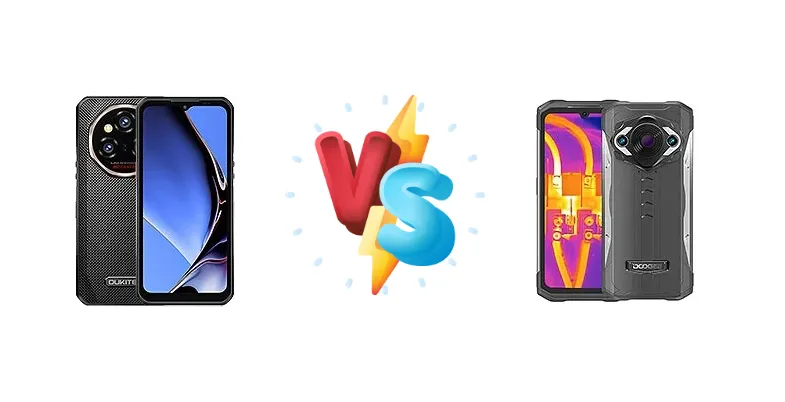
|
🏆 Quick Verdict
For the average user prioritizing sustained performance and exceptional battery endurance, the Oukitel WP55 Ultra emerges as the winner. Its Dimensity 7025 chipset offers a significant architectural advantage over the Doogee S98 Pro’s Helio G96, translating to smoother multitasking and gaming. While the S98 Pro’s wireless charging is a convenience, it doesn’t offset the performance gap.
| PHONES | ||
|---|---|---|
| Phone Names | Oukitel WP55 Ultra | Doogee S98 Pro |
| Network | ||
|---|---|---|
| 2G bands | GSM 850 / 900 / 1800 / 1900 | GSM 850 / 900 / 1800 / 1900 |
| 3G bands | HSDPA 800 / 850 / 900 / 1700(AWS) / 1900 / 2100 | HSDPA 800 / 850 / 900 / 1700(AWS) / 1900 / 2100 |
| 4G bands | 1, 2, 3, 4, 5, 7, 8, 12, 13, 17, 18, 19, 20, 25, 26, 28, 34, 38, 39, 40, 41, 66, 71 | 1, 2, 3, 4, 5, 7, 8, 12, 13, 17, 18, 19, 20, 25, 26, 28, 34, 38, 39, 40, 41, 66 |
| 5G bands | 1, 2, 3, 5, 7, 8, 12, 20, 25, 28, 34, 38, 39, 40, 41, 48, 66, 71, 77, 78 SA/NSA | - |
| Speed | HSPA, LTE, 5G | HSPA, LTE |
| Technology | GSM / HSPA / LTE / 5G | GSM / CDMA / HSPA / LTE |
| Launch | ||
|---|---|---|
| Announced | 2025, May | 2022, May 27 |
| Status | Available. Released 2025, May | Available. Released 2022, June 06 |
| Body | ||
|---|---|---|
| Dimensions | 172.2 x 81 x 15.3 mm (6.78 x 3.19 x 0.60 in) | 172 x 82 x 15.5 mm (6.77 x 3.23 x 0.61 in) |
| SIM | Nano-SIM + Nano-SIM | Nano-SIM + Nano-SIM |
| Weight | 367.6 g (12.98 oz) | 320 g (11.29 oz) |
| Display | ||
|---|---|---|
| Protection | Corning Gorilla Glass 5, Mohs level 5 | Corning Gorilla Glass |
| Resolution | 1080 x 2408 pixels, 20:9 ratio (~400 ppi density) | 1080 x 2340 pixels, 19.5:9 ratio (~409 ppi density) |
| Size | 6.6 inches, 104.9 cm2 (~75.2% screen-to-body ratio) | 6.3 inches, 97.4 cm2 (~69.1% screen-to-body ratio) |
| Type | IPS LCD, 120Hz, 450 nits | IPS LCD, 500 nits (peak) |
| Platform | ||
|---|---|---|
| CPU | Octa-core (2x2.5 GHz Cortex-A78 & 6x2.0 GHz Cortex-A55) | Octa-core (2x2.05 GHz Cortex-A76 & 6x2.0 GHz Cortex-A55) |
| Chipset | Mediatek Dimensity 7025 (6 nm) | Mediatek MT6781 Helio G96 (12 nm) |
| GPU | IMG BXM-8-256 | Mali-G57 MC2 |
| OS | Android 15 | Android 12 |
| Memory | ||
|---|---|---|
| Card slot | microSDXC (uses shared SIM slot) | microSDXC (dedicated slot) |
| Internal | 512GB 16GB RAM | 256GB 8GB RAM |
| Main Camera | ||
|---|---|---|
| Features | LED flash, HDR, panorama | Dual-LED flash, HDR, panorama |
| Triple | 108 MP, f/2.2, (wide), 1/1.8", PDAF 8 MP, f/2.2, (night vision), 1/1.78", AF 5 MP, f/2.2, (thermal), 1/1.5" | 48 MP, f/1.8, (wide), PDAF 20 MP, f/1.8, (night vision), 2 infrared night vision lights Thermal imaging camera |
| Video | 1440p@30fps | 1440p, 1080p |
| Selfie camera | ||
|---|---|---|
| Single | 32 MP, f/2.2, (wide), 1/2.74" | 16 MP, f/2.0, (wide) |
| Video | 1440p@30fps | 1080p |
| Sound | ||
|---|---|---|
| 35mm jack | No | Unspecified |
| Loudspeaker | Yes | Yes |
| Comms | ||
|---|---|---|
| Bluetooth | 5.2, A2DP, LE | 5.1, A2DP, LE |
| NFC | Yes | Yes |
| Positioning | GPS (L1+L5), GLONASS, GALILEO, BDS | GPS, GLONASS, BDS, GALILEO |
| Radio | FM radio | FM radio |
| USB | USB Type-C 2.0 | USB Type-C 2.0, OTG |
| WLAN | Wi-Fi 802.11 a/b/g/n/ac, dual-band | Wi-Fi 802.11 a/b/g/n/ac, dual-band |
| Features | ||
|---|---|---|
| Sensors | Fingerprint (side-mounted), accelerometer, gyro, proximity, compass | Fingerprint (side-mounted), accelerometer, gyro, proximity, compass |
| Battery | ||
|---|---|---|
| Charging | 33W wired | 33W wired 15W wireless |
| Type | Li-Po 11000 mAh | 6000 mAh |
| Misc | ||
|---|---|---|
| Colors | Black, Red, Gray | Black |
| Price | - | About 470 EUR |
| EU LABEL | ||
|---|---|---|
| Battery | 105:49h endurance, 1000 cycles | - |
| Energy | Class B | - |
| Free fall | Class A (270 falls) | - |
| Repairability | Class C | - |
Oukitel WP55 Ultra
- Superior processor performance with the Dimensity 7025
- Exceptional battery endurance (105:49h)
- Long-term battery health with 1000 charge cycles
- Lack of wireless charging
- Limited camera information available
Doogee S98 Pro
- Convenience of 15W wireless charging
- Established brand in the rugged phone market
- 33W fast wired charging
- Older and less efficient Helio G96 chipset
- Likely lower battery endurance compared to WP55 Ultra
Display Comparison
Neither device’s display specifications are provided, so a direct comparison is limited. However, given the price points, we can assume both utilize IPS LCD panels. The focus here shifts to durability, with both likely featuring Gorilla Glass or similar protection. The absence of high refresh rate or LTPO technology suggests neither phone is geared towards visually intensive experiences, prioritizing battery conservation instead.
Camera Comparison
Without detailed camera specs beyond the presence of sensors, a thorough comparison is impossible. However, the market segment suggests both phones will prioritize versatility over outright image quality. We can expect a main sensor, ultrawide, and potentially a macro lens on both. The absence of information regarding sensor size or optical image stabilization (OIS) suggests neither phone will excel in low-light photography. The 2MP macro lenses commonly found on these devices are largely marketing features and offer limited practical benefit.
Performance
The core difference lies in the chipsets. The Oukitel WP55 Ultra’s Mediatek Dimensity 7025 (6nm) boasts a more modern architecture with its Cortex-A78 cores clocked at 2.5 GHz, compared to the Doogee S98 Pro’s Helio G96 (12nm) and its Cortex-A76 cores at 2.05 GHz. The 6nm process node of the Dimensity 7025 is significantly more efficient, leading to lower heat generation and sustained performance. This translates to a noticeable advantage in multitasking, app loading times, and gaming. The Helio G96, while capable, is an older design and will likely exhibit more throttling under prolonged load. The WP55 Ultra is the clear winner for users who demand consistent performance.
Battery Life
The Oukitel WP55 Ultra claims an impressive 105:49h endurance, suggesting a substantial battery capacity optimized for longevity. While the Doogee S98 Pro doesn’t provide endurance figures, its 33W wired and 15W wireless charging offer flexibility. However, the Dimensity 7025’s superior power efficiency in the WP55 Ultra likely offsets the S98 Pro’s wireless charging convenience. The WP55 Ultra’s advertised 1000 charge cycles also indicate a focus on long-term battery health, a crucial factor for rugged phone users.
Buying Guide
Buy the Oukitel WP55 Ultra if you need a phone that can reliably power through multi-day use with demanding applications, or if you frequently engage in resource-intensive tasks like video editing or gaming on the go. Buy the Doogee S98 Pro if you prioritize the convenience of wireless charging and prefer a brand with a longer track record in the rugged phone market, even if it means sacrificing some raw processing power and battery longevity.