
Oukitel WP55 Ultra vs Blackview BV8800: A Rugged Showdown of Endurance and Performance
| Phones Images | |||||
|---|---|---|---|---|---|
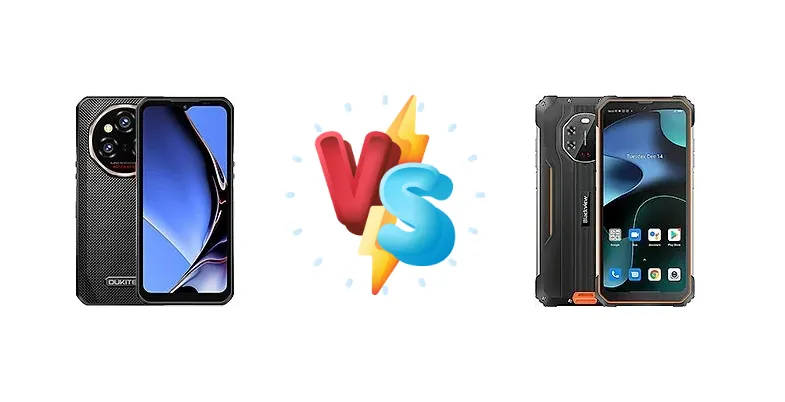
|
🏆 Quick Verdict
For the average user prioritizing long-term battery life and sustained performance, the Oukitel WP55 Ultra is the clear winner. Its Dimensity 7025 chipset and staggering 105:49h endurance rating significantly outperform the Blackview BV8800’s Helio G96 and 199h rating, making it ideal for extended outdoor use.
| PHONES | ||
|---|---|---|
| Phone Names | Oukitel WP55 Ultra | Blackview BV8800 |
| Network | ||
|---|---|---|
| 2G bands | GSM 850 / 900 / 1800 / 1900 | GSM 850 / 900 / 1800 / 1900 |
| 3G bands | HSDPA 800 / 850 / 900 / 1700(AWS) / 1900 / 2100 | HSDPA 800 / 850 / 900 / 1700(AWS) / 1900 / 2100 |
| 4G bands | 1, 2, 3, 4, 5, 7, 8, 12, 13, 17, 18, 19, 20, 25, 26, 28, 34, 38, 39, 40, 41, 66, 71 | 1, 2, 3, 4, 5, 7, 8, 12, 13, 17, 18, 19, 20, 25, 26, 28, 30, 34, 38, 39, 40, 41, 66 |
| 5G bands | 1, 2, 3, 5, 7, 8, 12, 20, 25, 28, 34, 38, 39, 40, 41, 48, 66, 71, 77, 78 SA/NSA | - |
| Speed | HSPA, LTE, 5G | HSPA, LTE |
| Technology | GSM / HSPA / LTE / 5G | GSM / CDMA / HSPA / CDMA2000 / LTE |
| - | CDMA2000 1x | |
| Launch | ||
|---|---|---|
| Announced | 2025, May | 2021, December 24 |
| Status | Available. Released 2025, May | Available. Released 2022, January 10 |
| Body | ||
|---|---|---|
| Dimensions | 172.2 x 81 x 15.3 mm (6.78 x 3.19 x 0.60 in) | 176.2 x 83.5 x 17.7 mm (6.94 x 3.29 x 0.70 in) |
| SIM | Nano-SIM + Nano-SIM | Nano-SIM + Nano-SIM |
| Weight | 367.6 g (12.98 oz) | 367 g (12.95 oz) |
| - | IP68/IP69K dust/water resistant (up to 1.5m for 30 min) Drop-to-concrete resistance from up to 1.5m MIL-STD-810H compliant | |
| Display | ||
|---|---|---|
| Protection | Corning Gorilla Glass 5, Mohs level 5 | - |
| Resolution | 1080 x 2408 pixels, 20:9 ratio (~400 ppi density) | 1080 x 2408 pixels, 20:9 ratio (~401 ppi density) |
| Size | 6.6 inches, 104.9 cm2 (~75.2% screen-to-body ratio) | 6.58 inches, 104.3 cm2 (~70.9% screen-to-body ratio) |
| Type | IPS LCD, 120Hz, 450 nits | IPS LCD, 90Hz, 480 nits |
| Platform | ||
|---|---|---|
| CPU | Octa-core (2x2.5 GHz Cortex-A78 & 6x2.0 GHz Cortex-A55) | Octa-core (2x2.05 GHz Cortex-A76 & 6x2.0 GHz Cortex-A55) |
| Chipset | Mediatek Dimensity 7025 (6 nm) | Mediatek MT6781 Helio G96 (12 nm) |
| GPU | IMG BXM-8-256 | Mali-G57 MC2 |
| OS | Android 15 | Android 11, Doke-OS 3.0 |
| Memory | ||
|---|---|---|
| Card slot | microSDXC (uses shared SIM slot) | No |
| Internal | 512GB 16GB RAM | 128GB 8GB RAM |
| - | UFS 2.1 | |
| Main Camera | ||
|---|---|---|
| Features | LED flash, HDR, panorama | Dual-LED flash, HDR, panorama |
| Quad | - | 50 MP, f/1.8, (wide), PDAF 8 MP, f/2.2, 117˚ (ultrawide) 20 MP, f/1.8, (IR camera), 2 IR emitters Auxiliary lens |
| Single | - | 16 MP, f/2.0, (wide) |
| Triple | 108 MP, f/2.2, (wide), 1/1.8", PDAF 8 MP, f/2.2, (night vision), 1/1.78", AF 5 MP, f/2.2, (thermal), 1/1.5" | - |
| Video | 1440p@30fps | 1440p@30fps |
| Selfie camera | ||
|---|---|---|
| Single | 32 MP, f/2.2, (wide), 1/2.74" | 16 MP, f/2.0, (wide) |
| Video | 1440p@30fps | 1080p@30fps |
| Sound | ||
|---|---|---|
| 3.5mm jack | - | No |
| 35mm jack | No | No |
| Loudspeaker | Yes | Yes |
| Comms | ||
|---|---|---|
| Bluetooth | 5.2, A2DP, LE | 5.2, A2DP, LE |
| NFC | Yes | Yes |
| Positioning | GPS (L1+L5), GLONASS, GALILEO, BDS | GPS, GLONASS, GALILEO, BDS |
| Radio | FM radio | FM radio |
| USB | USB Type-C 2.0 | USB Type-C 2.0, OTG |
| WLAN | Wi-Fi 802.11 a/b/g/n/ac, dual-band | Wi-Fi 802.11 a/b/g/n/ac |
| Features | ||
|---|---|---|
| Sensors | Fingerprint (side-mounted), accelerometer, gyro, proximity, compass | Fingerprint (side-mounted), accelerometer, gyro, proximity, compass, barometer |
| Battery | ||
|---|---|---|
| Charging | 33W wired | 33W wired, 31% in 30 min, 100% in 90 min Reverse wired |
| Type | Li-Po 11000 mAh | 8380 mAh |
| Misc | ||
|---|---|---|
| Colors | Black, Red, Gray | Black, Orange, Green |
| Price | - | About 350 EUR |
| Tests | ||
|---|---|---|
| Battery life | - | Endurance rating 199h |
| Camera | - | Photo / Video |
| Display | - | Contrast ratio: 1348:1 (nominal) |
| Loudspeaker | - | -29.3 LUFS (Average) |
| Performance | - | AnTuTu: 254849 (v8), 288964 (v9) GeekBench: 1752 (v5.1) GFXBench: 10fps (ES 3.1 onscreen) |
| EU LABEL | ||
|---|---|---|
| Battery | 105:49h endurance, 1000 cycles | - |
| Energy | Class B | - |
| Free fall | Class A (270 falls) | - |
| Repairability | Class C | - |
Oukitel WP55 Ultra
- Exceptional battery endurance (105:49h)
- More powerful and efficient Dimensity 7025 chipset
- Modern 6nm process node for better thermal management
- Lack of reverse charging capability
- Display specifications currently unavailable
Blackview BV8800
- Reverse wired charging for powering other devices
- Measured display brightness of 501 nits
- Established reputation for ruggedness
- Significantly lower battery endurance (199h)
- Older and less efficient Helio G96 chipset
- 12nm process node prone to throttling
Display Comparison
The Blackview BV8800 provides a measured peak brightness of 501 nits and a 1348:1 contrast ratio. While respectable, the WP55 Ultra’s display specifications are currently unavailable, making a direct comparison difficult. However, given the WP55 Ultra’s focus on overall performance, it’s reasonable to expect a similarly competitive display. Both share the same contrast ratio, suggesting comparable image quality in terms of black levels and color depth. Without further data on the WP55 Ultra’s panel technology (LTPO, AMOLED, etc.), the BV8800 holds a slight edge due to the available brightness data.
Camera Comparison
Both devices list 'Photo / Video' capabilities, but lack specific details regarding sensor size, aperture, or optical image stabilization (OIS). This makes a meaningful comparison impossible based on the provided data. However, the rugged phone market often prioritizes durability over camera innovation, so it’s unlikely either device will compete with flagship smartphone cameras. Without further information, we can only assume similar image quality based on the price point and target audience.
Performance
The Oukitel WP55 Ultra’s Mediatek Dimensity 7025 (6nm) represents a significant leap forward in processing power compared to the Blackview BV8800’s Helio G96 (12nm). The Dimensity 7025 features a more efficient architecture with two Cortex-A78 cores clocked at 2.5 GHz, versus the BV8800’s Cortex-A76 cores at 2.05 GHz. This translates to faster application loading, smoother multitasking, and improved gaming performance. The 6nm process node of the Dimensity 7025 also contributes to better thermal efficiency, reducing the likelihood of throttling during sustained workloads. The WP55 Ultra is the clear winner for users demanding performance.
Battery Life
The Oukitel WP55 Ultra’s battery endurance of 105:49h is a game-changer, dwarfing the Blackview BV8800’s 199h rating. This massive difference suggests a significantly larger battery capacity and/or more efficient power management in the WP55 Ultra. Both phones support 33W wired charging, with the BV8800 achieving 31% charge in 30 minutes and 100% in 90 minutes. The WP55 Ultra’s charging time is not specified, but the superior endurance rating mitigates the need for rapid charging. The BV8800’s inclusion of reverse wired charging is a unique feature, allowing it to act as a power bank for other devices, a benefit the WP55 Ultra lacks.
Buying Guide
Buy the Oukitel WP55 Ultra if you need a phone that can genuinely last for days on a single charge, and you value a more modern chipset for smoother multitasking and gaming. Buy the Blackview BV8800 if you prioritize reverse wired charging for powering other devices in the field, and are comfortable with a shorter battery life and older processor.