
Oukitel WP53 vs. Nokia XR20: A Deep Dive into Rugged Smartphone Choices
| Phones Images | |||||
|---|---|---|---|---|---|
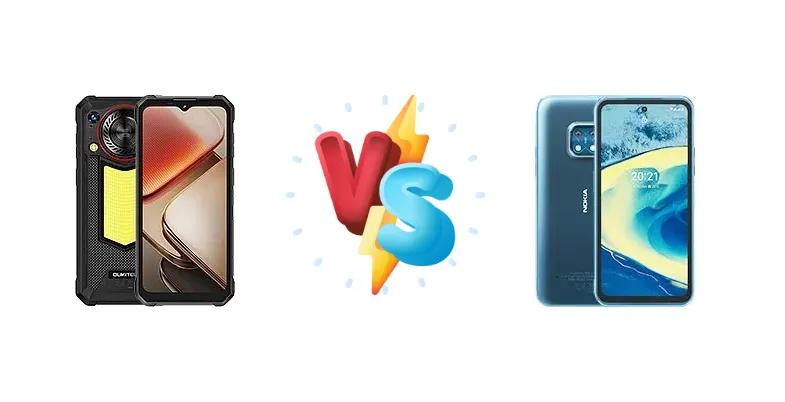
|
🏆 Quick Verdict
For users prioritizing maximum uptime and value, the Oukitel WP53 is the clear winner. Its 98-hour endurance significantly outpaces the XR20, making it ideal for extended outdoor use. However, the Nokia XR20’s Snapdragon 480 5G chipset offers a future-proofed connectivity experience.
| PHONES | ||
|---|---|---|
| Phone Names | Oukitel WP53 | Nokia XR20 |
| Network | ||
|---|---|---|
| 2G bands | GSM 850 / 900 / 1800 / 1900 | GSM 850 / 900 / 1800 / 1900 |
| 3G bands | HSDPA 850 / 900 / 1700(AWS) / 1900 / 2100 | HSDPA 850 / 900 / 1700(AWS) / 1900 / 2100 |
| 4G bands | 1, 2, 3, 4, 5, 7, 8, 12, 17, 18, 19, 20, 25, 26, 28, 38, 40, 41, 66 | 1, 2, 3, 4, 5, 7, 8, 12, 13, 14, 20, 25, 26, 28, 30, 38, 40, 41, 48, 66, 71 |
| 5G bands | - | 2, 5, 25, 38, 41, 48, 66, 77, 78 SA/NSA |
| Speed | HSPA, LTE | HSPA, LTE, 5G |
| Technology | GSM / HSPA / LTE | GSM / CDMA / HSPA / EVDO / LTE / 5G |
| - | CDMA2000 1xEV-DO | |
| Launch | ||
|---|---|---|
| Announced | 2025, June | 2021, July 27 |
| Status | Available. Released 2025, June | Available. Released 2021, August 04 |
| Body | ||
|---|---|---|
| Dimensions | 172.2 x 80.5 x 18.5 mm (6.78 x 3.17 x 0.73 in) | 171.6 x 81.5 x 10.6 mm (6.76 x 3.21 x 0.42 in) |
| SIM | Nano-SIM + Nano-SIM | · Nano-SIM· Nano-SIM + Nano-SIM |
| Weight | 388.7 g (13.72 oz) | 248 g (8.75 oz) |
| - | IP68 dust/water resistant (up to 1.5m for 60 min) Drop-to-concrete resistance from up to 1.8m MIL-STD-810H compliant | |
| Display | ||
|---|---|---|
| Protection | AGC Dragontrail, Mohs level 5 | Corning Gorilla Glass Victus |
| Resolution | 576 x 1280 pixels, 20:9 ratio (~215 ppi density) | 1080 x 2400 pixels, 20:9 ratio (~395 ppi density) |
| Size | 6.52 inches, 102.6 cm2 (~74.0% screen-to-body ratio) | 6.67 inches, 107.4 cm2 (~76.8% screen-to-body ratio) |
| Type | IPS LCD, 400 nits | IPS LCD, 550 nits |
| Platform | ||
|---|---|---|
| CPU | Octa-core (2x1.8 GHz Cortex-A75 & 6x1.6 GHz Cortex-A55) | Octa-core (2x2.0 GHz Kryo 460 & 6x1.8 GHz Kryo 460) |
| Chipset | Unisoc T615 (12 nm) | Qualcomm SM4350 Snapdragon 480 5G (8 nm) |
| GPU | Mali-G57 MP1 | Adreno 619 |
| OS | Android 15 | Android 11, upgradable to Android 13 |
| Memory | ||
|---|---|---|
| Card slot | microSDXC (uses shared SIM slot) | microSDXC (uses shared SIM slot) |
| Internal | 128GB 8GB RAM | 64GB 4GB RAM, 128GB 6GB RAM |
| Main Camera | ||
|---|---|---|
| Dual | 13 MP, f/2.2, (wide), 1/2.5", AF Auxiliary lens | 48 MP, f/1.8, (wide), 1/2.25", 0.8µm, PDAF 13 MP, f/2.4, 123˚ (ultrawide), 1/3.0", 1.12µm |
| Features | LED flash, HDR, panorama | Zeiss optics, Dual-LED dual-tone flash, second LED flash, HDR, panorama |
| Single | - | 8 MP, f/2.0 (wide), 1/4.0", 1.12µm |
| Video | 1080p@30fps | 1080p@30fps |
| Selfie camera | ||
|---|---|---|
| Single | 5 MP, f/2.2, (wide) | 8 MP, f/2.0 (wide), 1/4.0", 1.12µm |
| Video | 720p@30fps | 1080p@30fps |
| Sound | ||
|---|---|---|
| 3.5mm jack | - | Yes |
| 35mm jack | No | Yes |
| Loudspeaker | Yes (128 dB, 3W peak) | Yes, with stereo speakers |
| Comms | ||
|---|---|---|
| Bluetooth | 5.0, A2DP, LE | 5.1, A2DP, LE, aptX Adaptive |
| NFC | Yes | Yes |
| Positioning | GPS, GALILEO, GLONASS, BDS | GPS (L1+L5), GLONASS, BDS, GALILEO, QZSS, NavIC |
| Radio | FM radio | Unspecified |
| USB | USB Type-C 2.0 | USB Type-C 3.0 |
| WLAN | Wi-Fi 802.11 a/b/g/n/ac, dual-band | Wi-Fi 802.11 a/b/g/n/ac/6, dual-band, Wi-Fi Direct |
| Features | ||
|---|---|---|
| Sensors | Fingerprint (side-mounted), accelerometer, gyro, proximity, compass | Fingerprint (side-mounted), accelerometer, gyro, proximity, compass, barometer |
| Battery | ||
|---|---|---|
| Charging | 18W wired | 18W wired 15W wireless |
| Type | Li-Po 11000 mAh | Li-Po 4630 mAh |
| Misc | ||
|---|---|---|
| Colors | Black, Orange, Green | Ultra Blue, Granite Gray |
| Models | - | TA-1368, TA-1362 |
| Price | - | About 270 EUR |
| SAR EU | - | 1.13 W/kg (head) 1.43 W/kg (body) |
| EU LABEL | ||
|---|---|---|
| Battery | 98:11h endurance, 1200 cycles | - |
| Energy | Class B | - |
| Free fall | Class A (270 falls) | - |
| Repairability | Class C | - |
Oukitel WP53
- Exceptional 98-hour battery life
- High charge cycle count (1200)
- More affordable price point
- Less powerful processor
- No 5G connectivity
Nokia XR20
- 5G connectivity for faster data speeds
- Qualcomm Snapdragon 480 offers better performance
- Wireless charging support
- Significantly shorter battery life
- Higher price compared to the Oukitel WP53
Display Comparison
Neither device boasts a cutting-edge display. Details on panel type, resolution, and refresh rate are missing, but the focus here is clearly on durability, not visual fidelity. The absence of LTPO or high refresh rates suggests both prioritize power efficiency. Bezels are likely substantial on both to contribute to shock absorption.
Camera Comparison
Without detailed camera specs beyond the chipsets, a direct comparison is difficult. However, it’s safe to assume both phones feature modest camera systems geared towards functional photography rather than professional-grade results. The XR20’s Qualcomm ISP likely offers superior image processing capabilities, potentially resulting in better dynamic range and noise reduction. The Oukitel WP53 will likely rely more on software enhancements to compensate for a potentially less capable sensor. We can expect both to include a standard wide lens and potentially an ultrawide, but details on sensor size and aperture are crucial for a more accurate assessment.
Performance
The Nokia XR20’s Qualcomm Snapdragon 480 5G (8nm) represents a significant architectural advantage over the Oukitel WP53’s Unisoc T615 (12nm). The smaller 8nm node generally translates to improved power efficiency and thermal performance. While both CPUs feature an octa-core configuration with similar core arrangements (2x high-performance, 6x efficiency), the Snapdragon 480’s Kryo 460 cores are likely to offer a performance edge in CPU-intensive tasks and a more responsive user experience. The XR20 also benefits from the Adreno 619 GPU, which will outperform the T615’s integrated GPU in gaming and graphics-heavy applications. However, the WP53’s lower performance demands are offset by its massive battery.
Battery Life
This is where the Oukitel WP53 truly shines. Its claimed 98-hour endurance and 1200 charge cycles are exceptional. While both phones offer 18W wired charging, the XR20 adds 15W wireless charging, providing convenient topping-up options. However, the XR20’s battery capacity is not specified, making it difficult to estimate its real-world performance. The WP53’s massive endurance suggests a significantly larger battery capacity, making it the clear winner for users who prioritize long-term battery life over charging convenience.
Buying Guide
Buy the Oukitel WP53 if you need a phone that can genuinely last for days on a single charge, and if 5G isn't a critical requirement. This is the phone for construction workers, hikers, or anyone who frequently finds themselves off-grid. Buy the Nokia XR20 if you prioritize 5G connectivity for faster data speeds and occasional streaming, and value the Nokia brand’s software support and reputation for build quality.