
Oukitel WP53 vs. Cubot KingKong 7: A Deep Dive into Rugged Smartphone Performance
| Phones Images | |||||
|---|---|---|---|---|---|
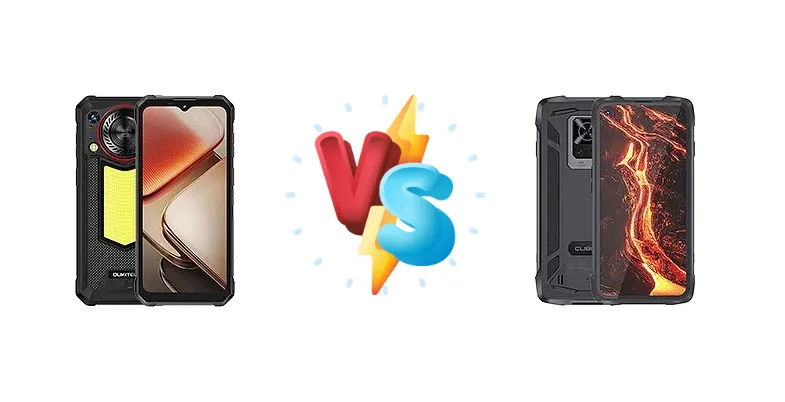
|
🏆 Quick Verdict
For the average user prioritizing all-day (and multi-day) battery life and a more efficient processor, the Oukitel WP53 is the better choice. Its Unisoc T615 chipset, coupled with a reported 98:11h endurance, offers a compelling package. However, users who prioritize raw CPU performance for demanding tasks may find the Cubot KingKong 7's Helio P60 more appealing.
| PHONES | ||
|---|---|---|
| Phone Names | Oukitel WP53 | Cubot KingKong 7 |
| Network | ||
|---|---|---|
| 2G bands | GSM 850 / 900 / 1800 / 1900 | GSM 850 / 900 / 1800 / 1900 |
| 3G bands | HSDPA 850 / 900 / 1700(AWS) / 1900 / 2100 | HSDPA 850 / 900 / 1700(AWS) / 1900 / 2100 |
| 4G bands | 1, 2, 3, 4, 5, 7, 8, 12, 17, 18, 19, 20, 25, 26, 28, 38, 40, 41, 66 | 1, 2, 3, 4, 5, 7, 8, 12, 13, 17, 18, 19, 20, 25, 26, 28, 38, 40, 41, 66 |
| Speed | HSPA, LTE | HSPA, LTE |
| Technology | GSM / HSPA / LTE | GSM / CDMA / HSPA / LTE |
| Launch | ||
|---|---|---|
| Announced | 2025, June | 2022 |
| Status | Available. Released 2025, June | Available. Released 2022 |
| Body | ||
|---|---|---|
| Dimensions | 172.2 x 80.5 x 18.5 mm (6.78 x 3.17 x 0.73 in) | 166.8 x 83.5 x 14 mm (6.57 x 3.29 x 0.55 in) |
| SIM | Nano-SIM + Nano-SIM | Nano-SIM + Nano-SIM |
| Weight | 388.7 g (13.72 oz) | 267 g (9.42 oz) |
| Display | ||
|---|---|---|
| Protection | AGC Dragontrail, Mohs level 5 | - |
| Resolution | 576 x 1280 pixels, 20:9 ratio (~215 ppi density) | 1080 x 2300 pixels (~400 ppi density) |
| Size | 6.52 inches, 102.6 cm2 (~74.0% screen-to-body ratio) | 6.36 inches, 100.4 cm2 (~72.1% screen-to-body ratio) |
| Type | IPS LCD, 400 nits | IPS LCD |
| Platform | ||
|---|---|---|
| CPU | Octa-core (2x1.8 GHz Cortex-A75 & 6x1.6 GHz Cortex-A55) | Octa-core (4x2.0 GHz Cortex-A73 & 4x2.0 GHz Cortex-A53) |
| Chipset | Unisoc T615 (12 nm) | Mediatek MT6771V/CA Helio P60 (12 nm) |
| GPU | Mali-G57 MP1 | Mali-G72 MP3 |
| OS | Android 15 | Android 11 |
| Memory | ||
|---|---|---|
| Card slot | microSDXC (uses shared SIM slot) | microSDXC (uses shared SIM slot) |
| Internal | 128GB 8GB RAM | 128GB 8GB RAM |
| Main Camera | ||
|---|---|---|
| Dual | 13 MP, f/2.2, (wide), 1/2.5", AF Auxiliary lens | - |
| Features | LED flash, HDR, panorama | LED flash |
| Triple | - | 64 MP, (wide), AF 16 MP, (ultrawide) 5 MP (macro) |
| Video | 1080p@30fps | Yes |
| Selfie camera | ||
|---|---|---|
| Single | 5 MP, f/2.2, (wide) | 32 MP |
| Video | 720p@30fps | Yes |
| Sound | ||
|---|---|---|
| 35mm jack | No | Unspecified |
| Loudspeaker | Yes (128 dB, 3W peak) | Yes |
| Comms | ||
|---|---|---|
| Bluetooth | 5.0, A2DP, LE | 4.2, A2DP |
| NFC | Yes | Yes |
| Positioning | GPS, GALILEO, GLONASS, BDS | GPS, GLONASS, BDS |
| Radio | FM radio | Unspecified |
| USB | USB Type-C 2.0 | USB Type-C, OTG |
| WLAN | Wi-Fi 802.11 a/b/g/n/ac, dual-band | Wi-Fi 802.11 a/b/g/n |
| Features | ||
|---|---|---|
| Sensors | Fingerprint (side-mounted), accelerometer, gyro, proximity, compass | Fingerprint (rear-mounted), accelerometer, gyro, proximity, compass |
| Battery | ||
|---|---|---|
| Charging | 18W wired | - |
| Type | Li-Po 11000 mAh | 5000 mAh |
| Misc | ||
|---|---|---|
| Colors | Black, Orange, Green | Black |
| EU LABEL | ||
|---|---|---|
| Battery | 98:11h endurance, 1200 cycles | - |
| Energy | Class B | - |
| Free fall | Class A (270 falls) | - |
| Repairability | Class C | - |
Oukitel WP53
- Exceptional battery life (98:11h endurance)
- Modern and efficient Unisoc T615 chipset
- Potentially better sustained performance due to thermal efficiency
- Potentially lower peak CPU performance compared to the Helio P60
- Display specifications unknown
Cubot KingKong 7
- More powerful CPU cores (Cortex-A73) for burst performance
- Potentially better for demanding applications
- Rugged design
- Likely shorter battery life compared to the Oukitel WP53
- Older chipset architecture may lead to more thermal throttling
Display Comparison
Neither device's display specifications are provided, so a direct comparison is limited. However, given the price point and rugged focus, both likely utilize IPS LCD panels. The choice will likely come down to viewing angles and color accuracy, which would require hands-on testing. Bezels are expected to be relatively substantial on both models, prioritizing durability over a sleek aesthetic.
Camera Comparison
Without detailed camera specifications, a comprehensive comparison is impossible. However, it's safe to assume both phones will feature multiple rear cameras, likely including a primary sensor, a wide-angle lens, and potentially a macro lens. Given the market segment, image processing will likely prioritize quick snapshots over high-fidelity photography. The presence of Optical Image Stabilization (OIS) would be a significant advantage, but is not specified for either device. The usefulness of a 2MP macro camera, common in this price range, is questionable, offering limited detail and often poor image quality.
Performance
The core difference lies in the chipsets. The Oukitel WP53 utilizes the Unisoc T615 (12nm), an octa-core processor with a mix of Cortex-A75 (1.8GHz) and A55 (1.6GHz) cores. This configuration balances performance and efficiency. Conversely, the Cubot KingKong 7 features the MediaTek Helio P60 (12nm), employing a different core arrangement – four Cortex-A73 (2.0GHz) and four Cortex-A53 (2.0GHz) cores. While the P60's A73 cores offer higher peak performance than the T615's A75 cores, the T615's newer architecture and optimized efficiency could translate to better sustained performance and less thermal throttling during prolonged use. The T615's architecture is more modern, potentially offering better power management.
Battery Life
The Oukitel WP53 boasts a significant advantage in battery endurance, with a reported 98:11h of usage. This is a substantial figure, suggesting a large battery capacity and efficient power management. The WP53 also supports 18W wired charging. The Cubot KingKong 7's battery capacity is not specified, but given the more powerful processor, it's likely smaller. While charging speed isn't mentioned, it's unlikely to exceed 18W. The WP53’s longer endurance makes it ideal for users who frequently find themselves away from power outlets.
Buying Guide
Buy the Oukitel WP53 if you need a phone that can reliably last through extended outdoor adventures, work shifts, or travel without frequent charging. It’s ideal for users who value battery longevity over peak performance. Buy the Cubot KingKong 7 if you prefer a phone with a slightly more powerful CPU for tasks like video editing or running more demanding applications, and are willing to compromise on battery endurance to achieve that.