
Oukitel WP53 vs. Blackview BV9200: A Deep Dive into Rugged Performance and Battery Life
| Phones Images | |||||
|---|---|---|---|---|---|
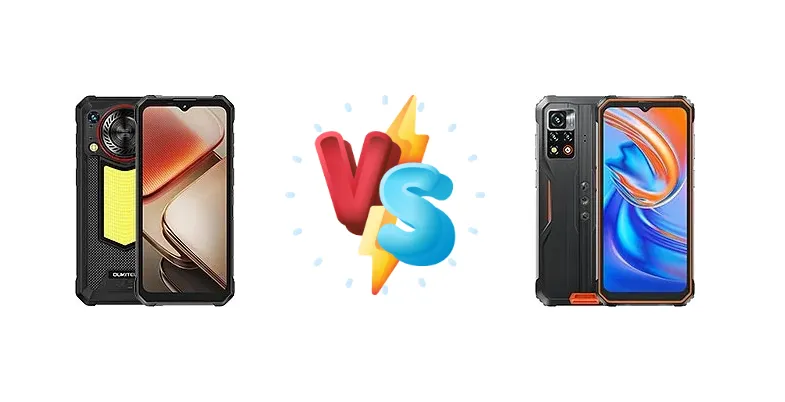
|
🏆 Quick Verdict
For the average user prioritizing all-day (and multi-day) battery life and cost-effectiveness, the Oukitel WP53 is the better choice. However, the Blackview BV9200’s significantly faster 66W charging and more capable Helio G96 chipset make it ideal for users who need quick power boosts and occasional performance bursts.
| PHONES | ||
|---|---|---|
| Phone Names | Oukitel WP53 | Blackview BV9200 |
| Network | ||
|---|---|---|
| 2G bands | GSM 850 / 900 / 1800 / 1900 | GSM 850 / 900 / 1800 / 1900 |
| 3G bands | HSDPA 850 / 900 / 1700(AWS) / 1900 / 2100 | HSDPA 850 / 900 / 1700(AWS) / 1900 / 2100 |
| 4G bands | 1, 2, 3, 4, 5, 7, 8, 12, 17, 18, 19, 20, 25, 26, 28, 38, 40, 41, 66 | 1, 2, 3, 4, 5, 7, 8, 12, 13, 17, 18, 19, 20, 25, 26, 28, 34, 38, 39, 40, 41, 66 |
| Speed | HSPA, LTE | HSPA, LTE |
| Technology | GSM / HSPA / LTE | GSM / CDMA / HSPA / LTE |
| - | CDMA 800 / 1900 | |
| Launch | ||
|---|---|---|
| Announced | 2025, June | 2022, December 28 |
| Status | Available. Released 2025, June | Available. Released 2023, January 09 |
| Body | ||
|---|---|---|
| Dimensions | 172.2 x 80.5 x 18.5 mm (6.78 x 3.17 x 0.73 in) | 174.5 x 81.8 x 13.6 mm (6.87 x 3.22 x 0.54 in) |
| SIM | Nano-SIM + Nano-SIM | Nano-SIM + Nano-SIM |
| Weight | 388.7 g (13.72 oz) | 310 g (10.93 oz) |
| - | IP68/IP69K dust/water resistant (up to 1.5m for 30 min) Drop-to-concrete resistance from up to 1.8m MIL-STD-810H compliant | |
| Display | ||
|---|---|---|
| Protection | AGC Dragontrail, Mohs level 5 | Corning Gorilla Glass 5 |
| Resolution | 576 x 1280 pixels, 20:9 ratio (~215 ppi density) | 1080 x 2408 pixels, 20:9 ratio (~400 ppi density) |
| Size | 6.52 inches, 102.6 cm2 (~74.0% screen-to-body ratio) | 6.6 inches, 104.9 cm2 (~73.5% screen-to-body ratio) |
| Type | IPS LCD, 400 nits | IPS LCD, 120Hz |
| Platform | ||
|---|---|---|
| CPU | Octa-core (2x1.8 GHz Cortex-A75 & 6x1.6 GHz Cortex-A55) | Octa-core (2x2.05 GHz Cortex-A76 & 6x2.0 GHz Cortex-A55) |
| Chipset | Unisoc T615 (12 nm) | Mediatek MT6781 Helio G96 (12 nm) |
| GPU | Mali-G57 MP1 | Mali-G52 MC2 |
| OS | Android 15 | Android 12, Doke-OS 3.1 |
| Memory | ||
|---|---|---|
| Card slot | microSDXC (uses shared SIM slot) | microSDXC (dedicated slot) |
| Internal | 128GB 8GB RAM | 256GB 8GB RAM |
| - | UFS 2.1 | |
| Main Camera | ||
|---|---|---|
| Dual | 13 MP, f/2.2, (wide), 1/2.5", AF Auxiliary lens | - |
| Features | LED flash, HDR, panorama | LED flash, HDR, panorama |
| Single | - | 16 MP, (wide), 1/3", 1.0µm |
| Triple | - | 50 MP, f/1.8, (wide), 1/2.76", 0.64µm, PDAF 8 MP, f/1.8, 120˚, (ultrawide), AF Auxiliary lens |
| Video | 1080p@30fps | 1440p@30fps, 1080p@30fps |
| Selfie camera | ||
|---|---|---|
| Single | 5 MP, f/2.2, (wide) | 16 MP, f/2.0, (wide), 1/3", 1.0µm |
| Video | 720p@30fps | 1080p |
| Sound | ||
|---|---|---|
| 3.5mm jack | - | No |
| 35mm jack | No | No |
| Loudspeaker | Yes (128 dB, 3W peak) | Yes, with dual speakers |
| Comms | ||
|---|---|---|
| Bluetooth | 5.0, A2DP, LE | 5.2, A2DP, LE |
| NFC | Yes | Yes |
| Positioning | GPS, GALILEO, GLONASS, BDS | GPS, GLONASS, GALILEO, BDS |
| Radio | FM radio | FM radio |
| USB | USB Type-C 2.0 | USB Type-C, OTG |
| WLAN | Wi-Fi 802.11 a/b/g/n/ac, dual-band | Wi-Fi 802.11 a/b/g/n/ac, dual-band |
| Features | ||
|---|---|---|
| Sensors | Fingerprint (side-mounted), accelerometer, gyro, proximity, compass | Fingerprint (side-mounted), accelerometer, gyro, proximity, compass, barometer |
| Battery | ||
|---|---|---|
| Charging | 18W wired | 66W wired 30W wireless |
| Type | Li-Po 11000 mAh | 5000 mAh |
| Misc | ||
|---|---|---|
| Colors | Black, Orange, Green | Black, Orange, Green |
| Price | - | About 200 EUR |
| EU LABEL | ||
|---|---|---|
| Battery | 98:11h endurance, 1200 cycles | - |
| Energy | Class B | - |
| Free fall | Class A (270 falls) | - |
| Repairability | Class C | - |
Oukitel WP53
- Exceptional battery life (98:11h endurance)
- Long-lasting battery health (1200 charge cycles)
- Cost-effective rugged option
- Slower processor (Unisoc T615)
- Slow charging speed (18W)
Blackview BV9200
- Faster processor (Helio G96)
- Fast charging (66W wired, 30W wireless)
- Brighter and higher contrast display
- Potentially shorter battery life
- Higher price point
Display Comparison
The Blackview BV9200 boasts a superior display experience, measured at 481 nits of peak brightness and a 1423:1 contrast ratio. This translates to better visibility outdoors and more vibrant colors compared to the Oukitel WP53, which lacks published display specifications. While the WP53 likely offers a functional display for its price point, the BV9200’s panel is demonstrably more refined, making it a better choice for media consumption and outdoor work. The higher contrast ratio on the BV9200 will also result in deeper blacks and a more immersive viewing experience.
Camera Comparison
Without detailed camera specifications for either device, a direct comparison is difficult. However, given the market positioning, it’s reasonable to assume the BV9200 likely features a more sophisticated camera system. The Helio G96 chipset also offers better image signal processing capabilities than the Unisoc T615. While both phones likely include multiple rear cameras, focusing on the main sensor’s quality is crucial. The presence of Optical Image Stabilization (OIS) – a feature often found in phones with more powerful chipsets like the BV9200 – would be a significant advantage for capturing sharp, stable photos and videos.
Performance
The Blackview BV9200’s Mediatek Helio G96 chipset represents a significant performance upgrade over the Oukitel WP53’s Unisoc T615. The G96 features a more modern CPU architecture – Cortex-A76 cores clocked at 2.05 GHz versus the WP53’s Cortex-A75 cores at 1.8 GHz – resulting in faster application loading and smoother multitasking. While both chipsets are built on a 12nm process, the architectural improvements in the G96 provide a tangible benefit. The WP53’s T615 prioritizes efficiency, contributing to its exceptional battery life, but it will struggle with graphically intensive games or demanding applications where the BV9200 excels.
Battery Life
The Oukitel WP53 claims an impressive 98:11h endurance and 1200 charge cycles, suggesting exceptional battery life. While the Blackview BV9200’s battery capacity isn’t specified, its 66W wired and 30W wireless charging capabilities are a major advantage. The WP53’s 18W charging is comparatively slow. This means the BV9200 can go from 0-100% much faster, even if its overall battery endurance is slightly less than the WP53. The 1200 charge cycle claim on the WP53 is also noteworthy, suggesting long-term battery health.
Buying Guide
Buy the Oukitel WP53 if you need a phone that can reliably last for days on a single charge, and your primary use cases involve everyday tasks like communication, navigation, and light media consumption. Buy the Blackview BV9200 if you prefer a phone that can quickly recharge, handle more demanding applications, and offers a brighter, more vibrant display for media viewing.