
Oukitel WP52 vs. Samsung Galaxy XCover Pro: A Deep Dive into Rugged Performance
| Phones Images | |||||
|---|---|---|---|---|---|
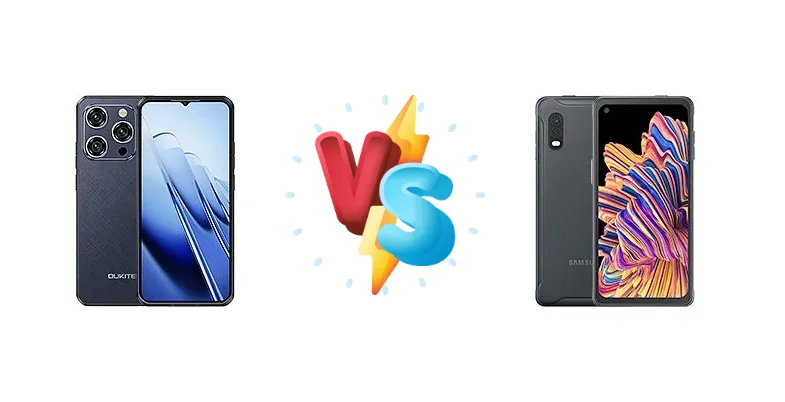
|
🏆 Quick Verdict
For the average user prioritizing long-term software support and a familiar interface, the Samsung Galaxy XCover Pro remains a solid choice. However, the Oukitel WP52 delivers significantly better performance and battery life thanks to its Dimensity 6100+ chipset and 65:13h endurance, making it the winner for power users and those needing all-day (and then some) operation.
| PHONES | ||
|---|---|---|
| Phone Names | Oukitel WP52 | Samsung Galaxy XCover Pro |
| Network | ||
|---|---|---|
| 2G bands | GSM 850 / 900 / 1800 / 1900 | GSM 850 / 900 / 1800 / 1900 |
| 3G bands | HSDPA 800 / 850 / 900 / 1700(AWS) / 1900 / 2100 | HSDPA 850 / 900 / 1900 / 2100 - International |
| 4G bands | 1, 2, 3, 4, 5, 7, 8, 12, 13, 17, 18, 19, 20, 25, 26, 28, 34, 38, 39, 40, 41, 66, 71 | 1, 2, 3, 5, 7, 8, 20, 28, 38, 40, 41 - International |
| 5G bands | 1, 2, 3, 5, 7, 8, 20, 28, 38, 41, 66, 77, 78, 79 SA/NSA | - |
| Speed | HSPA, LTE, 5G | HSPA 42.2/5.76 Mbps, LTE (3CA) Cat11 600/50 Mbps |
| Technology | GSM / HSPA / LTE / 5G | GSM / HSPA / LTE |
| - | 1, 2, 3, 4, 5, 7, 12, 13, 14, 20, 29, 38, 40, 41, 66 - Canada | |
| Launch | ||
|---|---|---|
| Announced | 2024, June 17 | 2020, January |
| Status | Available. Released 2024, June | Available. Released 2020, January |
| Body | ||
|---|---|---|
| Dimensions | 172.2 x 80 x 12 mm (6.78 x 3.15 x 0.47 in) | 159.9 x 76.7 x 10 mm (6.30 x 3.02 x 0.39 in) |
| SIM | Nano-SIM | · Nano-SIM· Nano-SIM + Nano-SIM |
| Weight | 281 g (9.91 oz) | 218 g (7.69 oz) |
| - | IP68 dust/water resistant (up to 1.5m for 35 min) Drop-to-concrete resistance from up to 1.5m MIL-STD-810G compliant* *does not guarantee ruggedness or use in extreme conditions | |
| Display | ||
|---|---|---|
| Protection | Corning Gorilla Glass 5, Mohs level 5 | Corning Gorilla Glass 5 |
| Resolution | 720 x 1612 pixels, 20:9 ratio (~267 ppi density) | 1080 x 2340 pixels, 19.5:9 ratio (~409 ppi density) |
| Size | 6.6 inches, 104.6 cm2 (~76.0% screen-to-body ratio) | 6.3 inches, 97.4 cm2 (~79.4% screen-to-body ratio) |
| Type | IPS LCD, 440 nits | IPS LCD |
| Platform | ||
|---|---|---|
| CPU | Octa-core (2x2.2 GHz Cortex-A76 & 6x2.0 GHz Cortex-A55) | Octa-core (4x2.3 GHz Cortex-A73 & 4x1.7 GHz Cortex-A53) |
| Chipset | Mediatek Dimensity 6100+ (6 nm) | Exynos 9611 (10 nm) |
| GPU | Mali-G57 MC2 | Mali-G72 MP3 |
| OS | Android 14 | Android 10, upgradable to Android 13, One UI 5 |
| Memory | ||
|---|---|---|
| Card slot | No | microSDXC (dedicated slot) |
| Internal | 256GB 4GB RAM | 64GB 4GB RAM |
| Main Camera | ||
|---|---|---|
| Dual | - | 25 MP, f/1.7, 26mm (wide), PDAF 8 MP, f/2.2, 123˚ (ultrawide), 1/4.0", 1.12µm |
| Features | LED flash, HDR, panorama | Dual-LED flash, HDR, panorama |
| Triple | 48 MP, f/1.8, (wide), 1/2.0", PDAF 2 MP (macro) Auxiliary lens | - |
| Video | 1440p@30fps, 1080p@30fps | 1080p@30fps |
| Selfie camera | ||
|---|---|---|
| Features | - | HDR |
| Single | 8 MP, f/2.2, (wide), 1/4.0" | 13 MP, f/2.0, (wide), 1/3.1", 1.12µm |
| Video | 720p@30fps | 1080p@30fps |
| Sound | ||
|---|---|---|
| 3.5mm jack | - | Yes |
| 35mm jack | No | Yes |
| Loudspeaker | Yes | Yes |
| Comms | ||
|---|---|---|
| Bluetooth | 5.2, A2DP, LE | 5.0, A2DP, LE |
| NFC | Yes | Yes |
| Positioning | GPS, GALILEO, GLONASS, BDS | GPS, GLONASS, GALILEO, BDS |
| Radio | FM radio | FM radio (market/region dependent) |
| USB | USB Type-C 2.0, OTG | USB Type-C 2.0 |
| WLAN | Wi-Fi 802.11 a/b/g/n/ac, dual-band | Wi-Fi 802.11 a/b/g/n/ac/k/v/r, dual-band, Wi-Fi Direct |
| Features | ||
|---|---|---|
| Sensors | Fingerprint (side-mounted), accelerometer, proximity, compass | Fingerprint (side-mounted), accelerometer, gyro, proximity, compass |
| - | ANT+ | |
| Battery | ||
|---|---|---|
| Charging | 18W wired | 15W wired |
| Type | Li-Po 6500 mAh | Li-Po 4050 mAh, removable |
| Misc | ||
|---|---|---|
| Colors | Black/Blue | Black |
| Models | - | SM-G715FN/DS, SM-G715FN, SM-G715F, SM-G715W, SM-G715U, SM-G715U1 |
| Price | About 360 EUR | About 120 EUR |
| SAR EU | - | 0.47 W/kg (head) 1.23 W/kg (body) |
| EU LABEL | ||
|---|---|---|
| Battery | 65:13h endurance, 1000 cycles | - |
| Energy | Class B | - |
| Free fall | Class A (270 falls) | - |
| Repairability | Class C | - |
Oukitel WP52
- Superior processing power with the Dimensity 6100+ chipset.
- Exceptional battery life (65:13h endurance).
- More efficient 6nm manufacturing process.
- Likely less refined software experience.
- Potentially limited long-term software support.
Samsung Galaxy XCover Pro
- Established Samsung brand and ecosystem.
- Guaranteed software updates and security patches.
- Potentially more polished user interface.
- Older and less powerful Exynos 9611 chipset.
- Shorter battery life compared to the WP52.
- Less efficient 10nm manufacturing process.
Display Comparison
Neither device boasts a cutting-edge display. Details on panel type, resolution, and refresh rate are missing for both, but the focus is clearly on durability, not visual fidelity. The absence of LTPO technology suggests neither phone will offer adaptive refresh rates for power saving. Bezels are likely substantial on both to contribute to shock absorption. Color accuracy is likely secondary to visibility in direct sunlight, a key requirement for rugged devices.
Camera Comparison
Without detailed camera specs beyond the chipset, a direct comparison is limited. However, the market positioning suggests the XCover Pro might prioritize image processing algorithms tuned for Samsung’s aesthetic. The WP52 likely focuses on providing functional imagery. The inclusion of a 2MP macro camera on either device is largely a marketing tactic, offering minimal practical benefit. Sensor size and aperture are critical factors missing from the data, but the chipset’s ISP capabilities will play a role in image quality.
Performance
The Oukitel WP52’s Mediatek Dimensity 6100+ (6nm) represents a significant leap over the Samsung Galaxy XCover Pro’s Exynos 9611 (10nm). The 6nm process node inherently offers better power efficiency, translating to less heat generation and improved sustained performance. The Dimensity 6100+’s CPU architecture – Cortex-A76 and A55 cores – is also more modern and efficient than the XCover Pro’s Cortex-A73 and A53 configuration. This means the WP52 will handle multitasking, gaming, and demanding applications with greater ease. While both are octa-core, the architectural differences are substantial.
Battery Life
The Oukitel WP52’s 65:13h endurance is a standout feature, dwarfing what the XCover Pro likely offers. While the XCover Pro’s 15W charging is adequate, the WP52’s 18W charging, combined with its larger battery capacity (implied by the endurance rating), means faster replenishment times. The Dimensity 6100+’s superior power efficiency further contributes to the WP52’s extended battery life, making it ideal for users who spend extended periods away from power outlets.
Buying Guide
Buy the Oukitel WP52 if you need a phone that can handle demanding tasks, offers exceptional battery life, and prioritizes raw performance over brand recognition. This is ideal for field workers, outdoor enthusiasts, or anyone who frequently uses resource-intensive apps. Buy the Samsung Galaxy XCover Pro if you prefer a phone with a well-established ecosystem, guaranteed software updates, and a more refined user experience, even if it means sacrificing some processing power and battery longevity.