
Oukitel WP52 vs Blackview BV9900E: A Deep Dive into Rugged Smartphone Performance
| Phones Images | |||||
|---|---|---|---|---|---|
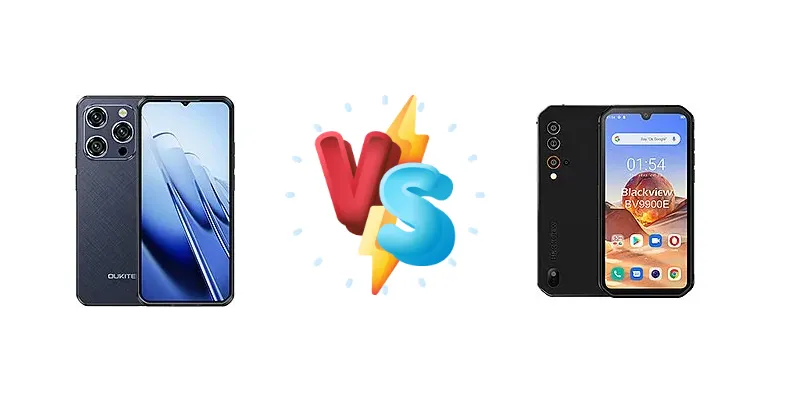
|
🏆 Quick Verdict
For the average user prioritizing longevity and sustained performance, the Oukitel WP52 emerges as the winner. Its newer Dimensity 6100+ chipset, coupled with exceptional 65:13h battery endurance, provides a smoother, longer-lasting experience than the Blackview BV9900E, despite the latter's wireless charging capability.
| PHONES | ||
|---|---|---|
| Phone Names | Oukitel WP52 | Blackview BV9900E |
| Network | ||
|---|---|---|
| 2G bands | GSM 850 / 900 / 1800 / 1900 | GSM 850 / 900 / 1800 / 1900 |
| 3G bands | HSDPA 800 / 850 / 900 / 1700(AWS) / 1900 / 2100 | HSDPA 800 / 850 / 900 / 1700(AWS) / 1900 / 2100 |
| 4G bands | 1, 2, 3, 4, 5, 7, 8, 12, 13, 17, 18, 19, 20, 25, 26, 28, 34, 38, 39, 40, 41, 66, 71 | 1, 2, 3, 4, 5, 7, 8, 12, 13, 17, 18, 19, 20, 25, 26, 28, 34, 38, 39, 40, 41, 66 |
| 5G bands | 1, 2, 3, 5, 7, 8, 20, 28, 38, 41, 66, 77, 78, 79 SA/NSA | - |
| Speed | HSPA, LTE, 5G | HSPA, LTE |
| Technology | GSM / HSPA / LTE / 5G | GSM / CDMA / HSPA / CDMA2000 / LTE |
| Launch | ||
|---|---|---|
| Announced | 2024, June 17 | 2020, September 10. Released 2020, September |
| Status | Available. Released 2024, June | Discontinued |
| Body | ||
|---|---|---|
| Dimensions | 172.2 x 80 x 12 mm (6.78 x 3.15 x 0.47 in) | 156.5 x 78.3 x 14.2 mm (6.16 x 3.08 x 0.56 in) |
| SIM | Nano-SIM | Nano-SIM + Nano-SIM |
| Weight | 281 g (9.91 oz) | 273 g (9.63 oz) |
| Display | ||
|---|---|---|
| Protection | Corning Gorilla Glass 5, Mohs level 5 | Corning Gorilla Glass 5 |
| Resolution | 720 x 1612 pixels, 20:9 ratio (~267 ppi density) | 1080 x 2280 pixels, 19:9 ratio (~432 ppi density) |
| Size | 6.6 inches, 104.6 cm2 (~76.0% screen-to-body ratio) | 5.84 inches, 85.1 cm2 (~69.5% screen-to-body ratio) |
| Type | IPS LCD, 440 nits | IPS LCD |
| Platform | ||
|---|---|---|
| CPU | Octa-core (2x2.2 GHz Cortex-A76 & 6x2.0 GHz Cortex-A55) | Octa-core (2x2.2 GHz Cortex-A75 & 6x2.0 GHz Cortex-A55) |
| Chipset | Mediatek Dimensity 6100+ (6 nm) | Mediatek MT6779V/CE Helio P90 (12 nm) |
| GPU | Mali-G57 MC2 | PowerVR GM9446 |
| OS | Android 14 | Android 10 |
| Memory | ||
|---|---|---|
| Card slot | No | microSDXC |
| Internal | 256GB 4GB RAM | 128GB 6GB RAM |
| Main Camera | ||
|---|---|---|
| Features | LED flash, HDR, panorama | LED flash, HDR, panorama |
| Quad | - | 48 MP, f/1.8, (wide), PDAF 16 MP, 120˚ (ultrawide) 2 MP (macro) Auxiliary lens |
| Triple | 48 MP, f/1.8, (wide), 1/2.0", PDAF 2 MP (macro) Auxiliary lens | - |
| Video | 1440p@30fps, 1080p@30fps | 4K@30fps, 1080p@60fps |
| Selfie camera | ||
|---|---|---|
| Single | 8 MP, f/2.2, (wide), 1/4.0" | 16 MP, f/2.0, (wide) |
| Video | 720p@30fps | 1080p@30fps |
| Sound | ||
|---|---|---|
| 35mm jack | No | No |
| Loudspeaker | Yes | Yes |
| Comms | ||
|---|---|---|
| Bluetooth | 5.2, A2DP, LE | 5.0, A2DP, LE |
| NFC | Yes | Yes |
| Positioning | GPS, GALILEO, GLONASS, BDS | GPS, GLONASS, GALILEO, BDS |
| Radio | FM radio | FM radio |
| USB | USB Type-C 2.0, OTG | USB Type-C 2.0, OTG |
| WLAN | Wi-Fi 802.11 a/b/g/n/ac, dual-band | Wi-Fi 802.11 a/b/g/n/ac |
| Features | ||
|---|---|---|
| Sensors | Fingerprint (side-mounted), accelerometer, proximity, compass | Fingerprint (side-mounted), accelerometer, gyro, proximity, compass, barometer |
| Battery | ||
|---|---|---|
| Charging | 18W wired | 15W wired 18W wireless |
| Type | Li-Po 6500 mAh | 4380 mAh |
| Misc | ||
|---|---|---|
| Colors | Black/Blue | Black, Silver |
| Price | About 360 EUR | About 260 EUR |
| EU LABEL | ||
|---|---|---|
| Battery | 65:13h endurance, 1000 cycles | - |
| Energy | Class B | - |
| Free fall | Class A (270 falls) | - |
| Repairability | Class C | - |
Oukitel WP52
- Superior battery life (65:13h endurance)
- More modern and efficient Dimensity 6100+ chipset
- Likely better sustained performance due to 6nm process
- Lacks wireless charging
- Charging speed is limited to 18W wired
Blackview BV9900E
- Convenience of 18W wireless charging
- Established rugged phone brand (Blackview)
- Offers charging flexibility with both wired and wireless options
- Older and less efficient Helio P90 chipset
- Shorter battery life compared to Oukitel WP52
- Potentially more thermal throttling under load
Display Comparison
Neither device's display specifications are provided, so a direct comparison is limited. However, given the WP52's newer chipset, it's reasonable to expect a more modern panel with potentially higher brightness and color accuracy. Blackview historically focuses on robust displays, so it likely offers good outdoor visibility. The absence of details necessitates relying on brand reputation and chipset generation as proxies for display quality.
Camera Comparison
Without detailed camera specifications, a precise comparison is impossible. However, the market segment suggests both phones will prioritize practicality over photographic excellence. The absence of sensor details implies neither device will challenge flagship camera performance. The focus will likely be on providing usable images in challenging conditions, leveraging the rugged nature of the phones. The 2MP macro cameras commonly found on these devices are unlikely to deliver significant detail and should be considered a secondary feature.
Performance
The Oukitel WP52’s Mediatek Dimensity 6100+ (6nm) represents a significant architectural leap over the Blackview BV9900E’s Helio P90 (12nm). The Dimensity 6100+ utilizes Cortex-A76 cores alongside A55s, while the BV9900E employs Cortex-A75 cores paired with A55s. The 6nm process node of the Dimensity 6100+ translates to improved power efficiency and thermal management, meaning the WP52 is less likely to throttle under sustained load. While both CPUs feature a 2x2.2 GHz clock speed on their performance cores, the architectural improvements in the Dimensity 6100+ will yield noticeable gains in real-world performance, particularly in demanding applications and multitasking.
Battery Life
The Oukitel WP52’s 65:13h endurance is a standout feature, indicating exceptional battery life. This is likely due to the efficient Dimensity 6100+ chipset and optimized power management. The Blackview BV9900E, with 15W wired and 18W wireless charging, offers charging flexibility. However, the slower wired charging speed compared to the WP52’s 18W, combined with the less efficient Helio P90, suggests it will require more frequent charging. The convenience of wireless charging is offset by the WP52’s significantly longer runtime between charges.
Buying Guide
Buy the Oukitel WP52 if you need a phone that can reliably last through multi-day expeditions or demanding work shifts, and value a more modern processor for smoother app performance. Buy the Blackview BV9900E if you prioritize the convenience of wireless charging and are willing to trade some processing power and battery life for that feature. The BV9900E is also a good choice for those already invested in the wireless charging ecosystem.