
Oukitel WP39 vs. Ulefone Power Armor 16 Pro: A Deep Dive into Rugged Performance
| Phones Images | |||||
|---|---|---|---|---|---|
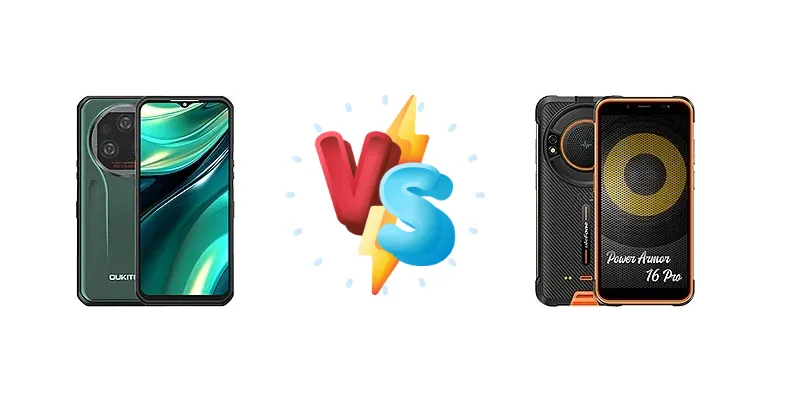
|
🏆 Quick Verdict
For the average user prioritizing performance and longevity, the Oukitel WP39 emerges as the clear winner. Its Dimensity 6100+ chipset provides a significantly more responsive experience than the Ulefone’s Helio G25, and its exceptional 109-hour battery endurance makes it ideal for extended off-grid use. While the Ulefone offers reverse wireless charging, the WP39’s overall package is more compelling.
| PHONES | ||
|---|---|---|
| Phone Names | Oukitel WP39 | Ulefone Power Armor 16 Pro |
| Network | ||
|---|---|---|
| 2G bands | GSM 850 / 900 / 1800 / 1900 | GSM 850 / 900 / 1800 / 1900 |
| 3G bands | HSDPA 800 / 850 / 900 / 1700(AWS) / 1900 / 2100 | HSDPA 800 / 850 / 900 / 1700(AWS) / 1900 / 2100 |
| 4G bands | 1, 2, 3, 4, 5, 7, 8, 12, 13, 17, 18, 19, 20, 25, 26, 28, 34, 38, 39, 40, 41, 66, 71 | 1, 2, 3, 4, 5, 7, 8, 12, 13, 17, 18, 19, 20, 25, 26, 28, 66 |
| 5G bands | 1, 2, 3, 5, 7, 8, 20, 25, 28, 38, 41, 66, 77, 78, 79 SA/NSA | - |
| Speed | HSPA, LTE, 5G | HSPA, LTE |
| Technology | GSM / HSPA / LTE / 5G | GSM / HSPA / LTE |
| - | eMMC 5.1 | |
| Launch | ||
|---|---|---|
| Announced | 2024, June 17 | 2022, September 16 |
| Status | Available. Released 2024, June | Available. Released 2022, September 16 |
| Body | ||
|---|---|---|
| Dimensions | 172.2 x 81 x 15 mm (6.78 x 3.19 x 0.59 in) | 173.4 x 83.4 x 18.3 mm (6.83 x 3.28 x 0.72 in) |
| SIM | Nano-SIM | Nano-SIM + Nano-SIM |
| Weight | 360 g (12.70 oz) | 405 g (14.29 oz) |
| - | IP68/IP69K dust/water resistant (up to 1.5m for 30 min) Drop-to-concrete resistance from up to 1.5m MIL-STD-810G compliant Flashlight with a dedicated button Accessory connector (ulefone endoscope, microscope) | |
| Display | ||
|---|---|---|
| Protection | Corning Gorilla Glass 5, Mohs level 5 | - |
| Resolution | 1080 x 2408 pixels, 20:9 ratio (~400 ppi density) | 720 x 1440 pixels, 18:9 ratio (~271 ppi density) |
| Size | 6.6 inches, 104.9 cm2 (~75.2% screen-to-body ratio) | 5.93 inches, 90.7 cm2 (~62.8% screen-to-body ratio) |
| Type | IPS LCD, 450 nits | IPS LCD |
| Platform | ||
|---|---|---|
| CPU | Octa-core (2x2.2 GHz Cortex-A76 & 6x2.0 GHz Cortex-A55) | Octa-core (4x2.0 GHz Cortex-A53 & 4x1.5 GHz Cortex-A53) |
| Chipset | Mediatek Dimensity 6100+ (6 nm) | Mediatek MT6762G Helio G25 (12 nm) |
| GPU | Mali-G57 MC2 | PowerVR GE8320 |
| OS | Android 14 | Android 12 |
| Memory | ||
|---|---|---|
| Card slot | No | microSDXC (dedicated slot) |
| Internal | 256GB 6GB RAM | 64GB 4GB RAM |
| Main Camera | ||
|---|---|---|
| Dual | - | 16 MP, f/1.8, (wide), 1.12µm, PDAF 2 MP (macro) |
| Features | LED flash, HDR, panorama | LED flash, HDR, panorama |
| Single | - | 8 MP, f/2.0, (wide), 1.12µm |
| Triple | 64 MP, f/1.9, (wide), 1/1.73", PDAF 8 MP, f/2.0, (night vision), 1/4", AF, infrared night vision lights 2 MP (macro) | - |
| Video | 1440p@30fps, 1080p@30fps | 1080p@30fps |
| Selfie camera | ||
|---|---|---|
| Single | 32 MP, f/2.2, (wide), 1/2.74" | 8 MP, f/2.0, (wide), 1.12µm |
| Video | 1080p@30fps | 1080p@30fps |
| Sound | ||
|---|---|---|
| 3.5mm jack | - | Yes |
| 35mm jack | No | Yes |
| Loudspeaker | Yes | Yes (122-decibel) |
| Comms | ||
|---|---|---|
| Bluetooth | 5.2, A2DP, LE | 5.0, A2DP, LE |
| NFC | Yes | Yes |
| Positioning | GPS, GALILEO, GLONASS, BDS | GPS, GLONASS, GALILEO, BDS |
| Radio | FM radio | Wireless FM radio, RDS, recording |
| USB | USB Type-C 2.0, OTG | USB Type-C 2.0, OTG, magnetic connector |
| WLAN | Wi-Fi 802.11 a/b/g/n/ac, dual-band | Wi-Fi 802.11 a/b/g/n/ac, dual-band |
| Features | ||
|---|---|---|
| Sensors | Fingerprint (side-mounted), accelerometer, gyro, proximity, compass | Fingerprint (side-mounted), accelerometer, proximity, compass |
| Battery | ||
|---|---|---|
| Charging | 18W wired | 18W wired 5W reverse wired |
| Type | Li-Po 11000 mAh | Li-Po 9600 mAh |
| Misc | ||
|---|---|---|
| Colors | Gray, Green | Black, Black/Orange |
| Price | About 280 EUR | About 220 EUR |
| EU LABEL | ||
|---|---|---|
| Battery | 109:23h endurance, 1100 cycles | - |
| Energy | Class B | - |
| Free fall | Class A (270 falls) | - |
| Repairability | Class C | - |
Oukitel WP39
- Significantly faster processor for smoother performance
- Exceptional battery life (109h endurance)
- Modern 6nm chipset for improved efficiency
- No reverse wireless charging
- Display specifications are unknown
Ulefone Power Armor 16 Pro
- Lower price point (likely)
- 5W reverse wired charging for accessories
- Rugged design for durability
- Outdated and less efficient Helio G25 chipset
- Significantly lower performance compared to the WP39
- Shorter battery life
Display Comparison
Neither device provides display specifications in the provided data. However, given the market segment, both likely feature IPS LCD panels optimized for outdoor visibility. The absence of details like resolution or refresh rate suggests a focus on durability and battery efficiency over premium display features. Expect both to prioritize brightness and viewing angles over color accuracy.
Camera Comparison
The provided data doesn't detail camera specifications beyond the chipsets. Given the rugged nature of these phones, expect both to prioritize durability over cutting-edge camera technology. It's reasonable to assume both will feature a main camera, potentially an ultrawide, and likely a basic macro lens. The image processing capabilities will largely depend on the ISP within each chipset; the Dimensity 6100+ likely offers superior image processing algorithms, resulting in better dynamic range and low-light performance. The absence of OIS information suggests neither phone will have optical image stabilization.
Performance
The performance gap between these two devices is substantial. The Oukitel WP39’s Mediatek Dimensity 6100+ (6nm) is a modern, octa-core processor featuring two high-performance Cortex-A76 cores clocked at 2.2 GHz and six efficiency cores at 2.0 GHz. This architecture delivers a significantly smoother experience for multitasking, gaming, and demanding applications. In contrast, the Ulefone Power Armor 16 Pro utilizes the older Mediatek MT6762G Helio G25 (12nm), with a less efficient configuration of four Cortex-A53 cores at 2.0 GHz and another four at 1.5 GHz. The larger 12nm node of the Helio G25 inherently results in higher power consumption and lower performance compared to the 6nm Dimensity 6100+. Users will notice a marked difference in app loading times and overall system responsiveness.
Battery Life
Battery life is a key differentiator. The Oukitel WP39 boasts an impressive 109:23h endurance and a 1100 cycle lifespan, indicating exceptional longevity. While both phones share the same 18W wired charging, the WP39’s superior battery efficiency, stemming from the 6nm Dimensity 6100+ chipset, allows it to maintain performance for significantly longer periods. The Ulefone Power Armor 16 Pro adds 5W reverse wired charging, a useful feature for topping up accessories, but this convenience is offset by its lower overall battery endurance.
Buying Guide
Buy the Oukitel WP39 if you need a rugged phone capable of handling demanding tasks like navigation, photography, and communication during extended outdoor adventures. Its superior processor and battery life make it ideal for professionals and enthusiasts. Buy the Ulefone Power Armor 16 Pro if you prioritize a lower price point and occasionally need to charge other devices wirelessly, accepting a trade-off in processing speed and overall responsiveness.