
Oukitel WP39 vs. Blackview BL8800 Pro: A Deep Dive into Rugged Smartphone Performance
| Phones Images | |||||
|---|---|---|---|---|---|
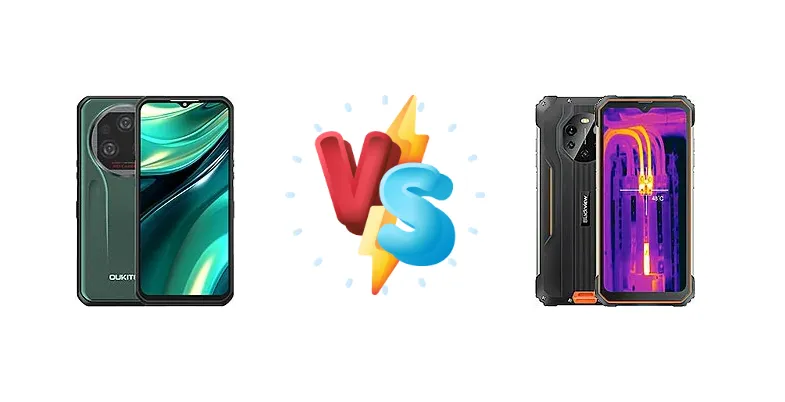
|
🏆 Quick Verdict
For users prioritizing maximum uptime and longevity, the Oukitel WP39 is the clear winner thanks to its incredible 109:23h endurance and 1100 charge cycles. However, the Blackview BL8800 Pro appeals to those who value quicker top-ups and a slightly more efficient chipset.
| PHONES | ||
|---|---|---|
| Phone Names | Oukitel WP39 | Blackview BL8800 Pro |
| Network | ||
|---|---|---|
| 2G bands | GSM 850 / 900 / 1800 / 1900 | GSM 850 / 900 / 1800 / 1900 |
| 3G bands | HSDPA 800 / 850 / 900 / 1700(AWS) / 1900 / 2100 | HSDPA 800 / 850 / 900 / 1700(AWS) / 1900 / 2100 |
| 4G bands | 1, 2, 3, 4, 5, 7, 8, 12, 13, 17, 18, 19, 20, 25, 26, 28, 34, 38, 39, 40, 41, 66, 71 | 1, 2, 3, 4, 5, 7, 8, 12, 13, 17, 18, 19, 20, 25, 26, 28, 30, 66 |
| 5G bands | 1, 2, 3, 5, 7, 8, 20, 25, 28, 38, 41, 66, 77, 78, 79 SA/NSA | 1, 3, 5, 7, 8, 20, 28, 38, 40, 41, 77, 78, 79 SA/NSA |
| Speed | HSPA, LTE, 5G | HSPA, LTE, 5G |
| Technology | GSM / HSPA / LTE / 5G | GSM / CDMA / HSPA / CDMA2000 / LTE / 5G |
| - | CDMA2000 1x | |
| Launch | ||
|---|---|---|
| Announced | 2024, June 17 | 2022, May 09 |
| Status | Available. Released 2024, June | Available. Released 2022, May 09 |
| Body | ||
|---|---|---|
| Dimensions | 172.2 x 81 x 15 mm (6.78 x 3.19 x 0.59 in) | 176.2 x 83.5 x 17.7 mm (6.94 x 3.29 x 0.70 in) |
| SIM | Nano-SIM | Nano-SIM + Nano-SIM |
| Weight | 360 g (12.70 oz) | 367 g (12.95 oz) |
| - | IP68/IP69K dust/water resistant (up to 1.5m for 30 min) Drop-to-concrete resistance from up to 1.5m MIL-STD-810H compliant | |
| Display | ||
|---|---|---|
| Protection | Corning Gorilla Glass 5, Mohs level 5 | - |
| Resolution | 1080 x 2408 pixels, 20:9 ratio (~400 ppi density) | 1080 x 2408 pixels, 20:9 ratio (~401 ppi density) |
| Size | 6.6 inches, 104.9 cm2 (~75.2% screen-to-body ratio) | 6.58 inches, 104.3 cm2 (~70.9% screen-to-body ratio) |
| Type | IPS LCD, 450 nits | IPS LCD, 480 nits |
| Platform | ||
|---|---|---|
| CPU | Octa-core (2x2.2 GHz Cortex-A76 & 6x2.0 GHz Cortex-A55) | Octa-core (2x2.2 GHz Cortex-A76 & 6x2.0 GHz Cortex-A55) |
| Chipset | Mediatek Dimensity 6100+ (6 nm) | Mediatek Dimensity 700 (7 nm) |
| GPU | Mali-G57 MC2 | Mali-G57 MC2 |
| OS | Android 14 | Android 11, Doke-OS 3.0 |
| Memory | ||
|---|---|---|
| Card slot | No | No |
| Internal | 256GB 6GB RAM | 128GB 8GB RAM |
| - | UFS 2.1 | |
| Main Camera | ||
|---|---|---|
| Features | LED flash, HDR, panorama | Thermal imaging, Dual-LED flash, HDR, panorama |
| Penta | - | 50 MP, f/1.8, (wide), PDAF 5 MP, thermal assisted camera FLIR thermal camera (Lepton module) 2x Auxiliary lens |
| Single | - | 16 MP, f/2.0, (wide) |
| Triple | 64 MP, f/1.9, (wide), 1/1.73", PDAF 8 MP, f/2.0, (night vision), 1/4", AF, infrared night vision lights 2 MP (macro) | - |
| Video | 1440p@30fps, 1080p@30fps | 1440p@30fps |
| Selfie camera | ||
|---|---|---|
| Single | 32 MP, f/2.2, (wide), 1/2.74" | 16 MP, f/2.0, (wide) |
| Video | 1080p@30fps | 1080p@30fps |
| Sound | ||
|---|---|---|
| 3.5mm jack | - | No |
| 35mm jack | No | No |
| Loudspeaker | Yes | Yes |
| Comms | ||
|---|---|---|
| Bluetooth | 5.2, A2DP, LE | 5.1, A2DP, LE |
| NFC | Yes | Yes |
| Positioning | GPS, GALILEO, GLONASS, BDS | GPS, GLONASS, GALILEO, BDS |
| Radio | FM radio | FM radio |
| USB | USB Type-C 2.0, OTG | USB Type-C 2.0, OTG |
| WLAN | Wi-Fi 802.11 a/b/g/n/ac, dual-band | Wi-Fi 802.11 a/b/g/n/ac |
| Features | ||
|---|---|---|
| Sensors | Fingerprint (side-mounted), accelerometer, gyro, proximity, compass | Fingerprint (side-mounted), accelerometer, gyro, proximity, compass, barometer |
| Battery | ||
|---|---|---|
| Charging | 18W wired | 33W wired, 31% in 30 min, 100% in 90 min Reverse wired |
| Type | Li-Po 11000 mAh | 8380 mAh |
| Misc | ||
|---|---|---|
| Colors | Gray, Green | Black, Orange, Green |
| Price | About 280 EUR | About 300 EUR |
| EU LABEL | ||
|---|---|---|
| Battery | 109:23h endurance, 1100 cycles | - |
| Energy | Class B | - |
| Free fall | Class A (270 falls) | - |
| Repairability | Class C | - |
Oukitel WP39
- Exceptional battery life (109:23h endurance)
- High battery cycle count (1100 cycles)
- Potentially better thermal management with 6nm Dimensity 6100+
- Slower charging speed (18W)
- No reverse charging
Blackview BL8800 Pro
- Faster charging (33W with 90 min full charge)
- Reverse wired charging capability
- 7nm chipset fabrication
- Significantly lower battery endurance
- Potentially less efficient chipset
Display Comparison
Neither device provides display specifications in the provided data. However, given their market positioning, we can expect both to utilize IPS LCD panels prioritizing durability over cutting-edge features like OLED. Bezels are likely to be substantial on both to enhance drop protection. Color accuracy is likely to be standard for this price segment, focusing on practical usability rather than professional color grading.
Camera Comparison
The provided data lacks camera specifications. Given the rugged nature of these phones, we can anticipate a focus on practicality over high-end imaging. Expect a primary sensor, likely around 48MP or 64MP, with supporting lenses for ultrawide or macro photography. The usefulness of a 2MP macro lens is questionable, offering limited detail and often poor image quality. Image processing will likely prioritize dynamic range and clarity in challenging outdoor conditions.
Performance
Both the Oukitel WP39 and Blackview BL8800 Pro utilize an octa-core CPU configuration with the same core arrangement (2x2.2 GHz Cortex-A76 & 6x2.0 GHz Cortex-A55). However, the chipset differs significantly: the WP39 employs the Mediatek Dimensity 6100+ (6nm), while the BL8800 Pro uses the Dimensity 700 (7nm). The 6nm process of the Dimensity 6100+ *should* offer improved power efficiency compared to the 7nm Dimensity 700, potentially translating to better thermal management under sustained load. While both chipsets are capable, the 6100+ is a newer generation and likely provides a slight edge in overall performance and efficiency.
Battery Life
This is where the Oukitel WP39 truly shines. Its 109:23h endurance rating is exceptional, indicating significantly longer usage between charges than most smartphones. The 1100 charge cycles suggest a battery designed for longevity, resisting degradation over extended use. The Blackview BL8800 Pro, while offering a respectable 33W wired charging (reaching 31% in 30 minutes and 100% in 90 minutes) and reverse wired charging, cannot match the WP39’s sheer endurance. The faster charging speed is a convenience, but the WP39’s battery life minimizes the need for frequent top-ups.
Buying Guide
Buy the Oukitel WP39 if you need a phone that can reliably last for days on a single charge, especially in situations where access to power is limited. This is the ideal choice for extended camping trips, construction work, or anyone who simply dislikes frequent charging. Buy the Blackview BL8800 Pro if you prefer the convenience of faster 33W charging, including reverse wired charging, and want a phone built on a more modern 7nm process, potentially offering better sustained performance in demanding tasks.