
Oukitel WP39 Pro vs. Ulefone Power Armor 19T: A Deep Dive into Rugged Smartphone Performance
| Phones Images | |||||
|---|---|---|---|---|---|
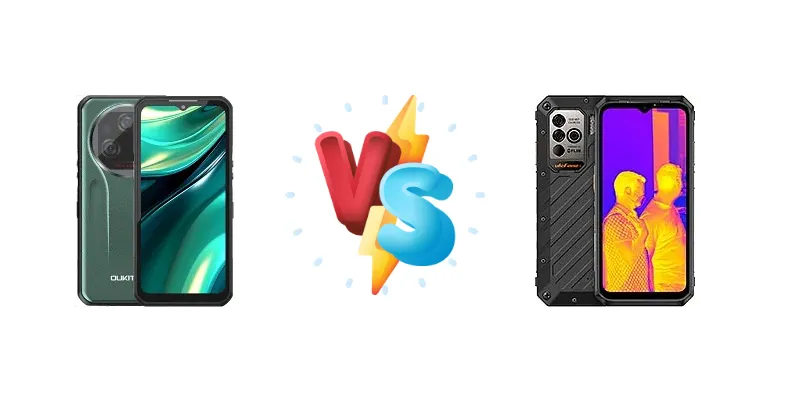
|
🏆 Quick Verdict
For the average user prioritizing long-term battery life and consistent performance, the Oukitel WP39 Pro is the better choice. Its Dimensity 6300 chipset, coupled with exceptional 109:23h endurance, outweighs the Ulefone Power Armor 19T’s faster charging, which doesn't fully compensate for its comparatively shorter runtime.
| PHONES | ||
|---|---|---|
| Phone Names | Oukitel WP39 Pro | Ulefone Power Armor 19T |
| Network | ||
|---|---|---|
| 2G bands | GSM 850 / 900 / 1800 / 1900 | GSM 850 / 900 / 1800 / 1900 |
| 3G bands | HSDPA 800 / 850 / 900 / 1700(AWS) / 1900 / 2100 | HSDPA 800 / 850 / 900 / 1700(AWS) / 1900 / 2100 |
| 4G bands | 1, 2, 3, 4, 5, 7, 8, 12, 13, 17, 18, 19, 20, 25, 26, 28, 34, 38, 39, 40, 41, 66, 71 | 1, 2, 3, 4, 5, 7, 8, 12, 13, 17, 18, 19, 20, 25, 26, 28, 34, 38, 39, 40, 41, 66, 71 |
| 5G bands | 1, 2, 3, 5, 7, 8, 20, 28, 38, 40, 41, 66, 71, 77, 78 SA/NSA | - |
| Speed | HSPA, LTE, 5G | HSPA, LTE |
| Technology | GSM / HSPA / LTE / 5G | GSM / CDMA / HSPA / CDMA2000 / LTE |
| - | CDMA2000 1x | |
| Launch | ||
|---|---|---|
| Announced | 2025, February 11 | 2023, March 06 |
| Status | Available. Released 2025, March 15 | Available. Released 2023, March 06 |
| Body | ||
|---|---|---|
| Dimensions | 172.2 x 81 x 15.2 mm (6.78 x 3.19 x 0.60 in) | 175.2 x 83.4 x 18.8 mm (6.90 x 3.28 x 0.74 in) |
| SIM | Nano-SIM + Nano-SIM | Nano-SIM + Nano-SIM |
| Weight | 360 g (12.70 oz) | 409 g (14.43 oz) |
| - | IP68/IP69K dust/water resistant (up to 1.5m for 30 min) Drop-to-concrete resistance from up to 1.5m MIL-STD-810H compliant Accessory connector (ulefone endoscope, microscope) | |
| Display | ||
|---|---|---|
| Protection | Corning Gorilla Glass 5, Mohs level 5 | Corning Gorilla Glass 5 |
| Resolution | 1080 x 2408 pixels, 20:9 ratio (~400 ppi density) | 1080 x 2408 pixels, 20:9 ratio (~401 ppi density) |
| Size | 6.6 inches, 104.9 cm2 (~75.2% screen-to-body ratio) | 6.58 inches, 104.3 cm2 (~71.4% screen-to-body ratio) |
| Type | IPS LCD, 450 nits | IPS LCD, 120Hz |
| Platform | ||
|---|---|---|
| CPU | Octa-core (2x2.2 GHz Cortex-A76 & 6x2.0 GHz Cortex-A55) | Octa-core (2x2.2 GHz Cortex-A76 & 6x2.0 GHz Cortex-A55) |
| Chipset | Mediatek Dimensity 6300 (6 nm) | Mediatek Helio G99 (6 nm) |
| GPU | Mali-G57 MC2 | Mali-G57 MC2 |
| OS | Android 14 | Android 12 |
| Memory | ||
|---|---|---|
| Card slot | microSDXC (uses shared SIM slot) | microSDXC (uses shared SIM slot) |
| Internal | 512GB 12GB RAM | 256GB 12GB RAM |
| Main Camera | ||
|---|---|---|
| Features | LED flash, HDR, portrait, panorama | Hexa-LED flash, HDR, panorama |
| Triple | 64 MP, f/1.9, (wide), 1/1.73", PDAF 8 MP, f/2.2, (night vision), AF 2 MP (macro) | 108 MP, f/1.9, (wide), 1/1.52", 0.7µm, PDAF 5 MP (macro) FLIR thermal camera (Lepton module) 5 MP (for thermal module) |
| Video | 1440p@30fps | 1440p@30fps, 1080p@30fps |
| Selfie camera | ||
|---|---|---|
| Single | 32 MP, f/2.2, (wide), 1/2.74" | 16 MP, f/2.0, (wide), 1.0µm |
| Video | 1080p@30fps | 1080p@30fps |
| Sound | ||
|---|---|---|
| 3.5mm jack | - | Yes |
| 35mm jack | No | Yes |
| Loudspeaker | Yes | Yes |
| Comms | ||
|---|---|---|
| Bluetooth | 5.2, A2DP, LE | 5.2, A2DP, LE |
| NFC | Yes | Yes |
| Positioning | GPS, GLONASS, GALILEO, BDS | GPS, GLONASS, GALILEO, BDS |
| Radio | FM radio | Wireless FM radio, RDS, recording |
| USB | USB Type-C 2.0, OTG | USB Type-C 2.0, OTG, magnetic connector |
| WLAN | Wi-Fi 802.11 a/b/g/n/ac, dual-band | Wi-Fi 802.11 a/b/g/n/ac, dual-band |
| Features | ||
|---|---|---|
| Sensors | Fingerprint (side-mounted), accelerometer, gyro, proximity, compass | Fingerprint (side-mounted), accelerometer, gyro, proximity, compass |
| Battery | ||
|---|---|---|
| Charging | 33W wired, 100% in 187 min Reverse wired | 66W wired, 52% in 30 min 15W wireless 5W wireless reversed |
| Type | Li-Po 11000 mAh | Li-Po 9600 mAh |
| Misc | ||
|---|---|---|
| Colors | Black, Grey, Green | Black |
| Price | - | About 440 EUR |
| EU LABEL | ||
|---|---|---|
| Battery | 109:23h endurance, 1100 cycles | - |
| Energy | Class B | - |
| Free fall | Class A (270 falls) | - |
| Repairability | Class C | - |
Oukitel WP39 Pro
- Exceptional battery life (109:23h endurance)
- Modern Dimensity 6300 chipset for smoother performance
- High battery cycle count (1100 cycles) for longevity
- Slower charging speed (33W)
- Lacks wireless charging capabilities
Ulefone Power Armor 19T
- Faster 66W wired charging
- Convenient 15W wireless charging
- 5W reverse wireless charging for accessories
- Shorter battery life compared to the Oukitel
- Helio G99 chipset is slightly less powerful than Dimensity 6300
Display Comparison
Neither device provides display specifications in the provided data. However, given their market segment, we can expect both to utilize IPS LCD panels prioritizing durability and visibility in direct sunlight over color accuracy. Bezels are likely to be substantial to reinforce the rugged design. Expect both to have similar brightness levels, optimized for outdoor use.
Camera Comparison
The provided data doesn't detail camera specifications beyond the chipsets. Given the rugged nature of these phones, expect a focus on practicality over cutting-edge camera technology. Both will likely feature a primary sensor, an ultrawide, and potentially a macro lens. The absence of details prevents a direct comparison, but larger sensor sizes and optical image stabilization (OIS) – if present – would be key differentiators. We can assume both will offer adequate image quality for casual use, but won't compete with flagship smartphone cameras.
Performance
Both the Oukitel WP39 Pro and Ulefone Power Armor 19T utilize an octa-core CPU configuration with the same core arrangement (2x2.2 GHz Cortex-A76 & 6x2.0 GHz Cortex-A55). The key difference lies in the chipset: the Oukitel features the Mediatek Dimensity 6300 (6nm), while the Ulefone uses the Helio G99 (6nm). While both are 6nm chips, the Dimensity 6300 generally offers a slight performance advantage in CPU and GPU tasks, translating to smoother multitasking and potentially better gaming performance. The 6nm process node on both contributes to improved thermal efficiency compared to older 12nm or 7nm chips, but the Dimensity 6300’s architecture is more modern.
Battery Life
This is where the Oukitel WP39 Pro truly shines. Its reported 109:23h endurance is exceptional, indicating significantly longer battery life than the Ulefone Power Armor 19T. While the Ulefone compensates with 66W wired charging (100% in an estimated 80-90 minutes based on 52% in 30 minutes), the Oukitel’s 33W charging (100% in 187 minutes) is slower. However, the WP39 Pro’s 1100 charge cycles suggest a longer lifespan for the battery itself. The Ulefone also offers 15W wireless and 5W reverse wireless charging, features absent on the Oukitel, adding convenience for compatible devices.
Buying Guide
Buy the Oukitel WP39 Pro if you need a phone that can genuinely last for days on a single charge, and you value consistent performance over the absolute fastest charging speeds. This is ideal for extended trips, fieldwork, or anyone who dislikes frequent charging. Buy the Ulefone Power Armor 19T if you prioritize quick top-ups and appreciate the convenience of wireless charging, even if it means sacrificing some overall battery endurance. This suits users who can charge their phone opportunistically throughout the day.