
Oukitel WP39 Pro vs. Doogee V30T: A Deep Dive into Rugged Smartphone Performance
| Phones Images | |||||
|---|---|---|---|---|---|
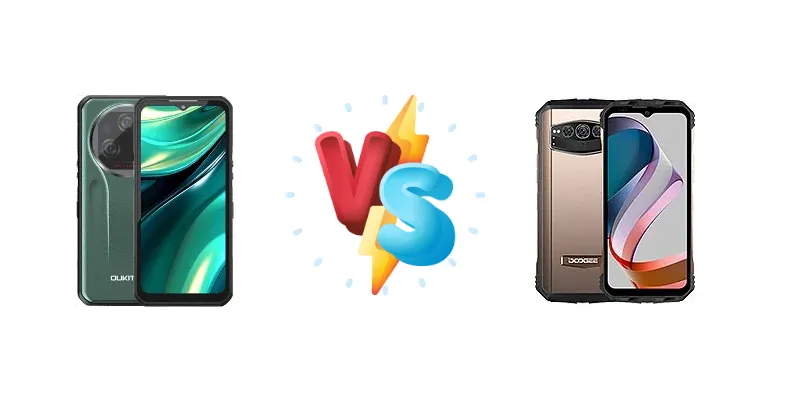
|
🏆 Quick Verdict
For users prioritizing all-day (and multi-day) battery life and a more affordable price point, the Oukitel WP39 Pro is the clear winner. However, those who demand faster performance for gaming or demanding applications and value quicker charging will find the Doogee V30T a more suitable choice.
| PHONES | ||
|---|---|---|
| Phone Names | Oukitel WP39 Pro | Doogee V30T |
| Network | ||
|---|---|---|
| 2G bands | GSM 850 / 900 / 1800 / 1900 | GSM 850 / 900 / 1800 / 1900 |
| 3G bands | HSDPA 800 / 850 / 900 / 1700(AWS) / 1900 / 2100 | HSDPA 800 / 850 / 900 / 1700(AWS) / 1900 / 2100 |
| 4G bands | 1, 2, 3, 4, 5, 7, 8, 12, 13, 17, 18, 19, 20, 25, 26, 28, 34, 38, 39, 40, 41, 66, 71 | 1, 2, 3, 4, 5, 7, 8, 12, 17, 18, 19, 20, 25, 26, 28, 34, 38, 39, 40, 41, 66 |
| 5G bands | 1, 2, 3, 5, 7, 8, 20, 28, 38, 40, 41, 66, 71, 77, 78 SA/NSA | 1, 3, 7, 28, 38, 41, 77, 78, 79 SA/NSA |
| Speed | HSPA, LTE, 5G | HSPA, LTE, 5G |
| Technology | GSM / HSPA / LTE / 5G | GSM / CDMA / HSPA / LTE / 5G |
| Launch | ||
|---|---|---|
| Announced | 2025, February 11 | 2023, April 16 |
| Status | Available. Released 2025, March 15 | Available. Released 2023, May |
| Body | ||
|---|---|---|
| Dimensions | 172.2 x 81 x 15.2 mm (6.78 x 3.19 x 0.60 in) | 178.4 x 83.1 x 17.8 mm (7.02 x 3.27 x 0.70 in) |
| SIM | Nano-SIM + Nano-SIM | Nano-SIM + Nano-SIM |
| Weight | 360 g (12.70 oz) | 376 g (13.26 oz) |
| Display | ||
|---|---|---|
| Protection | Corning Gorilla Glass 5, Mohs level 5 | Corning Gorilla Glass 5 |
| Resolution | 1080 x 2408 pixels, 20:9 ratio (~400 ppi density) | 1080 x 2408 pixels, 20:9 ratio (~401 ppi density) |
| Size | 6.6 inches, 104.9 cm2 (~75.2% screen-to-body ratio) | 6.58 inches, 104.3 cm2 (~70.4% screen-to-body ratio) |
| Type | IPS LCD, 450 nits | IPS LCD, 120Hz |
| Platform | ||
|---|---|---|
| CPU | Octa-core (2x2.2 GHz Cortex-A76 & 6x2.0 GHz Cortex-A55) | Octa-core (2x2.6 GHz Cortex-A78 & 6x2.0 GHz Cortex-A55) |
| Chipset | Mediatek Dimensity 6300 (6 nm) | Mediatek Dimensity 1080 (6 nm) |
| GPU | Mali-G57 MC2 | Mali-G68 MC4 |
| OS | Android 14 | Android 12 |
| Memory | ||
|---|---|---|
| Card slot | microSDXC (uses shared SIM slot) | microSDXC (uses shared SIM slot) |
| Internal | 512GB 12GB RAM | 256GB 12GB RAM |
| Main Camera | ||
|---|---|---|
| Features | LED flash, HDR, portrait, panorama | Dual-LED flash, HDR, panorama |
| Triple | 64 MP, f/1.9, (wide), 1/1.73", PDAF 8 MP, f/2.2, (night vision), AF 2 MP (macro) | 108 MP, f/1.8, (wide), 1/1.52", 0.7µm, PDAF, OIS 20 MP, f/1.8, (night vision), 2 infrared night vision lights 16 MP, f/2.2, 130˚ (ultrawide), AF |
| Video | 1440p@30fps | 4K@30fps, 1080p@30fps |
| Selfie camera | ||
|---|---|---|
| Single | 32 MP, f/2.2, (wide), 1/2.74" | 32 MP, f/1.8, (wide), 1/2.8", 0.8µm |
| Video | 1080p@30fps | 4K@30fps, 1080p@30fps |
| Sound | ||
|---|---|---|
| 35mm jack | No | No |
| Loudspeaker | Yes | Yes, with stereo speakers |
| Comms | ||
|---|---|---|
| Bluetooth | 5.2, A2DP, LE | 5.2, A2DP, LE |
| NFC | Yes | Yes (market/region dependent) |
| Positioning | GPS, GLONASS, GALILEO, BDS | GPS (L1+L5), GLONASS, GALILEO, BDS |
| Radio | FM radio | FM radio |
| USB | USB Type-C 2.0, OTG | USB Type-C 2.0, OTG |
| WLAN | Wi-Fi 802.11 a/b/g/n/ac, dual-band | Wi-Fi 802.11 a/b/g/n/ac/6, dual-band |
| Features | ||
|---|---|---|
| Sensors | Fingerprint (side-mounted), accelerometer, gyro, proximity, compass | Fingerprint (side-mounted), accelerometer, gyro, proximity, compass |
| Battery | ||
|---|---|---|
| Charging | 33W wired, 100% in 187 min Reverse wired | 66W wired, 55% in 30 min 15W wireless Reverse wired |
| Type | Li-Po 11000 mAh | 10800 mAh |
| Misc | ||
|---|---|---|
| Colors | Black, Grey, Green | Marble Black, Rose Gold, Galaxy Gray |
| Price | - | About 420 EUR |
| EU LABEL | ||
|---|---|---|
| Battery | 109:23h endurance, 1100 cycles | - |
| Energy | Class B | - |
| Free fall | Class A (270 falls) | - |
| Repairability | Class C | - |
Oukitel WP39 Pro
- Exceptional battery life (109:23h endurance)
- High battery cycle count (1100 cycles)
- More affordable price point (likely)
- Less powerful processor
- Slower charging speed (187 minutes to 100%)
Doogee V30T
- Faster processor (Dimensity 1080)
- Significantly faster charging (66W, 55% in 30 min)
- Wireless charging support (15W)
- Likely shorter battery life
- Potentially higher price
Display Comparison
Neither device provides display specifications in the provided data. However, given their rugged positioning, both likely utilize durable, scratch-resistant panels. The absence of LTPO technology suggests neither will offer adaptive refresh rates for power saving. Bezels are likely to be substantial on both to enhance drop protection. Color accuracy is likely a secondary concern compared to visibility in direct sunlight.
Camera Comparison
The provided data lacks camera specifications beyond the chipsets. Given the market segment, both phones likely feature multiple rear cameras, but image quality will heavily depend on sensor size and image processing algorithms. Without specific sensor details, it’s difficult to definitively declare a winner. However, the V30T’s more powerful chipset could enable more sophisticated image processing, potentially leading to better low-light performance and dynamic range. The inclusion of Optical Image Stabilization (OIS) on either device would be a significant advantage, but is unknown.
Performance
The Doogee V30T boasts a significant performance advantage thanks to its Mediatek Dimensity 1080 chipset, featuring 2x2.6 GHz Cortex-A78 cores compared to the Oukitel WP39 Pro’s Dimensity 6300 with 2x2.2 GHz Cortex-A76 cores. This translates to noticeably faster application loading times and smoother multitasking. While both chipsets are fabricated on a 6nm process, the A78 cores in the V30T offer superior single-core performance. The V30T’s chipset is better suited for graphically intensive tasks like gaming. The WP39 Pro’s Dimensity 6300 is still capable for everyday tasks, but will exhibit more lag under heavy load.
Battery Life
The Oukitel WP39 Pro shines in battery endurance, achieving an impressive 109:23h rating and supporting 1100 charge cycles, indicating long-term battery health. While the Doogee V30T’s battery capacity is not specified, its 66W charging capability is a major advantage, reaching 55% charge in just 30 minutes. The WP39 Pro’s 33W charging takes 187 minutes for a full charge. The WP39 Pro’s longevity is ideal for users who prioritize minimizing charging frequency, while the V30T offers the convenience of rapid top-ups.
Buying Guide
Buy the Oukitel WP39 Pro if you need a phone that can reliably last through extended outdoor adventures, work trips, or emergency situations without frequent charging. It’s ideal for users who value longevity over raw processing power. Buy the Doogee V30T if you prefer a smoother experience with more demanding apps, enjoy mobile gaming, and appreciate the convenience of significantly faster wired and wireless charging capabilities.