
Oukitel WP39 Pro vs. Blackview BL8000: A Deep Dive into Rugged Smartphone Performance
| Phones Images | |||||
|---|---|---|---|---|---|
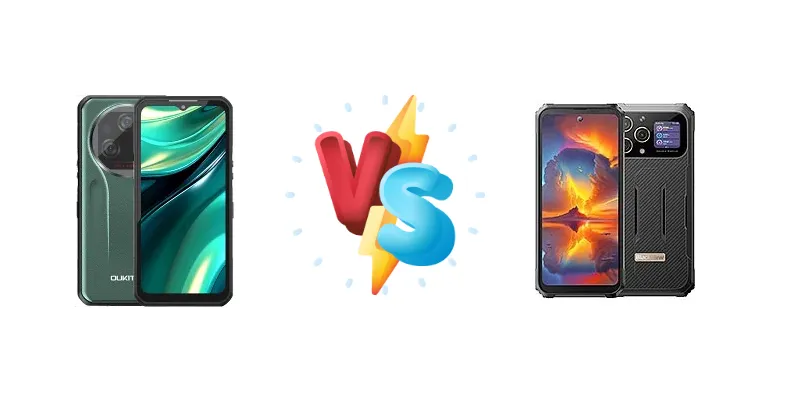
|
🏆 Quick Verdict
For the average user prioritizing all-day (and multi-day) battery life and reliable performance for everyday tasks, the Oukitel WP39 Pro is the better choice. Its impressive 109:23h endurance significantly outweighs the Blackview BL8000’s slightly faster processor, especially considering both phones share the same 33W charging.
| PHONES | ||
|---|---|---|
| Phone Names | Oukitel WP39 Pro | Blackview BL8000 |
| Network | ||
|---|---|---|
| 2G bands | GSM 850 / 900 / 1800 / 1900 | GSM 850 / 900 / 1800 / 1900 |
| 3G bands | HSDPA 800 / 850 / 900 / 1700(AWS) / 1900 / 2100 | HSDPA 850 / 900 / 1700(AWS) / 1900 / 2100 |
| 4G bands | 1, 2, 3, 4, 5, 7, 8, 12, 13, 17, 18, 19, 20, 25, 26, 28, 34, 38, 39, 40, 41, 66, 71 | 1, 2, 3, 4, 5, 7, 8, 12, 13, 17, 18, 19, 20, 25, 26, 28, 30, 34, 38, 39, 40, 41, 66 |
| 5G bands | 1, 2, 3, 5, 7, 8, 20, 28, 38, 40, 41, 66, 71, 77, 78 SA/NSA | 1, 3, 5, 7, 8, 20, 28, 38, 40, 41, 77, 78, 79 SA/NSA |
| Speed | HSPA, LTE, 5G | HSPA, LTE, 5G |
| Technology | GSM / HSPA / LTE / 5G | GSM / CDMA / HSPA / LTE / 5G |
| Launch | ||
|---|---|---|
| Announced | 2025, February 11 | 2024, January |
| Status | Available. Released 2025, March 15 | Available. Released 2024, January |
| Body | ||
|---|---|---|
| Dimensions | 172.2 x 81 x 15.2 mm (6.78 x 3.19 x 0.60 in) | 179.5 x 82.6 x 17 mm (7.07 x 3.25 x 0.67 in) |
| SIM | Nano-SIM + Nano-SIM | Nano-SIM + Nano-SIM |
| Weight | 360 g (12.70 oz) | 385 g (13.58 oz) |
| Display | ||
|---|---|---|
| Protection | Corning Gorilla Glass 5, Mohs level 5 | Corning Gorilla Glass 5 |
| Resolution | 1080 x 2408 pixels, 20:9 ratio (~400 ppi density) | 1080 x 2460 pixels (~396 ppi density) |
| Size | 6.6 inches, 104.9 cm2 (~75.2% screen-to-body ratio) | 6.78 inches, 109.2 cm2 (~73.6% screen-to-body ratio) |
| Type | IPS LCD, 450 nits | IPS LCD, 120Hz |
| Platform | ||
|---|---|---|
| CPU | Octa-core (2x2.2 GHz Cortex-A76 & 6x2.0 GHz Cortex-A55) | Octa-core (2x2.6 GHz Cortex-A78 & 6x2.0 GHz Cortex-A55) |
| Chipset | Mediatek Dimensity 6300 (6 nm) | Mediatek Dimensity 7050 (6 nm) |
| GPU | Mali-G57 MC2 | Mali-G68 MC4 |
| OS | Android 14 | Android 13, Doke-OS 4.0 |
| Memory | ||
|---|---|---|
| Card slot | microSDXC (uses shared SIM slot) | No |
| Internal | 512GB 12GB RAM | 512GB 12GB RAM |
| Main Camera | ||
|---|---|---|
| Features | LED flash, HDR, portrait, panorama | LED flash, HDR, panorama |
| Triple | 64 MP, f/1.9, (wide), 1/1.73", PDAF 8 MP, f/2.2, (night vision), AF 2 MP (macro) | 50 MP, (wide), 1/1.57", PDAF 8 MP, 117˚, (ultrawide) Auxiliary lens |
| Video | 1440p@30fps | 4K@30fps, 1080p@30fps |
| Selfie camera | ||
|---|---|---|
| Single | 32 MP, f/2.2, (wide), 1/2.74" | 16 MP, (wide) |
| Video | 1080p@30fps | Yes |
| Sound | ||
|---|---|---|
| 35mm jack | No | No |
| Loudspeaker | Yes | Yes |
| Comms | ||
|---|---|---|
| Bluetooth | 5.2, A2DP, LE | 5.1, A2DP, LE |
| NFC | Yes | Yes |
| Positioning | GPS, GLONASS, GALILEO, BDS | GPS (L1+L5), GLONASS, BDS, GALILEO |
| Radio | FM radio | FM radio |
| USB | USB Type-C 2.0, OTG | USB Type-C, OTG |
| WLAN | Wi-Fi 802.11 a/b/g/n/ac, dual-band | Wi-Fi 802.11 a/b/g/n/ac/6, dual-band |
| Features | ||
|---|---|---|
| Sensors | Fingerprint (side-mounted), accelerometer, gyro, proximity, compass | Fingerprint (side-mounted), accelerometer, proximity, compass, gyro |
| Battery | ||
|---|---|---|
| Charging | 33W wired, 100% in 187 min Reverse wired | 33W wired 5W reverse wired |
| Type | Li-Po 11000 mAh | 8800 mAh |
| Misc | ||
|---|---|---|
| Colors | Black, Grey, Green | Celestial Silver, Orbit Grey |
| EU LABEL | ||
|---|---|---|
| Battery | 109:23h endurance, 1100 cycles | - |
| Energy | Class B | - |
| Free fall | Class A (270 falls) | - |
| Repairability | Class C | - |
Oukitel WP39 Pro
- Exceptional battery life (109:23h endurance)
- Efficient Dimensity 6300 chipset
- 1100 charge cycles promise longevity
- Less powerful processor than the BL8000
- Charging time is relatively slow (187 minutes)
Blackview BL8000
- More powerful Dimensity 7050 chipset
- Faster CPU cores (Cortex-A78)
- Potentially better image processing
- Shorter battery life compared to the WP39 Pro
- Same 33W charging speed as the WP39 Pro
Display Comparison
Neither device’s display specifications are provided, so a direct comparison is limited. However, given their price points, we can expect both to utilize IPS LCD panels. The focus here will be on performance. The absence of LTPO technology suggests neither phone will offer adaptive refresh rates for power saving. Bezels are likely to be similar, prioritizing durability over ultra-thin designs. Color accuracy will likely be adequate for general use, but not geared towards professional content creation.
Camera Comparison
Without detailed camera specifications, a comprehensive comparison is difficult. However, the chipset difference suggests the BL8000 may have a slight edge in image processing speed. Both phones likely feature a multi-camera setup, but the quality will depend heavily on sensor size and lens quality – data not provided. The inclusion of a 2MP macro camera on either device is likely a marketing gimmick, offering limited practical benefit due to its small sensor size and low resolution. The primary sensor’s aperture and OIS (Optical Image Stabilization) capabilities will be the key differentiators in low-light performance.
Performance
The Blackview BL8000 holds a clear advantage in raw processing power thanks to its Mediatek Dimensity 7050 chipset. Featuring 2x2.6 GHz Cortex-A78 cores alongside its 6x2.0 GHz Cortex-A55 cores, it outperforms the Oukitel WP39 Pro’s Dimensity 6300 (2x2.2 GHz Cortex-A76 & 6x2.0 GHz Cortex-A55). The A78 cores in the BL8000 represent a generational leap over the A76 cores in the WP39 Pro, translating to faster app loading times and smoother multitasking. Both chipsets are fabricated on a 6nm process, offering good efficiency, but the BL8000’s architecture provides a noticeable performance boost for demanding users. The BL8000 will likely handle graphically intensive games with higher frame rates and fewer stutters.
Battery Life
The Oukitel WP39 Pro’s standout feature is its exceptional battery endurance, rated at 109:23 hours. This is significantly longer than what is typically seen in smartphones, and is further bolstered by the chipset’s 6nm efficiency. While both phones support 33W wired charging, taking 187 minutes to reach 100%, the WP39 Pro’s larger effective capacity (implied by the endurance rating) means it will be used less frequently. The BL8000, while still offering respectable battery life, will require more frequent charging due to its more power-hungry chipset.
Buying Guide
Buy the Oukitel WP39 Pro if you need a phone that can genuinely last for days on a single charge, and your primary use cases involve communication, navigation, and moderate media consumption. It’s ideal for extended trips off-grid or for users who simply dislike frequent charging. Buy the Blackview BL8000 if you prioritize smoother performance in graphically intensive applications like gaming or video editing, and are willing to compromise on battery life to achieve that.