
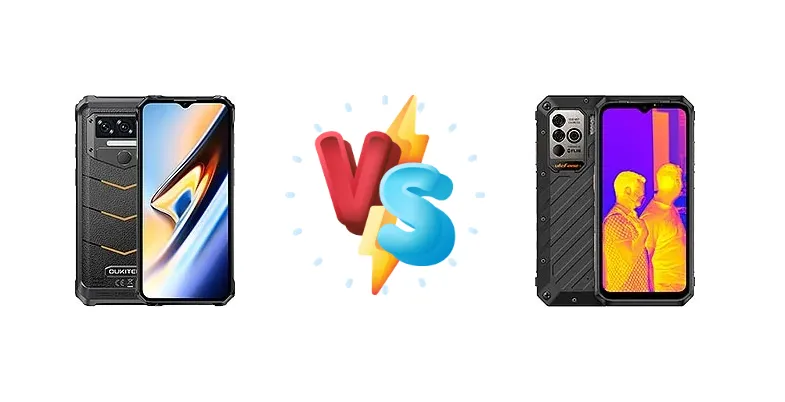
Oukitel WP38 vs. Ulefone Power Armor 19T: A Rugged Showdown
| Phones Images | |||||
|---|---|---|---|---|---|
|
🏆 Quick Verdict
For the average user prioritizing responsiveness and future-proofing, the Ulefone Power Armor 19T is the better choice. Its Helio G99 chipset and 66W charging significantly outperform the Oukitel WP38’s older hardware, despite the WP38’s exceptional battery longevity. However, those needing maximum uptime above all else will find the WP38 compelling.
| PHONES | ||
|---|---|---|
| Phone Names | Oukitel WP38 | Ulefone Power Armor 19T |
| Network | ||
|---|---|---|
| 2G bands | GSM 850 / 900 / 1800 / 1900 | GSM 850 / 900 / 1800 / 1900 |
| 3G bands | HSDPA 800 / 850 / 900 / 1700(AWS) / 1900 / 2100 | HSDPA 800 / 850 / 900 / 1700(AWS) / 1900 / 2100 |
| 4G bands | 1, 2, 3, 4, 5, 7, 8, 12, 17, 18, 19, 20, 25, 26, 28, 38, 39, 40, 41, 66 | 1, 2, 3, 4, 5, 7, 8, 12, 13, 17, 18, 19, 20, 25, 26, 28, 34, 38, 39, 40, 41, 66, 71 |
| Speed | HSPA, LTE | HSPA, LTE |
| Technology | GSM / HSPA / LTE | GSM / CDMA / HSPA / CDMA2000 / LTE |
| - | CDMA2000 1x | |
| Launch | ||
|---|---|---|
| Announced | 2024, May | 2023, March 06 |
| Status | Available. Released 2024, June | Available. Released 2023, March 06 |
| Body | ||
|---|---|---|
| Dimensions | 172.2 x 80.7 x 17.1 mm (6.78 x 3.18 x 0.67 in) | 175.2 x 83.4 x 18.8 mm (6.90 x 3.28 x 0.74 in) |
| SIM | Nano-SIM | Nano-SIM + Nano-SIM |
| Weight | 366 g (12.91 oz) | 409 g (14.43 oz) |
| - | IP68/IP69K dust/water resistant (up to 1.5m for 30 min) Drop-to-concrete resistance from up to 1.5m MIL-STD-810H compliant Accessory connector (ulefone endoscope, microscope) | |
| Display | ||
|---|---|---|
| Protection | Corning Gorilla Glass 5, Mohs level 5 | Corning Gorilla Glass 5 |
| Resolution | 720 x 1600 pixels, 20:9 ratio (~269 ppi density) | 1080 x 2408 pixels, 20:9 ratio (~401 ppi density) |
| Size | 6.52 inches, 102.6 cm2 (~73.9% screen-to-body ratio) | 6.58 inches, 104.3 cm2 (~71.4% screen-to-body ratio) |
| Type | IPS LCD, 400 nits | IPS LCD, 120Hz |
| Platform | ||
|---|---|---|
| CPU | Octa-core (4x2.0 GHz Cortex-A73 & 4x2.0 GHz Cortex-A53) | Octa-core (2x2.2 GHz Cortex-A76 & 6x2.0 GHz Cortex-A55) |
| Chipset | Mediatek MT8788 (12 nm) | Mediatek Helio G99 (6 nm) |
| GPU | Mali-G72 MP3 | Mali-G57 MC2 |
| OS | Android 13 | Android 12 |
| Memory | ||
|---|---|---|
| Card slot | No | microSDXC (uses shared SIM slot) |
| Internal | 256GB 6GB RAM | 256GB 12GB RAM |
| Main Camera | ||
|---|---|---|
| Dual | 13 MP, f/2.2, (wide), 1/3.1", AF 2 MP (macro) | - |
| Features | LED flash, panorama | Hexa-LED flash, HDR, panorama |
| Triple | - | 108 MP, f/1.9, (wide), 1/1.52", 0.7µm, PDAF 5 MP (macro) FLIR thermal camera (Lepton module) 5 MP (for thermal module) |
| Video | 1080p@30fps | 1440p@30fps, 1080p@30fps |
| Selfie camera | ||
|---|---|---|
| Single | 5 MP, f/2.2, (wide), 1/2.74" | 16 MP, f/2.0, (wide), 1.0µm |
| Video | 1080p@30fps | 1080p@30fps |
| Sound | ||
|---|---|---|
| 3.5mm jack | - | Yes |
| 35mm jack | No | Yes |
| Loudspeaker | Yes | Yes |
| Comms | ||
|---|---|---|
| Bluetooth | 4.2, A2DP | 5.2, A2DP, LE |
| NFC | Yes | Yes |
| Positioning | GPS, GLONASS, GALILEO | GPS, GLONASS, GALILEO, BDS |
| Radio | FM radio | Wireless FM radio, RDS, recording |
| USB | USB Type-C 2.0, OTG | USB Type-C 2.0, OTG, magnetic connector |
| WLAN | Wi-Fi 802.11 a/b/g/n/ac, dual-band | Wi-Fi 802.11 a/b/g/n/ac, dual-band |
| Features | ||
|---|---|---|
| Sensors | Fingerprint (rear-mounted), accelerometer, proximity, compass | Fingerprint (side-mounted), accelerometer, gyro, proximity, compass |
| Battery | ||
|---|---|---|
| Charging | 18W wired | 66W wired, 52% in 30 min 15W wireless 5W wireless reversed |
| Type | Li-Po 10600 mAh | Li-Po 9600 mAh |
| Misc | ||
|---|---|---|
| Colors | Black, Gray, Green | Black |
| Price | - | About 440 EUR |
| EU LABEL | ||
|---|---|---|
| Battery | 102:32h endurance, 1000 cycles | - |
| Energy | Class B | - |
| Free fall | Class A (270 falls) | - |
| Repairability | Class C | - |
Oukitel WP38
- Exceptional battery endurance (102:32h)
- Long-term battery health with 1000 charge cycles
- Rugged design for demanding environments
- Outdated chipset (MT8788)
- Slow charging speed (18W)
- Likely lower performance in demanding tasks
Ulefone Power Armor 19T
- Faster and more efficient chipset (Helio G99)
- Ultra-fast 66W wired charging (52% in 30min)
- Wireless and reverse wireless charging capabilities
- Potentially shorter battery life compared to WP38
- May run warmer under sustained load
- Higher price point (likely)
Display Comparison
Neither device’s display specifications are provided, so a direct comparison is limited. However, given the price points, we can assume both utilize IPS LCD panels. The focus here shifts to performance. The WP38’s older chipset will likely struggle with smooth animations and high refresh rates, if supported at all. The 19T’s Helio G99, built on a 6nm process, offers a more modern foundation for a fluid visual experience.
Camera Comparison
Without detailed camera specifications, a precise comparison is impossible. However, the chipset difference suggests the 19T will have a more capable image signal processor (ISP), leading to better image processing, noise reduction, and dynamic range. The WP38’s older chipset will likely result in slower image capture and less sophisticated post-processing. We anticipate the 19T will handle low-light photography more effectively.
Performance
The Ulefone Power Armor 19T’s Mediatek Helio G99 represents a significant leap in performance over the Oukitel WP38’s MT8788. The G99 utilizes a more modern CPU architecture (2x2.2 GHz Cortex-A76 & 6x2.0 GHz Cortex-A55) compared to the WP38’s (4x2.0 GHz Cortex-A73 & 4x2.0 GHz Cortex-A53). Crucially, the 6nm fabrication process of the G99 provides superior power efficiency and thermal management, reducing throttling during sustained workloads. This translates to faster app launches, smoother multitasking, and a more enjoyable gaming experience on the 19T.
Battery Life
The Oukitel WP38 boasts an impressive 102:32h endurance rating, suggesting exceptional battery life. However, the Ulefone Power Armor 19T compensates with its 66W wired charging, capable of reaching 52% charge in just 30 minutes. While the WP38’s 18W charging is adequate, it pales in comparison. The 19T also includes 15W wireless and 5W reverse wireless charging, adding versatility. The WP38’s 1000 charge cycles suggest a focus on long-term battery health, but the 19T’s faster charging mitigates the need for frequent top-ups, potentially reducing overall cycle count.
Buying Guide
Buy the Oukitel WP38 if you need a phone that can genuinely last for days on a single charge, and aren't heavily reliant on demanding applications. It’s ideal for extended trips off-grid or situations where access to power is limited. Buy the Ulefone Power Armor 19T if you prefer a smoother, more responsive user experience, faster app loading times, and the convenience of incredibly quick charging – perfect for users who need a powerful, reliable device for work and play.