
Oukitel WP38 vs Blackview BV9300: A Deep Dive into Rugged Smartphone Performance
| Phones Images | |||||
|---|---|---|---|---|---|
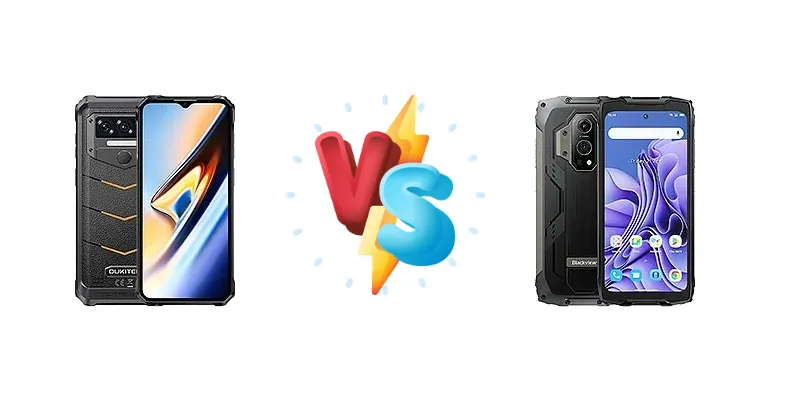
|
🏆 Quick Verdict
For the average user prioritizing performance and faster charging, the Blackview BV9300 is the clear winner. Its Helio G99 chipset delivers a noticeable upgrade over the WP38’s MT8788. However, if maximizing battery life and longevity is paramount, the Oukitel WP38’s impressive endurance and 1000-cycle battery life make it a strong contender.
| PHONES | ||
|---|---|---|
| Phone Names | Oukitel WP38 | Blackview BV9300 |
| Network | ||
|---|---|---|
| 2G bands | GSM 850 / 900 / 1800 / 1900 | GSM 850 / 900 / 1800 / 1900 |
| 3G bands | HSDPA 800 / 850 / 900 / 1700(AWS) / 1900 / 2100 | HSDPA 850 / 900 / 1700(AWS) / 1900 / 2100 |
| 4G bands | 1, 2, 3, 4, 5, 7, 8, 12, 17, 18, 19, 20, 25, 26, 28, 38, 39, 40, 41, 66 | 1, 2, 3, 4, 5, 7, 8, 12, 13, 17, 18, 19, 20, 25, 26, 28, 30, 34, 38, 39, 40, 41, 66 |
| Speed | HSPA, LTE | HSPA, LTE |
| Technology | GSM / HSPA / LTE | GSM / CDMA / HSPA / LTE |
| - | CDMA 800 / 1900 | |
| Launch | ||
|---|---|---|
| Announced | 2024, May | 2023, May 10 |
| Status | Available. Released 2024, June | Available. Released 2023, May 10 |
| Body | ||
|---|---|---|
| Dimensions | 172.2 x 80.7 x 17.1 mm (6.78 x 3.18 x 0.67 in) | 184.6 x 85.6 x 22.8 mm (7.27 x 3.37 x 0.90 in) |
| SIM | Nano-SIM | Nano-SIM + Nano-SIM |
| Weight | 366 g (12.91 oz) | 520 g (1.15 lb) |
| - | IP68/IP69K dust/water resistant (up to 1.5m for 30 min) Drop-to-concrete resistance from up to 1.8m MIL-STD-810H compliant Laser rangefinder (up to 40m) Dedicated flashlight (100 lumens) | |
| Display | ||
|---|---|---|
| Protection | Corning Gorilla Glass 5, Mohs level 5 | Corning Gorilla Glass 5 |
| Resolution | 720 x 1600 pixels, 20:9 ratio (~269 ppi density) | 1080 x 2388 pixels (~391 ppi density) |
| Size | 6.52 inches, 102.6 cm2 (~73.9% screen-to-body ratio) | 6.7 inches, 108.7 cm2 (~68.8% screen-to-body ratio) |
| Type | IPS LCD, 400 nits | IPS LCD, 120Hz |
| Platform | ||
|---|---|---|
| CPU | Octa-core (4x2.0 GHz Cortex-A73 & 4x2.0 GHz Cortex-A53) | Octa-core (2x2.2 GHz Cortex-A76 & 6x2.0 GHz Cortex-A55) |
| Chipset | Mediatek MT8788 (12 nm) | Mediatek Helio G99 (6 nm) |
| GPU | Mali-G72 MP3 | Mali-G57 MC2 |
| OS | Android 13 | Android 12, Doke-OS 3.1 |
| Memory | ||
|---|---|---|
| Card slot | No | microSDXC (uses shared SIM slot) |
| Internal | 256GB 6GB RAM | 256GB 12GB RAM |
| - | UFS 2.1 | |
| Main Camera | ||
|---|---|---|
| Dual | 13 MP, f/2.2, (wide), 1/3.1", AF 2 MP (macro) | - |
| Features | LED flash, panorama | LED flash, HDR, panorama |
| Triple | - | 50 MP, (wide), 1/2.76", 0.64µm, PDAF 8 MP, 120˚, (ultrawide), AF Auxiliary lens |
| Video | 1080p@30fps | 1440p@30fps, 1080p@30fps |
| Selfie camera | ||
|---|---|---|
| Single | 5 MP, f/2.2, (wide), 1/2.74" | 32 MP, (wide) |
| Video | 1080p@30fps | 1080p |
| Sound | ||
|---|---|---|
| 3.5mm jack | - | No |
| 35mm jack | No | No |
| Loudspeaker | Yes | Yes |
| Comms | ||
|---|---|---|
| Bluetooth | 4.2, A2DP | 5.2, A2DP, LE |
| NFC | Yes | Yes |
| Positioning | GPS, GLONASS, GALILEO | GPS, GLONASS, GALILEO, BDS |
| Radio | FM radio | FM radio |
| USB | USB Type-C 2.0, OTG | USB Type-C, OTG |
| WLAN | Wi-Fi 802.11 a/b/g/n/ac, dual-band | Wi-Fi 802.11 a/b/g/n/ac, dual-band |
| Features | ||
|---|---|---|
| Sensors | Fingerprint (rear-mounted), accelerometer, proximity, compass | Fingerprint (side-mounted), accelerometer, proximity, compass |
| Battery | ||
|---|---|---|
| Charging | 18W wired | 33W wired 5W reverse wired |
| Type | Li-Po 10600 mAh | 15080 mAh |
| Misc | ||
|---|---|---|
| Colors | Black, Gray, Green | Black, Orange, Green |
| Price | - | About 390 EUR |
| EU LABEL | ||
|---|---|---|
| Battery | 102:32h endurance, 1000 cycles | - |
| Energy | Class B | - |
| Free fall | Class A (270 falls) | - |
| Repairability | Class C | - |
Oukitel WP38
- Exceptional battery life (102.32h endurance)
- Long battery lifespan (1000 charge cycles)
- Rugged build quality (implied by brand)
- Older, less powerful chipset (MT8788)
- Slower charging speed (18W)
- Potentially limited gaming performance
Blackview BV9300
- More powerful chipset (Helio G99)
- Faster charging (33W wired + 5W reverse)
- Improved thermal efficiency (6nm process)
- Likely shorter battery life compared to WP38
- Battery lifespan may be shorter than WP38
- Potentially higher price
Display Comparison
Neither device’s display specifications are provided, so a direct comparison is limited. However, given the price points, we can assume both utilize IPS LCD panels. The BV9300’s more modern chipset suggests a potentially higher refresh rate, contributing to smoother visuals. The WP38 likely prioritizes power efficiency over display fidelity.
Camera Comparison
Without detailed camera specifications, a precise comparison is difficult. However, the chipset difference indirectly impacts camera performance. The BV9300’s Helio G99 includes a more capable image signal processor (ISP), enabling faster image processing and potentially better low-light performance. The WP38’s MT8788 ISP is older and less efficient. Both phones likely include multiple cameras, but the quality of those sensors will be the determining factor, and that data is unavailable.
Performance
The Blackview BV9300’s Mediatek Helio G99 (6nm) represents a significant leap in performance over the Oukitel WP38’s Mediatek MT8788 (12nm). The G99’s Cortex-A76 cores, clocked at 2.2 GHz, outperform the WP38’s Cortex-A73 cores at 2.0 GHz. The 6nm process node also translates to improved thermal efficiency, reducing throttling during sustained workloads. This means the BV9300 will handle gaming and demanding apps with greater ease. The WP38’s chipset is adequate for everyday tasks, but will struggle with more intensive applications.
Battery Life
The Oukitel WP38 boasts an impressive 102.32-hour endurance rating, suggesting exceptional battery life. While the BV9300’s battery capacity isn’t specified, its more powerful chipset will consume more energy. However, the BV9300 compensates with 33W wired charging, significantly faster than the WP38’s 18W charging. The WP38’s 1000 charge cycles also indicate a longer lifespan for the battery itself. The BV9300 also offers 5W reverse wired charging, a feature absent on the WP38, allowing it to charge smaller accessories.
Buying Guide
Buy the Oukitel WP38 if you need a phone that can genuinely last for days on a single charge, and you primarily use it for basic tasks like communication and navigation. It’s ideal for extended trips off-grid or for professionals who require reliable connectivity without frequent charging. Buy the Blackview BV9300 if you prefer a smoother, more responsive experience for gaming, multitasking, and demanding applications. The faster charging and more modern chipset make it a better choice for power users and those who value performance.