
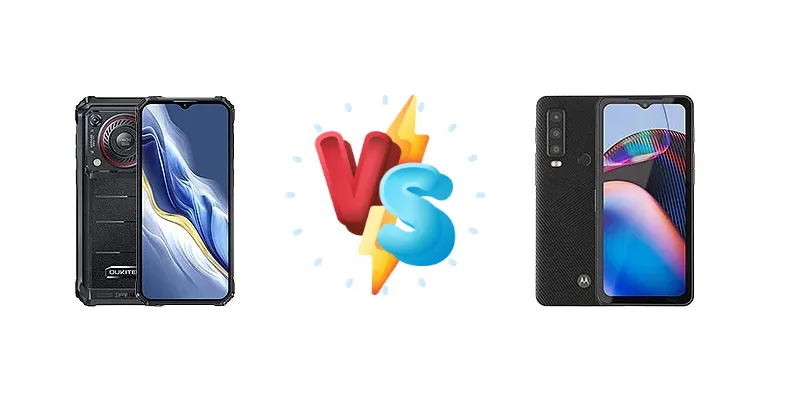
Oukitel WP36 vs. Motorola Defy 2: A Deep Dive into Rugged Smartphone Choices
| Phones Images | |||||
|---|---|---|---|---|---|
|
🏆 Quick Verdict
For users prioritizing longevity and off-grid capability, the Oukitel WP36 is the clear winner, boasting exceptional battery life. However, the Motorola Defy 2 delivers a far smoother and more responsive experience thanks to its Dimensity 930 chipset, making it ideal for users who demand performance.
| PHONES | ||
|---|---|---|
| Phone Names | Oukitel WP36 | Motorola Defy 2 |
| Network | ||
|---|---|---|
| 2G bands | GSM 850 / 900 / 1800 / 1900 | GSM 850 / 900 / 1800 / 1900 |
| 3G bands | HSDPA 850 / 900 / 1700(AWS) / 1900 / 2100 | HSDPA 850 / 900 / 1700(AWS) / 1900 / 2100 |
| 4G bands | 1, 2, 3, 4, 5, 7, 8, 12, 17, 18, 19, 20, 25, 26, 28, 38, 39, 40, 41, 66 | 1, 2, 3, 4, 5, 7, 8, 12, 13, 14, 17, 20, 25, 26, 28, 30, 38, 40, 41, 46, 48, 66, 71 |
| 5G bands | - | 2, 5, 23, 25, 26, 28, 38, 41, 48, 66, 70, 71, 77, 78, 255, 256 SA/NSA/Sub6/mmWave |
| Speed | HSPA, LTE | HSPA, LTE, 5G |
| Technology | GSM / CDMA / HSPA / LTE | GSM / HSPA / LTE / 5G |
| Launch | ||
|---|---|---|
| Announced | 2024, January 06 | 2023, February 24 |
| Status | Available. Released 2024, January | Available. Released 2023, October |
| Body | ||
|---|---|---|
| Build | - | Glass front (Gorilla Glass Victus), plastic back, aluminum frame |
| Dimensions | 172.2 x 80.7 x 19.1 mm (6.78 x 3.18 x 0.75 in) | 171 x 80 x 11.9 mm (6.73 x 3.15 x 0.47 in) |
| SIM | Nano-SIM + Nano-SIM | Nano-SIM + Nano-SIM |
| Weight | 393.7 g (13.90 oz) | 268 g (9.45 oz) |
| - | IP68/IP69 dust/water resistant (up to 5m for 35 min) Drop-to-concrete resistance from up to 1.8m MIL-STD-810H compliant | |
| Display | ||
|---|---|---|
| Protection | Corning Gorilla Glass 5, Mohs level 5 | Corning Gorilla Glass Victus |
| Resolution | 720 x 1600 pixels, 20:9 ratio (~269 ppi density) | 1080 x 2408 pixels, 20:9 ratio (~400 ppi density) |
| Size | 6.52 inches, 102.6 cm2 (~73.9% screen-to-body ratio) | 6.6 inches, 104.9 cm2 (~76.7% screen-to-body ratio) |
| Type | IPS LCD, 400 nits | IPS LCD, 120Hz |
| Platform | ||
|---|---|---|
| CPU | Octa-core (4x2.0 GHz Cortex-A73 & 4x2.0 GHz Cortex-A53) | Octa-core (2x2.2 GHz Cortex-A78 & 6x2.0 GHz Cortex-A55) |
| Chipset | Mediatek MT8788 (12 nm) | Mediatek Dimensity 930 (6 nm) |
| GPU | Mali-G72 MP3 | IMG BXM-8-256 |
| OS | Android 13 | Android 12 |
| Memory | ||
|---|---|---|
| Card slot | microSDXC (uses shared SIM slot) | microSDXC (uses shared SIM slot) |
| Internal | 128GB 8GB RAM | 128GB 6GB RAM |
| Main Camera | ||
|---|---|---|
| Dual | 13 MP, f/2.2, (wide), 1/3.1", AF 2 MP (macro) | - |
| Features | LED flash | Dual-LED flash, HDR, panorama |
| Triple | - | 50 MP, f/1.8, (wide), PDAF 8 MP, f/2.2, (ultrawide) 2 MP (macro) |
| Video | 1080p@30fps | 1080p@30fps |
| Selfie camera | ||
|---|---|---|
| Single | 5 MP, f/2.2, (wide), 1/5.0" | 8 MP, f/2.0, (wide) |
| Video | 1080p@30fps | 1080p@30fps |
| Sound | ||
|---|---|---|
| 3.5mm jack | - | No |
| 35mm jack | No | No |
| Loudspeaker | Yes (128 dB, 3.5W peak) | Yes |
| Comms | ||
|---|---|---|
| Bluetooth | 4.2, A2DP | 5.1, A2DP, LE |
| NFC | Yes | Yes |
| Positioning | GPS, GLONASS, GALILEO, BDS | GPS (L1+L5), GLONASS, GALILEO, BDS |
| Radio | FM radio | Unspecified |
| USB | USB Type-C 2.0, OTG | USB Type-C 2.0, OTG |
| WLAN | Wi-Fi 802.11 a/b/g/n/ac, dual-band | Wi-Fi 802.11 a/b/g/n/ac, dual-band |
| Features | ||
|---|---|---|
| Sensors | Fingerprint (side-mounted), accelerometer, gyro, proximity, compass | Fingerprint (rear-mounted), accelerometer, gyro, proximity, compass |
| - | Emergency SOS via satellite (Bullitt Satellite Connect service) | |
| Battery | ||
|---|---|---|
| Charging | 15W wired Reverse wired | 15W wireless |
| Type | Li-Po 10600 mAh | Li-Po 5000 mAh |
| Misc | ||
|---|---|---|
| Colors | Black, | Black |
| Models | - | BM1S1B |
| Price | About 190 EUR | About 570 EUR |
| EU LABEL | ||
|---|---|---|
| Battery | 101:19h endurance, 1000 cycles | - |
| Energy | Class B | - |
| Free fall | Class A (270 falls) | - |
| Repairability | Class C | - |
Oukitel WP36
- Exceptional battery life (101:19h endurance)
- Robust and durable construction
- Reverse wired charging capability
- Outdated and less powerful chipset
- Slow 15W wired charging
Motorola Defy 2
- Powerful Mediatek Dimensity 930 chipset
- 6nm process for improved efficiency
- Convenient 15W wireless charging
- Likely shorter battery life than WP36
- Potentially higher price point
Display Comparison
Neither device provides display specifications, but given the market positioning, we can infer differences. The WP36 likely utilizes a standard LCD panel focused on visibility and durability, while the Defy 2, aiming for a more premium feel, may incorporate a higher-quality panel. The absence of LTPO technology on either suggests neither will offer adaptive refresh rates for power saving. Bezels are likely substantial on the WP36 to enhance drop protection, while the Defy 2 may prioritize a slightly more modern aesthetic.
Camera Comparison
Without detailed camera specs, a direct comparison is difficult. However, the chipset difference suggests the Defy 2 will have a more capable image signal processor (ISP), leading to better image processing and low-light performance. The WP36 likely relies on software optimization to compensate for a less powerful ISP. The presence of a 2MP macro camera on the WP36 is likely a marketing feature with limited real-world utility, while the Defy 2’s camera system is expected to be more focused on overall image quality and versatility.
Performance
The performance gap is substantial. The Motorola Defy 2’s Mediatek Dimensity 930 (6nm) represents a significant leap over the Oukitel WP36’s Mediatek MT8788 (12nm). The Dimensity 930’s Cortex-A78 cores, clocked at 2.2 GHz, offer considerably more processing power than the WP36’s Cortex-A73 cores at 2.0 GHz. The 6nm process node also translates to improved thermal efficiency, meaning the Defy 2 is less likely to throttle under sustained load. This benefits users engaging in multitasking, gaming, or demanding applications. The WP36 will handle basic tasks adequately, but will struggle with more intensive workloads.
Battery Life
The Oukitel WP36’s standout feature is its exceptional battery endurance, rated at 101:19h. This is likely achieved through a large battery capacity and the relatively power-efficient MT8788 chipset. While the Defy 2 lacks specific battery capacity information, its more powerful Dimensity 930 will consume more power. The WP36’s 15W wired charging is slow by modern standards, but the focus is on maximizing runtime, not rapid replenishment. The Defy 2 compensates with 15W wireless charging, offering convenience, and also supports reverse wired charging, allowing it to act as a power bank for other devices.
Buying Guide
Buy the Oukitel WP36 if you need a phone that can last for days on a single charge, are frequently in environments where power access is limited, and prioritize a truly rugged design above all else. Buy the Motorola Defy 2 if you prefer a more responsive and capable device for everyday tasks, streaming, and light gaming, and value the convenience of wireless charging.