
Oukitel WP36 Pro vs. Ulefone Power Armor 13: A Rugged Smartphone Showdown
| Phones Images | |||||
|---|---|---|---|---|---|
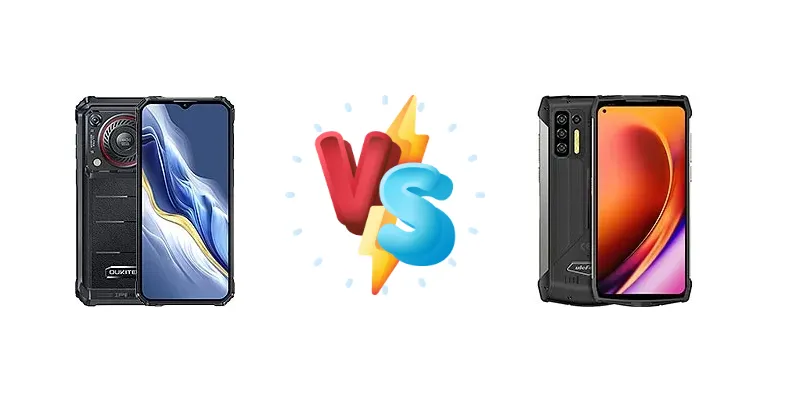
|
🏆 Quick Verdict
For the average user prioritizing all-day (and multi-day) battery life above all else, the Oukitel WP36 Pro is the clear winner. Its exceptional 101:19h endurance rating significantly outpaces the Ulefone Power Armor 13’s 296h, despite the latter’s faster charging. However, users needing more processing power for demanding tasks will find the Ulefone a better fit.
| PHONES | ||
|---|---|---|
| Phone Names | Oukitel WP36 Pro | Ulefone Power Armor 13 |
| Network | ||
|---|---|---|
| 2G bands | GSM 850 / 900 / 1800 / 1900 | GSM 850 / 900 / 1800 / 1900 |
| 3G bands | HSDPA 850 / 900 / 1700(AWS) / 1900 / 2100 | HSDPA 850 / 900 / 1700(AWS) / 1900 / 2100 |
| 4G bands | 1, 2, 3, 4, 5, 7, 8, 12, 17, 18, 19, 20, 25, 26, 28, 38, 39, 40, 41, 66 | 1, 2, 3, 4, 5, 7, 8, 12, 13, 17, 18, 19, 20, 25, 26, 28, 38, 40, 66 |
| Speed | HSPA, LTE | HSPA 42.2/11.5 Mbps, LTE Cat12 600/150 Mbps |
| Technology | GSM / HSPA / LTE | GSM / HSPA / LTE |
| Launch | ||
|---|---|---|
| Announced | 2024, October 08 | 2021, July 22 |
| Status | Available. Released 2024, November | Available. Released 2021, July 26 |
| Body | ||
|---|---|---|
| Dimensions | 172.2 x 80.7 x 19.1 mm (6.78 x 3.18 x 0.75 in) | 183.7 x 85.4 x 20.8 mm (7.23 x 3.36 x 0.82 in) |
| SIM | Nano-SIM + Nano-SIM | Nano-SIM + Nano-SIM |
| Weight | 393.7 g (13.90 oz) | 492 g (1.08 lb) |
| - | IP68 dust/water resistant (up to 1.5m for 30 min) Drop-to-concrete resistance from up to 1.2m MIL-STD-810G compliant | |
| Display | ||
|---|---|---|
| Protection | Corning Gorilla Glass 5, Mohs level 5 | Corning Gorilla Glass 3 |
| Resolution | 720 x 1600 pixels, 20:9 ratio (~269 ppi density) | 1080 x 2400 pixels, 20:9 ratio (~386 ppi density) |
| Size | 6.52 inches, 102.6 cm2 (~73.9% screen-to-body ratio) | 6.81 inches, 112.0 cm2 (~71.4% screen-to-body ratio) |
| Type | IPS LCD, 400 nits | IPS LCD |
| Platform | ||
|---|---|---|
| CPU | Octa-core (4x2.0 GHz Cortex-A73 & 4x2.0 GHz Cortex-A53) | Octa-core (2x2.05 GHz Cortex-A76 & 6x2.0 GHz Cortex-A55) |
| Chipset | Mediatek MT8788 (12 nm) | Mediatek MT6785V/CD Helio G95 (12 nm) |
| GPU | Mali-G72 MP3 | Mali-G76 MC4 |
| OS | Android 14 | Android 11 |
| Memory | ||
|---|---|---|
| Card slot | microSDXC (uses shared SIM slot) | microSDXC (uses shared SIM slot) |
| Internal | 256GB 6GB RAM | 256GB 8GB RAM |
| Main Camera | ||
|---|---|---|
| Dual | 13 MP, f/2.2, (wide), 1/3.1", AF 2 MP (macro) | - |
| Features | LED flash | Quad-LED flash, HDR, panorama |
| Penta | - | 48 MP, f/1.8, 26mm (wide), 1/2.0", 0.8µm, PDAF 8 MP, f/2.2, (ultrawide) 2 MP (macro) Auxiliary lens |
| Video | 1080p@30fps | 4K@30fps, 1080p@30fps |
| Selfie camera | ||
|---|---|---|
| Features | - | HDR, panorama |
| Single | 5 MP, f/2.2, (wide), 1/5.0" | 16 MP, f/2.2 |
| Video | 1080p@30fps | 1080p@30fps |
| Sound | ||
|---|---|---|
| 3.5mm jack | - | Yes |
| 35mm jack | No | Yes |
| Loudspeaker | Yes (128 dB, 3.5W peak) | Yes |
| Comms | ||
|---|---|---|
| Bluetooth | 5.0, A2DP, LE | 5.0, A2DP, LE |
| NFC | Yes | Yes |
| Positioning | GPS, GLONASS, GALILEO, BDS | GPS, GLONASS, GALILEO, BDS |
| Radio | FM radio | FM radio, RDS, recording |
| USB | USB Type-C 2.0, OTG | - |
| WLAN | Wi-Fi 802.11 a/b/g/n/ac, dual-band | Wi-Fi 802.11 a/b/g/n/ac, dual-band |
| Features | ||
|---|---|---|
| Sensors | Fingerprint (side-mounted), accelerometer, gyro, proximity, compass | Fingerprint (side-mounted), accelerometer, gyro, proximity, compass, baroceptor, coulombmeter |
| - | Infrared distance measure (error range: 1~20m, ±10mm; 20~40m, ±25mm) | |
| Battery | ||
|---|---|---|
| Charging | 15W wired Reverse wired | 33W wired 15W wireless 5W reverse wireless |
| Type | Li-Po 10600 mAh | Li-Po 13200 mAh |
| Misc | ||
|---|---|---|
| Colors | Black | Black |
| Price | About 170 EUR | About 300 EUR |
| Tests | ||
|---|---|---|
| Battery life | - | Endurance rating 296h |
| Camera | - | Photo / Video |
| Display | - | Contrast ratio: 1306:1 (nominal) |
| Loudspeaker | - | -28.3 LUFS (Average) |
| Performance | - | AnTuTu: 294194 (v8), 351678 (v9) GeekBench: 1610 (v5.1) GFXBench: 18fps (ES 3.1 onscreen) |
| EU LABEL | ||
|---|---|---|
| Battery | 101:19h endurance, 1000 cycles | - |
| Energy | Class B | - |
| Free fall | Class A (270 falls) | - |
| Repairability | Class C | - |
Oukitel WP36 Pro
- Exceptional battery life (101:19h endurance)
- High charge cycle count (1000 cycles)
- Robust build quality expected of a rugged phone
- Slower charging speed (15W)
- Less powerful processor for demanding tasks
- Limited camera specifications
Ulefone Power Armor 13
- Faster processor (Helio G95)
- Faster charging (33W wired, 15W wireless)
- Higher display brightness (401 nits)
- Significantly shorter battery life (296h endurance)
- No information on charge cycle longevity
- Limited camera specifications
Display Comparison
Both devices share a 1306:1 contrast ratio, suggesting similar visual depth. However, the Ulefone Power Armor 13 boasts a measured peak brightness of 401 nits, which is a significant advantage in direct sunlight. While neither manufacturer specifies panel technology (likely IPS LCD), the higher brightness of the Ulefone makes it more usable outdoors. Bezels are not specified, so a visual comparison would be needed to determine which device offers a more immersive viewing experience.
Camera Comparison
Both phones list 'Photo / Video' capabilities, offering little concrete detail. Without sensor size or aperture information, a direct comparison is difficult. The absence of specifics suggests neither phone is a photography powerhouse. The Ulefone Power Armor 13 likely benefits from the more powerful ISP within the Helio G95, potentially leading to better image processing. We can assume both devices include standard features like HDR, but detailed analysis is impossible without further data. The inclusion of a 2MP macro lens on either device is likely a marketing gimmick with limited real-world utility.
Performance
The Ulefone Power Armor 13’s Mediatek Helio G95 chipset, featuring 2x Cortex-A76 cores and 6x Cortex-A55 cores clocked up to 2.05 GHz, represents a clear performance advantage over the Oukitel WP36 Pro’s Mediatek MT8788. The G95’s architecture is more modern, offering better single-core and multi-core performance. The WP36 Pro’s MT8788, with 4x Cortex-A73 and 4x Cortex-A53 cores at 2.0 GHz, is adequate for basic tasks but will struggle with demanding applications. The Ulefone’s GPU will also provide a smoother gaming experience. RAM specifications are missing, but the chipset difference is substantial.
Battery Life
The Oukitel WP36 Pro’s standout feature is its incredible 101:19h endurance rating, backed by a claimed 1000 charge cycles. This dwarfs the Ulefone Power Armor 13’s 296h endurance. While the Ulefone compensates with 33W wired charging, 15W wireless charging, and 5W reverse wireless charging, the sheer longevity of the WP36 Pro is unmatched. The WP36 Pro’s 15W wired charging is slower, but the extended battery life minimizes the need for frequent top-ups. The Ulefone’s wireless charging is a convenience the Oukitel lacks.
Buying Guide
Buy the Oukitel WP36 Pro if you need a phone that can genuinely last for days on a single charge, and if your usage is primarily focused on communication, navigation, and basic tasks. It’s ideal for extended outdoor adventures or situations where access to power is limited. Buy the Ulefone Power Armor 13 if you prioritize a more responsive user experience, faster charging speeds (including wireless), and a slightly more modern chipset for handling demanding applications and occasional gaming.