
Doogee V Max LR vs Oukitel WP33 Pro: A Deep Dive into Rugged Performance
| Phones Images | |||||
|---|---|---|---|---|---|
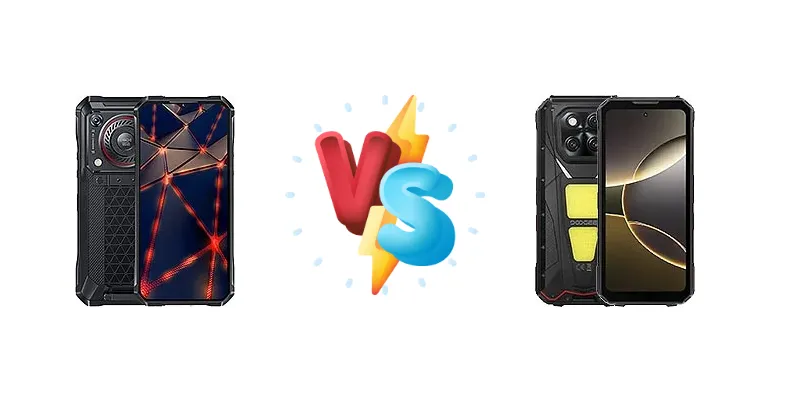
|
🏆 Quick Verdict
For most users, the Doogee V Max LR emerges as the stronger choice. Its Dimensity 7300 chipset, built on a more efficient 4nm process, provides a noticeable performance uplift over the Oukitel WP33 Pro’s Dimensity 6100+. While the WP33 Pro offers respectable battery life, the V Max LR’s faster charging and superior processing power make it the more versatile option.
| PHONES | ||
|---|---|---|
| Phone Names | Oukitel WP33 Pro | Doogee V Max LR |
| Network | ||
|---|---|---|
| 2G bands | GSM 850 / 900 / 1800 / 1900 | GSM 850 / 900 / 1800 / 1900 |
| 3G bands | HSDPA 800 / 850 / 900 / 1700(AWS) / 1900 / 2100 | HSDPA 800 / 850 / 900 / 1700(AWS) / 1900 / 2100 |
| 4G bands | 1, 2, 3, 4, 5, 7, 8, 12, 13, 17, 18, 19, 20, 25, 26, 28, 66, 71 | 1, 2, 3, 4, 5, 7, 8, 12, 17, 18, 19, 20, 25, 26, 28, 34, 38, 39, 40, 41, 66 |
| 5G bands | 1, 2, 3, 5, 7, 8, 20, 25, 28, 38, 41, 66, 77, 78, 79 SA/NSA | 1, 3, 7, 28, 38, 41, 77, 78, 79 SA/NSA |
| Speed | HSPA, LTE, 5G | HSPA, LTE, 5G |
| Technology | GSM / CDMA / HSPA / LTE / 5G | GSM / CDMA / HSPA / LTE / 5G |
| Launch | ||
|---|---|---|
| Announced | 2024, January 06 | 2025, September |
| Status | Available. Released 2024, January | Available. Released 2025, October |
| Body | ||
|---|---|---|
| Dimensions | 175.4 x 84 x 27.2 mm (6.91 x 3.31 x 1.07 in) | 183.5 x 85.4 x 30.5 mm (7.22 x 3.36 x 1.20 in) |
| SIM | Nano-SIM + eSIM | Nano-SIM + Nano-SIM |
| Weight | 577.5 g (1.27 lb) | 630 g (1.39 lb) |
| Display | ||
|---|---|---|
| Protection | Corning Gorilla Glass 5, Mohs level 5 | Mohs level 6 |
| Resolution | 1080 x 2408 pixels, 20:9 ratio (~400 ppi density) | 1080 x 2460 pixels (~396 ppi density) |
| Size | 6.6 inches, 104.9 cm2 (~71.2% screen-to-body ratio) | 6.78 inches, 109.2 cm2 (~69.7% screen-to-body ratio) |
| Type | IPS LCD, 450 nits | IPS LCD, 120Hz, 500 nits |
| Platform | ||
|---|---|---|
| CPU | Octa-core (2x2.2 GHz Cortex-A76 & 6x2.0 GHz Cortex-A55) | Octa-core (2x2.6 GHz Cortex-A78 & 6x2.0 GHz Cortex-A55) |
| Chipset | Mediatek Dimensity 6100+ (6 nm) | Mediatek Dimensity 7300 (4 nm) |
| GPU | Mali-G57 MC2 | Mali-G615 MC2 |
| OS | Android 13 | Android 15 |
| Memory | ||
|---|---|---|
| Card slot | No | microSDXC (dedicated slot) |
| Internal | 256GB 8GB RAM | 512GB 16GB RAM |
| Main Camera | ||
|---|---|---|
| Features | LED flash, HDR, panorama | Dual-LED flash, HDR, panorama |
| Triple | 64 MP, f/1.9, (wide), 1/1.73", PDAF 20 MP, f/2.2, (night vision), 1/2.78", AF, infrared night vision lights 2 MP (macro) | 200 MP, f/2.0, (wide), 1/1.3", PDAF 20 MP, f/1.8, (night vision), 2 infrared night vision lights 8 MP, f/2.2, 119˚ (ultrawide) |
| Video | 1440p@30fps, 1080p@30fps | 4K@30fps, 1080p@30fps |
| Selfie camera | ||
|---|---|---|
| Single | 32 MP, f/2.2, (wide), 1/2.74" | 32 MP, f/2.3, (wide) |
| Video | 1080p@30fps | 1080p@30fps |
| Sound | ||
|---|---|---|
| 35mm jack | No | No |
| Loudspeaker | Yes (136 dB, 5W peak, 36mm speaker) | Yes (130 dB) |
| Comms | ||
|---|---|---|
| Bluetooth | 5.2, A2DP, LE | 5.4, A2DP, LE |
| Infrared port | - | Yes |
| NFC | Yes | Yes |
| Positioning | GPS, GLONASS, GALILEO, BDS | GPS (L1+L5), GLONASS, GALILEO, BDS |
| Radio | FM radio | FM radio |
| USB | USB Type-C 2.0, OTG | USB Type-C |
| WLAN | Wi-Fi 802.11 a/b/g/n/ac, dual-band | Wi-Fi 802.11 a/b/g/n/ac/6e, dual-band |
| Features | ||
|---|---|---|
| Sensors | Fingerprint (side-mounted), accelerometer, gyro, proximity, compass | Fingerprint (side-mounted), accelerometer, gyro, proximity, compass |
| Battery | ||
|---|---|---|
| Charging | 33W wired 18W reverse wired | 45W wired 10W reverse wired |
| Type | Li-Po 22000 mAh | 20500 mAh |
| Misc | ||
|---|---|---|
| Colors | Black | Black, Tarnish |
| Price | About 400 EUR | About 770 EUR |
| EU LABEL | ||
|---|---|---|
| Battery | 166:39h endurance, 1100 cycles | 192:26h endurance, 1100 cycles |
| Energy | Class B | Class B |
| Free fall | Class A (270 falls) | Class A (270 falls) |
| Repairability | Class C | Class C |
Oukitel WP33 Pro
- Excellent battery endurance (166:39h)
- Competitive price point
- Rugged build quality
- Less powerful chipset (Dimensity 6100+)
- Slower charging speed (33W)
Doogee V Max LR
- More powerful chipset (Dimensity 7300)
- Faster charging (45W)
- Longer battery endurance (192:26h)
- Potentially higher price
- May run slightly warmer under heavy load
Display Comparison
Neither device’s display specifications are provided, so a direct comparison is limited. However, given the price points and target market, we can assume both utilize LCD panels. The focus here will be on performance. The chipset’s ability to drive the display smoothly is where the difference lies. The Doogee V Max LR’s Dimensity 7300, with its more powerful GPU, will likely deliver a more fluid experience, especially in graphically intensive applications.
Camera Comparison
Without specific camera sensor details, a detailed comparison is impossible. However, the chipset’s ISP (Image Signal Processor) plays a crucial role. The Dimensity 7300 in the Doogee V Max LR has a more advanced ISP, capable of handling higher resolution sensors and more complex image processing algorithms. This suggests better low-light performance, dynamic range, and overall image quality compared to the Oukitel WP33 Pro. The presence of a more powerful ISP also enables features like faster autofocus and improved video stabilization.
Performance
The core difference lies in the chipsets. The Doogee V Max LR’s Dimensity 7300 (4nm) features Cortex-A78 cores clocked at 2.6 GHz, a significant step up from the Oukitel WP33 Pro’s Dimensity 6100+ (6nm) with its 2.2 GHz Cortex-A76 cores. The 4nm process node of the Dimensity 7300 translates to improved power efficiency and reduced thermal throttling under sustained load. This means the V Max LR will maintain higher performance for longer periods during gaming or video editing. While both utilize 6x Cortex-A55 efficiency cores, the architectural advantage of the A78 in the Doogee will be noticeable in real-world usage.
Battery Life
The Doogee V Max LR boasts a slightly longer battery endurance rating of 192:26h compared to the Oukitel WP33 Pro’s 166:39h. Both devices claim 1100 charge cycles, indicating similar long-term battery health. However, the V Max LR’s 45W wired charging is a significant advantage over the WP33 Pro’s 33W charging. This translates to faster top-ups, reducing downtime. While the WP33 Pro’s endurance is commendable, the V Max LR’s combination of respectable endurance and faster charging provides greater flexibility.
Buying Guide
Buy the Oukitel WP33 Pro if you prioritize maximizing battery life above all else and operate on a tighter budget. Its 166:39h endurance is excellent for extended off-grid use. Buy the Doogee V Max LR if you need a more responsive and capable device for multitasking, gaming, or demanding applications, and value the convenience of 45W fast charging. The V Max LR is the better choice for power users and those who want a future-proofed rugged phone.