
Oukitel WP32 Pro vs. Doogee V30 Pro: A Deep Dive into Rugged Smartphone Performance
| Phones Images | |||||
|---|---|---|---|---|---|
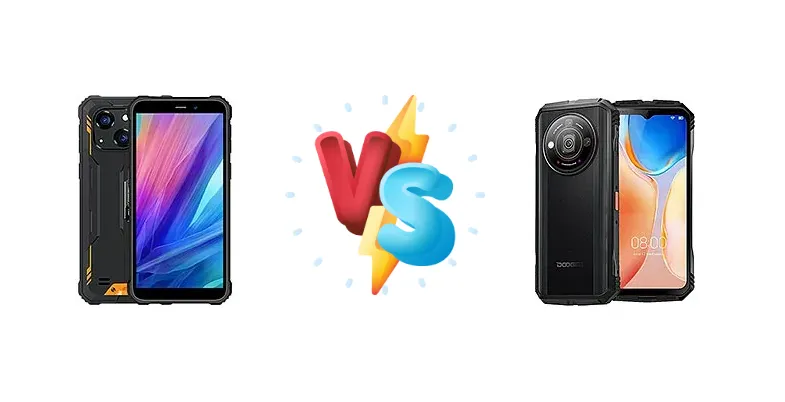
|
🏆 Quick Verdict
For the average user prioritizing longevity and cost-effectiveness, the Oukitel WP32 Pro is the better choice. Its exceptional 58:56h battery endurance and 1000 charge cycles outweigh the performance deficit. However, users demanding responsive multitasking and gaming should opt for the Doogee V30 Pro's superior processing power.
| PHONES | ||
|---|---|---|
| Phone Names | Oukitel WP32 Pro | Doogee V30 Pro |
| Network | ||
|---|---|---|
| 2G bands | GSM 850 / 900 / 1800 / 1900 | GSM 850 / 900 / 1800 / 1900 |
| 3G bands | HSDPA 850 / 900 / 1700(AWS) / 1900 / 2100 | HSDPA 800 / 850 / 900 / 1700(AWS) / 1900 / 2100 |
| 4G bands | 1, 2, 3, 4, 5, 7, 8, 12, 17, 19, 20, 25, 26, 28, 66 | 1, 2, 3, 4, 5, 7, 8, 12, 17, 18, 19, 20, 25, 26, 28, 34, 38, 39, 40, 41, 66 |
| 5G bands | - | 1, 3, 7, 28, 38, 41, 77, 78, 79 SA/NSA |
| Speed | HSPA, LTE | HSPA, LTE, 5G |
| Technology | GSM / HSPA / LTE | GSM / CDMA / HSPA / LTE / 5G |
| Launch | ||
|---|---|---|
| Announced | 2024, May 20 | 2023, October 24 |
| Status | Available. Released 2024, July | Available. Released 2023, November 01 |
| Body | ||
|---|---|---|
| Dimensions | 166 x 81.1 x 15 mm (6.54 x 3.19 x 0.59 in) | 178.5 x 83.1 x 17.9 mm (7.03 x 3.27 x 0.70 in) |
| SIM | Nano-SIM + Nano-SIM | Nano-SIM + Nano-SIM |
| Weight | 300 g (10.58 oz) | - |
| Display | ||
|---|---|---|
| Protection | Corning Gorilla Glass 5, Mohs level 5 | Corning Gorilla Glass 5 |
| Resolution | 576 x 1152 pixels, 18:9 ratio (~215 ppi density) | 1080 x 2408 pixels, 20:9 ratio (~401 ppi density) |
| Size | 6.0 inches, 92.9 cm2 (~69.0% screen-to-body ratio) | 6.58 inches, 104.3 cm2 (~70.3% screen-to-body ratio) |
| Type | IPS LCD | IPS LCD, 120Hz |
| Platform | ||
|---|---|---|
| CPU | Octa-core (2x1.6 GHz Cortex-A75 & 6x1.6 GHz Cortex-A55) | Octa-core (2x2.6 GHz Cortex-A78 & 6x2.0 GHz Cortex-A55) |
| Chipset | Unisoc T606 (12 nm) | Mediatek Dimensity 7050 (6 nm) |
| GPU | Mali-G57 MP1 | Mali-G68 MC4 |
| OS | Android 14 | Android 13 |
| Memory | ||
|---|---|---|
| Card slot | microSDXC (uses shared SIM slot) | microSDXC (uses shared SIM slot) |
| Internal | 256GB 6GB RAM | 512GB 12GB RAM |
| Main Camera | ||
|---|---|---|
| Features | LED flash | Dual-LED flash, HDR, panorama |
| Single | 20 MP, f/1.8, (wide), 1/2.8", PDAF | - |
| Triple | - | 200 MP, f/1.7, (wide), 1/1.4", PDAF 24 MP, f/1.8, (night vision), 2 infrared night vision lights 16 MP, f/2.2, 125˚ (ultrawide) |
| Video | 1080p@30fps | 4K@30fps, 1080p@30fps |
| Selfie camera | ||
|---|---|---|
| Single | 5 MP, f/2.2, (wide), 1/5.0" | 32 MP, f/1.8, (wide), 1/2.7" |
| Video | 720p@30fps | 1080p@30fps |
| Sound | ||
|---|---|---|
| 35mm jack | Yes | Unspecified |
| Loudspeaker | Yes | Yes, with stereo speakers |
| Comms | ||
|---|---|---|
| Bluetooth | 4.2, A2DP, LE | 5.2, A2DP, LE |
| NFC | Yes | Yes (market/region dependent) |
| Positioning | GPS, GLONASS, GALILEO, BDS | GPS (L1+L5), GLONASS, GALILEO, BDS |
| Radio | FM radio | FM radio |
| USB | USB Type-C 2.0, OTG | USB Type-C 2.0, OTG |
| WLAN | Wi-Fi 802.11 a/b/g/n/ac, dual-band | Wi-Fi 802.11 a/b/g/n/ac/6, dual-band |
| Features | ||
|---|---|---|
| Sensors | Accelerometer, proximity, compass | Fingerprint (side-mounted), accelerometer, gyro, proximity, compass |
| Battery | ||
|---|---|---|
| Charging | 10W wired | 33W wired Reverse wired |
| Type | Li-Po 6300 mAh | 10800 mAh |
| Misc | ||
|---|---|---|
| Colors | Black, Green, Orange | Black, Orange, Silver |
| Price | About 190 EUR | About 440 EUR |
| EU LABEL | ||
|---|---|---|
| Battery | 58:56h endurance, 1000 cycles | - |
| Energy | Class B | - |
| Free fall | Class A (270 falls) | - |
| Repairability | Class C | - |
Oukitel WP32 Pro
- Exceptional battery life (58:56h endurance)
- High charge cycle count (1000 cycles)
- More affordable price point
- Significantly slower processor
- Slow 10W charging
- Likely lower-quality display
Doogee V30 Pro
- Powerful MediaTek Dimensity 7050 chipset
- Fast 33W wired charging with reverse charging
- Potentially superior display quality
- Likely shorter battery life compared to WP32 Pro
- Higher price tag
- Battery health may degrade faster with frequent fast charging
Display Comparison
Neither device's display specifications are provided, so a direct comparison is limited. However, given the WP32 Pro's focus on value, it likely utilizes a standard LCD panel. The V30 Pro, positioned as a more premium offering, may incorporate a higher-quality panel with improved color accuracy and viewing angles. The absence of refresh rate data suggests both likely operate at 60Hz. Bezels are expected to be larger on the WP32 Pro to maintain its lower price point.
Camera Comparison
Without detailed camera specifications, a comprehensive comparison is difficult. However, the chipset difference suggests the Doogee V30 Pro will benefit from a more powerful image signal processor (ISP), enabling better image processing and potentially superior low-light performance. The WP32 Pro will likely rely on software optimization to compensate for its less capable chipset. The presence of a 2MP macro camera on either device is likely a marketing gimmick, offering limited practical benefit due to its small sensor size and low resolution.
Performance
The core difference lies in the chipsets. The Doogee V30 Pro’s MediaTek Dimensity 7050 (6nm) represents a substantial leap in performance over the Oukitel WP32 Pro’s Unisoc T606 (12nm). The Dimensity 7050’s Cortex-A78 cores, clocked at 2.6 GHz, deliver significantly faster processing speeds compared to the WP32 Pro’s Cortex-A75 cores at 1.6 GHz. This translates to snappier app launches, smoother multitasking, and a more enjoyable gaming experience. The 6nm process node of the Dimensity 7050 also contributes to improved thermal efficiency, reducing the likelihood of throttling under sustained load. The WP32 Pro will be adequate for basic tasks, but will struggle with demanding applications.
Battery Life
The Oukitel WP32 Pro boasts impressive battery endurance, achieving 58:56h in testing and supporting 1000 charge cycles, indicating long-term battery health. While the Doogee V30 Pro’s battery capacity is unknown, its 33W wired charging (and reverse wired charging) provides a significant advantage in terms of convenience. The WP32 Pro’s 10W charging is comparatively slow, requiring considerably longer to reach a full charge. The V30 Pro’s reverse charging capability also adds versatility, allowing it to top up other devices.
Buying Guide
Buy the Oukitel WP32 Pro if you need a phone that can reliably last for days on a single charge, prioritize affordability, and require a durable device for basic communication and light tasks. Buy the Doogee V30 Pro if you prefer a smoother, faster user experience, frequently engage in gaming or demanding applications, and value the convenience of 33W fast charging and reverse wireless charging.