
Oukitel WP300 vs. Nokia XR20: A Deep Dive into Rugged Smartphone Performance
| Phones Images | |||||
|---|---|---|---|---|---|
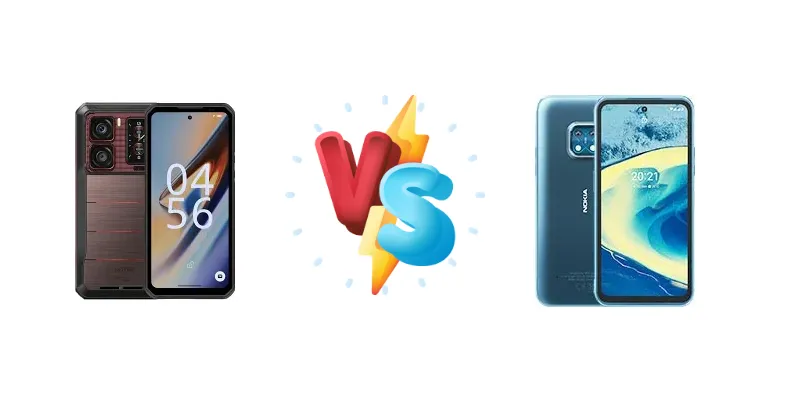
|
🏆 Quick Verdict
For users prioritizing performance and battery endurance, the Oukitel WP300 is the clear winner. Its Dimensity 7025 chipset offers a significant performance advantage over the Snapdragon 480 in the Nokia XR20, coupled with a substantially longer battery life. However, the XR20 remains a solid choice for those valuing 5G connectivity and Nokia’s software ecosystem.
| PHONES | ||
|---|---|---|
| Phone Names | Oukitel WP300 | Nokia XR20 |
| Network | ||
|---|---|---|
| 2G bands | GSM 850 / 900 / 1800 / 1900 | GSM 850 / 900 / 1800 / 1900 |
| 3G bands | HSDPA 800 / 850 / 900 / 1700(AWS) / 1900 / 2100 | HSDPA 850 / 900 / 1700(AWS) / 1900 / 2100 |
| 4G bands | 1, 2, 3, 4, 5, 7, 8, 12, 13, 17, 18, 19, 20, 25, 26, 28, 34, 38, 40, 41, 66, 71 | 1, 2, 3, 4, 5, 7, 8, 12, 13, 14, 20, 25, 26, 28, 30, 38, 40, 41, 48, 66, 71 |
| 5G bands | 1, 2, 3, 5, 7, 8, 12, 20, 28, 38, 39, 40, 41, 66, 71, 77, 78 SA/NSA | 2, 5, 25, 38, 41, 48, 66, 77, 78 SA/NSA |
| Speed | HSPA, LTE, 5G | HSPA, LTE, 5G |
| Technology | GSM / HSPA / LTE / 5G | GSM / CDMA / HSPA / EVDO / LTE / 5G |
| - | CDMA2000 1xEV-DO | |
| Launch | ||
|---|---|---|
| Announced | 2024, December | 2021, July 27 |
| Status | Available. Released 2025, March 20 | Available. Released 2021, August 04 |
| Body | ||
|---|---|---|
| Dimensions | 181.3 x 84.9 x 21.2 mm (7.14 x 3.34 x 0.83 in) | 171.6 x 81.5 x 10.6 mm (6.76 x 3.21 x 0.42 in) |
| SIM | Nano-SIM + Nano-SIM | · Nano-SIM· Nano-SIM + Nano-SIM |
| Weight | 512 g (1.13 lb) | 248 g (8.75 oz) |
| - | IP68 dust/water resistant (up to 1.5m for 60 min) Drop-to-concrete resistance from up to 1.8m MIL-STD-810H compliant | |
| Display | ||
|---|---|---|
| Protection | Corning Gorilla Glass 5, Mohs level 5 | Corning Gorilla Glass Victus |
| Resolution | 1080 x 2460 pixels (~395 ppi density) | 1080 x 2400 pixels, 20:9 ratio (~395 ppi density) |
| Size | 6.8 inches, 109.8 cm2 (~71.3% screen-to-body ratio) | 6.67 inches, 107.4 cm2 (~76.8% screen-to-body ratio) |
| Type | IPS LCD, 120Hz, 650 nits | IPS LCD, 550 nits |
| Platform | ||
|---|---|---|
| CPU | Octa-core (2x2.6 GHz Cortex-A78 & 6x2.0 GHz Cortex-A55) | Octa-core (2x2.0 GHz Kryo 460 & 6x1.8 GHz Kryo 460) |
| Chipset | Mediatek Dimensity 7025 (6 nm) | Qualcomm SM4350 Snapdragon 480 5G (8 nm) |
| GPU | IMG BXM-8-256 | Adreno 619 |
| OS | Android 15 | Android 11, upgradable to Android 13 |
| Memory | ||
|---|---|---|
| Card slot | microSDXC (uses shared SIM slot) | microSDXC (uses shared SIM slot) |
| Internal | 512GB 12GB RAM | 64GB 4GB RAM, 128GB 6GB RAM |
| Main Camera | ||
|---|---|---|
| Dual | 108 MP, f/1.9, (wide), 1/1.8", PDAF 2 MP (macro) | 48 MP, f/1.8, (wide), 1/2.25", 0.8µm, PDAF 13 MP, f/2.4, 123˚ (ultrawide), 1/3.0", 1.12µm |
| Features | LED flash, HDR, panorama | Zeiss optics, Dual-LED dual-tone flash, second LED flash, HDR, panorama |
| Single | - | 8 MP, f/2.0 (wide), 1/4.0", 1.12µm |
| Video | 4K@30fps | 1080p@30fps |
| Selfie camera | ||
|---|---|---|
| Single | 32 MP, 1/2.74" | 8 MP, f/2.0 (wide), 1/4.0", 1.12µm |
| Video | 1080p@30fps | 1080p@30fps |
| Sound | ||
|---|---|---|
| 3.5mm jack | - | Yes |
| 35mm jack | No | Yes |
| Loudspeaker | Yes | Yes, with stereo speakers |
| Comms | ||
|---|---|---|
| Bluetooth | 5.2, A2DP, LE | 5.1, A2DP, LE, aptX Adaptive |
| NFC | Yes | Yes |
| Positioning | GPS, GLONASS, GALILEO, BDS | GPS (L1+L5), GLONASS, BDS, GALILEO, QZSS, NavIC |
| Radio | FM radio | Unspecified |
| USB | USB Type-C 2.0, OTG | USB Type-C 3.0 |
| WLAN | Wi-Fi 802.11 a/b/g/n/ac/6, dual-band | Wi-Fi 802.11 a/b/g/n/ac/6, dual-band, Wi-Fi Direct |
| Features | ||
|---|---|---|
| Sensors | Fingerprint (side-mounted), accelerometer, gyro, proximity, compass | Fingerprint (side-mounted), accelerometer, gyro, proximity, compass, barometer |
| Battery | ||
|---|---|---|
| Charging | 45W wired Reverse wired | 18W wired 15W wireless |
| Type | Li-Po 16000 mAh | Li-Po 4630 mAh |
| Misc | ||
|---|---|---|
| Colors | Gray, Red | Ultra Blue, Granite Gray |
| Models | - | TA-1368, TA-1362 |
| Price | - | About 270 EUR |
| SAR EU | - | 1.13 W/kg (head) 1.43 W/kg (body) |
| EU LABEL | ||
|---|---|---|
| Battery | 152:22h endurance, 1000 cycles | - |
| Energy | Class B | - |
| Free fall | Class A (270 falls) | - |
| Repairability | Class C | - |
Oukitel WP300
- Significantly faster processor for smoother performance
- Exceptional battery life and longevity
- Faster 45W wired charging with reverse charging capability
- 5G connectivity not confirmed
- Software update policy is unknown
Nokia XR20
- Reliable 5G connectivity
- Nokia’s guaranteed software updates
- Wireless charging convenience
- Slower processor and less responsive performance
- Slower charging speeds
- Potentially shorter battery life
Display Comparison
Display specifications are absent from the provided data, but considering the market positioning, we can infer differences. The XR20 likely features a standard LCD panel, typical of its price range, while the WP300 may utilize a slightly more advanced panel to complement its performance focus. Bezels are likely similar, given both phones target a rugged aesthetic. Color accuracy is also likely comparable, prioritizing visibility in outdoor conditions over color fidelity.
Camera Comparison
Camera details are limited, but the focus should be on real-world image quality rather than megapixel counts. Both phones likely feature a primary camera for general photography. The XR20’s image processing may lean towards a more natural look, consistent with Nokia’s brand identity. The WP300 might prioritize vibrant colors and sharper details. Without sensor size information, it’s difficult to definitively assess low-light performance, but the chipset’s image signal processor (ISP) on the WP300 likely offers more advanced processing capabilities.
Performance
The Oukitel WP300’s Mediatek Dimensity 7025 (6nm) represents a significant leap in processing power compared to the Nokia XR20’s Qualcomm Snapdragon 480 5G (8nm). The Dimensity 7025’s Cortex-A78 cores, clocked at 2.6 GHz, offer substantially higher single-core performance, crucial for responsive app loading and smoother multitasking. The Snapdragon 480’s Kryo 460 cores, at 2.0 GHz, are geared towards efficiency rather than outright speed. The 6nm fabrication process of the Dimensity 7025 also contributes to better thermal efficiency, potentially reducing throttling during sustained workloads. This translates to a more consistently fluid experience on the WP300, particularly for gaming and demanding applications.
Battery Life
The Oukitel WP300 boasts a remarkable 152-22h endurance rating, significantly exceeding what’s typically expected from a smartphone. This, combined with the 1000 cycle battery lifespan claim, suggests a focus on longevity. While the XR20’s battery capacity is unknown, its 18W wired and 15W wireless charging are slower than the WP300’s 45W wired and reverse wired charging. The WP300’s faster charging allows for quicker top-ups, while the XR20’s wireless charging offers convenience. The WP300’s superior endurance means users will likely rely less on charging, making the faster charging a secondary benefit.
Buying Guide
Buy the Oukitel WP300 if you need a phone that can handle demanding tasks, extended outdoor use, and require minimal charging. This is ideal for construction workers, outdoor enthusiasts, or anyone who frequently finds themselves away from power outlets. Buy the Nokia XR20 if you prefer a more mainstream smartphone experience with guaranteed software updates, reliable 5G connectivity, and a focus on usability over raw power. This suits users who need a durable phone for everyday life and value a trusted brand.