
Oukitel WP300 vs Doogee S99: A Deep Dive into Rugged Smartphone Performance
| Phones Images | |||||
|---|---|---|---|---|---|
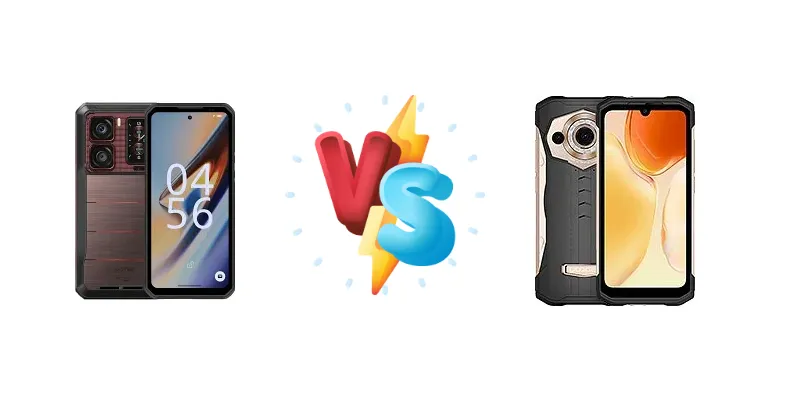
|
🏆 Quick Verdict
For the average user needing a rugged phone with exceptional battery life and future-proofed performance, the Oukitel WP300 emerges as the winner. Its Dimensity 7025 chipset, built on a 6nm process, provides a significant performance and efficiency advantage over the Doogee S99’s older 12nm Helio G96, justifying the trade-off in wireless charging.
| PHONES | ||
|---|---|---|
| Phone Names | Oukitel WP300 | Doogee S99 |
| Network | ||
|---|---|---|
| 2G bands | GSM 850 / 900 / 1800 / 1900 | GSM 850 / 900 / 1800 / 1900 |
| 3G bands | HSDPA 800 / 850 / 900 / 1700(AWS) / 1900 / 2100 | HSDPA 800 / 850 / 900 / 1700(AWS) / 1900 / 2100 |
| 4G bands | 1, 2, 3, 4, 5, 7, 8, 12, 13, 17, 18, 19, 20, 25, 26, 28, 34, 38, 40, 41, 66, 71 | 1, 2, 3, 4, 5, 7, 8, 12, 13, 17, 18, 19, 20, 25, 26, 28, 34, 38, 39, 40, 41, 66 |
| 5G bands | 1, 2, 3, 5, 7, 8, 12, 20, 28, 38, 39, 40, 41, 66, 71, 77, 78 SA/NSA | - |
| Speed | HSPA, LTE, 5G | HSPA, LTE |
| Technology | GSM / HSPA / LTE / 5G | GSM / CDMA / HSPA / LTE |
| Launch | ||
|---|---|---|
| Announced | 2024, December | 2022, December 05 |
| Status | Available. Released 2025, March 20 | Available. Released 2022, December 05 |
| Body | ||
|---|---|---|
| Dimensions | 181.3 x 84.9 x 21.2 mm (7.14 x 3.34 x 0.83 in) | 172 x 82 x 15.5 mm (6.77 x 3.23 x 0.61 in) |
| SIM | Nano-SIM + Nano-SIM | Nano-SIM + Nano-SIM |
| Weight | 512 g (1.13 lb) | - |
| Display | ||
|---|---|---|
| Protection | Corning Gorilla Glass 5, Mohs level 5 | Corning Gorilla Glass |
| Resolution | 1080 x 2460 pixels (~395 ppi density) | 1080 x 2340 pixels, 19.5:9 ratio (~409 ppi density) |
| Size | 6.8 inches, 109.8 cm2 (~71.3% screen-to-body ratio) | 6.3 inches, 97.4 cm2 (~69.1% screen-to-body ratio) |
| Type | IPS LCD, 120Hz, 650 nits | IPS LCD |
| Platform | ||
|---|---|---|
| CPU | Octa-core (2x2.6 GHz Cortex-A78 & 6x2.0 GHz Cortex-A55) | Octa-core (2x2.05 GHz Cortex-A76 & 6x2.0 GHz Cortex-A55) |
| Chipset | Mediatek Dimensity 7025 (6 nm) | Mediatek MT6781 Helio G96 (12 nm) |
| GPU | IMG BXM-8-256 | Mali-G57 MC2 |
| OS | Android 15 | Android 12 |
| Memory | ||
|---|---|---|
| Card slot | microSDXC (uses shared SIM slot) | microSDXC (dedicated slot) |
| Internal | 512GB 12GB RAM | 128GB 8GB RAM |
| Main Camera | ||
|---|---|---|
| Dual | 108 MP, f/1.9, (wide), 1/1.8", PDAF 2 MP (macro) | - |
| Features | LED flash, HDR, panorama | Dual-LED flash, HDR, panorama |
| Triple | - | 108 MP, f/1.9, (wide), 1/1.52", 0.7µm, PDAF 64 MP, f/1.8, (night vision), 2 infrared night vision lights 16 MP, f/1.8, 130˚ (ultrawide) |
| Video | 4K@30fps | 1440p@30fps, 1080p@30fps |
| Selfie camera | ||
|---|---|---|
| Single | 32 MP, 1/2.74" | 32 MP, f/2.0, (wide), 1/2.8", 0.8µm |
| Video | 1080p@30fps | 1080p@30fps |
| Sound | ||
|---|---|---|
| 35mm jack | No | No |
| Loudspeaker | Yes | Yes |
| Comms | ||
|---|---|---|
| Bluetooth | 5.2, A2DP, LE | 5.1, A2DP, LE |
| NFC | Yes | Yes (market/region dependent) |
| Positioning | GPS, GLONASS, GALILEO, BDS | GPS, GLONASS, GALILEO, BDS |
| Radio | FM radio | FM radio |
| USB | USB Type-C 2.0, OTG | USB Type-C 2.0, OTG |
| WLAN | Wi-Fi 802.11 a/b/g/n/ac/6, dual-band | Wi-Fi 802.11 a/b/g/n/ac, dual-band |
| Features | ||
|---|---|---|
| Sensors | Fingerprint (side-mounted), accelerometer, gyro, proximity, compass | Fingerprint (side-mounted), accelerometer, gyro, proximity, compass |
| Battery | ||
|---|---|---|
| Charging | 45W wired Reverse wired | 33W wired, 45% in 30 min 15W wireless Reverse wired |
| Type | Li-Po 16000 mAh | 6000 mAh |
| Misc | ||
|---|---|---|
| Colors | Gray, Red | Gold, Black |
| Price | - | About 250 EUR |
| EU LABEL | ||
|---|---|---|
| Battery | 152:22h endurance, 1000 cycles | - |
| Energy | Class B | - |
| Free fall | Class A (270 falls) | - |
| Repairability | Class C | - |
Oukitel WP300
- Superior processor performance with the Dimensity 7025.
- Exceptional battery endurance (152-22h).
- Long-term battery health with 1000 charge cycles.
- Lacks wireless charging.
- Display specifications are unknown, potentially less refined.
Doogee S99
- Convenient wireless charging (15W).
- Faster initial charge with 33W wired charging (45% in 30 min).
- Established Helio G96 chipset with known performance characteristics.
- Less powerful processor compared to the Dimensity 7025.
- Lower power efficiency due to the 12nm process node.
Display Comparison
Neither device's display specifications are provided, so a direct comparison is limited. However, given the WP300's focus on endurance and the S99's broader feature set, we can infer the S99 may prioritize display quality with potentially higher brightness and color accuracy. The WP300 likely focuses on durability and power efficiency, potentially sacrificing some display refinement. Both will likely feature ruggedized glass or plastic for impact resistance.
Camera Comparison
Without detailed camera specifications, a precise comparison is difficult. However, the market positioning of these devices suggests the Doogee S99 might offer a more comprehensive camera system with potentially more features. The WP300 likely prioritizes durability over camera complexity. Both will likely include a main sensor, ultrawide, and potentially a macro lens, but image processing algorithms and sensor size will be key differentiators. We anticipate the S99 to lean towards more saturated, social-media-ready images, while the WP300 may aim for more realistic color reproduction.
Performance
The Oukitel WP300’s Mediatek Dimensity 7025 (6nm) represents a substantial leap forward compared to the Doogee S99’s Helio G96 (12nm). The 6nm process node allows for greater transistor density and improved power efficiency, translating to less heat generation and sustained performance. The Dimensity 7025’s Cortex-A78 cores, clocked at 2.6 GHz, outperform the Helio G96’s Cortex-A76 cores at 2.05 GHz. This difference is particularly noticeable in demanding applications like gaming and video editing. While both utilize a 6x Cortex-A55 cluster for efficiency, the Dimensity 7025’s overall architecture provides a more modern and capable platform.
Battery Life
The Oukitel WP300 boasts an impressive 152-22h endurance rating, suggesting a large battery capacity optimized for longevity. While the Doogee S99’s battery capacity is unknown, its 33W wired charging and 15W wireless charging offer more versatile charging options. The WP300 compensates with 45W wired charging and reverse wired charging. The WP300’s stated 1000 charge cycles indicate a focus on long-term battery health, suggesting the battery chemistry is designed to withstand repeated charging and discharging without significant degradation. The S99’s 33W charging can reach 45% in 30 minutes, but the WP300’s 45W charging likely offers a faster overall charge time.
Buying Guide
Buy the Oukitel WP300 if you prioritize long-term performance, extended battery life for multi-day use, and a more efficient processor for demanding tasks. Buy the Doogee S99 if you value the convenience of wireless charging and are looking for a more established, though less powerful, chipset within the rugged phone category. The S99 is a good choice for users who don't heavily game or run resource-intensive applications.