
Oukitel WP30 Pro vs. Infinix Hot 30i: A Performance and Value Showdown
| Phones Images | |||||
|---|---|---|---|---|---|
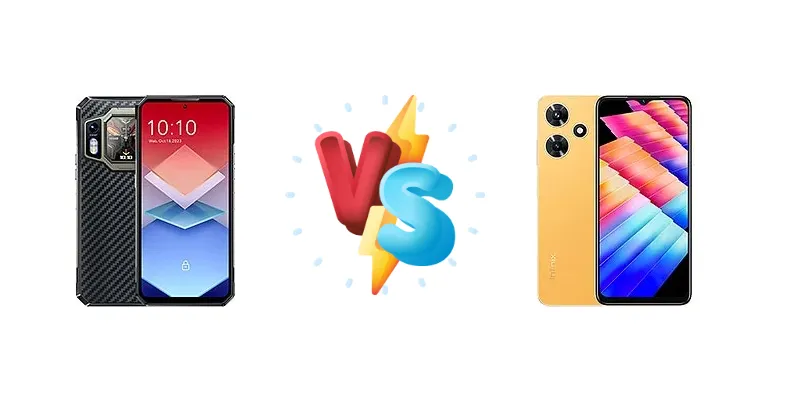
|
🏆 Quick Verdict
For users prioritizing raw performance and fast charging, the Oukitel WP30 Pro is the clear winner. Its Dimensity 8050 offers a significant leap in processing power over the Infinix Hot 30i’s Unisoc T606. However, the Hot 30i provides a compelling value proposition for everyday tasks and users on a tighter budget.
| PHONES | ||
|---|---|---|
| Phone Names | Oukitel WP30 Pro | Infinix Hot 30i |
| Network | ||
|---|---|---|
| 2G bands | GSM 850 / 900 / 1800 / 1900 | GSM 850 / 900 / 1800 / 1900 |
| 3G bands | HSDPA 800 / 850 / 900 / 1700(AWS) / 1900 / 2100 | HSDPA 850 / 900 / 1700(AWS) / 1900 / 2100 |
| 4G bands | 1, 2, 3, 4, 5, 7, 8, 12, 13, 17, 18, 19, 20, 25, 26, 28, 34, 38, 39, 40, 41, 66, 71 | 1, 2, 3, 4, 5, 7, 8, 20, 28, 38, 40, 41 |
| 5G bands | 1, 2, 3, 5, 7, 8, 12, 20, 25, 28, 34, 38, 39, 40, 41, 48, 66, 71, 77, 78, 79 SA/NSA | - |
| Speed | HSPA, LTE, 5G | HSPA, LTE |
| Technology | GSM / CDMA / HSPA / LTE / 5G | GSM / HSPA / LTE |
| Launch | ||
|---|---|---|
| Announced | 2023, October | 2023, March 31 |
| Status | Available. Released 2023, November 11 | Available. Released 2023, March 31 |
| Body | ||
|---|---|---|
| Build | - | Glass front, plastic frame, plastic back |
| Dimensions | 177.4 x 83.6 x 19 mm (6.98 x 3.29 x 0.75 in) | 164 x 75.8 x 8.4 mm (6.46 x 2.98 x 0.33 in) |
| SIM | Nano-SIM + eSIM | Nano-SIM + Nano-SIM |
| Weight | 413.8 g (14.60 oz) | 191 g (6.74 oz) |
| Display | ||
|---|---|---|
| Protection | Corning Gorilla Glass 5 | - |
| Resolution | 1080 x 2460 pixels (~396 ppi density) | 720 x 1612 pixels, 20:9 ratio (~269 ppi density) |
| Size | 6.78 inches, 109.2 cm2 (~73.6% screen-to-body ratio) | 6.56 inches, 103.4 cm2 (~83.2% screen-to-body ratio) |
| Type | IPS LCD, 120Hz, 430 nits | IPS LCD, 90Hz, 500 nits (peak) |
| Platform | ||
|---|---|---|
| CPU | Octa-core (1x3.0 GHz Cortex-A78 & 3x2.6 GHz Cortex-A78 & 4x2.0 GHz Cortex-A55) | Octa-core (2x1.6 GHz Cortex-A75 & 6x1.6 GHz Cortex-A55) |
| Chipset | Mediatek Dimensity 8050 (6 nm) | Unisoc T606 (12 nm) |
| GPU | Mali-G77 MC9 | Mali-G57 MP1 |
| OS | Android 13 | Android 12, XOS 10.6 |
| Memory | ||
|---|---|---|
| Card slot | No | microSDXC (dedicated slot) |
| Internal | 512GB 12GB RAM | 64GB 4GB RAM, 128GB 4GB RAM, 128GB 8GB RAM |
| - | UFS 2.2 | |
| Main Camera | ||
|---|---|---|
| Dual | - | 13 MP, f/1.9, (wide), AF 0.08 MP, (depth) |
| Features | LED flash, HDR, panorama | Dual-LED flash, HDR, panorama |
| Single | - | 13 MP, f/1.9, (wide), 1/3.07", AF Auxiliary lens |
| Triple | 108 MP, f/1.9, (wide), 1/1.33", PDAF 20 MP, f/2.0, (night vision), 1/2.78", AF, infrared night vision lights 5 MP (macro) | - |
| Video | 4K@30fps, 1080p@30fps | 1080p@30fps |
| Selfie camera | ||
|---|---|---|
| Features | - | Dual-LED flash |
| Single | 32 MP, f/2.2, (wide), 1/2.74" | 8 MP, f/2.0, (wide), 1/3.94" |
| Video | 1080p@30fps | 1080p@30fps |
| Sound | ||
|---|---|---|
| 3.5mm jack | - | Yes |
| 35mm jack | Unspecified | Yes |
| Loudspeaker | Yes | Yes |
| Comms | ||
|---|---|---|
| Bluetooth | 5.2, A2DP, LE | Yes |
| NFC | Yes | Yes (Hot 30i NFC only) |
| Positioning | GPS (L1+L5), GLONASS, GALILEO, BDS | GPS |
| Radio | Unspecified | FM radio |
| USB | USB Type-C 2.0, OTG | USB Type-C 2.0, OTG |
| WLAN | Wi-Fi 802.11 a/b/g/n/ac/6, dual-band | Wi-Fi 802.11 a/b/g/n/ac, dual-band |
| Features | ||
|---|---|---|
| Sensors | Fingerprint (side-mounted), accelerometer, gyro, proximity, compass | Fingerprint (side-mounted), accelerometer, proximity, compass |
| Battery | ||
|---|---|---|
| Charging | 120W wired, 50% in 15 min, 100% in 50 min | 18W wired |
| Type | Li-Po 11000 mAh | 5000 mAh |
| Misc | ||
|---|---|---|
| Colors | Black | Mirror Black, Glacier Blue, Diamond White, Marigold |
| Models | - | X669, X669D |
| Price | About 500 EUR | - |
Oukitel WP30 Pro
- Significantly faster processor for gaming and multitasking
- Ultra-fast 120W charging
- Likely superior camera performance
- Potentially better display quality
- Likely higher price point
- Potentially larger size and weight
Infinix Hot 30i
- More affordable price
- Good battery life for basic usage
- Lightweight and portable
- Efficient processor for everyday tasks
- Slower processor for demanding tasks
- Slow 18W charging
- Likely lower camera quality
- Potentially lower display quality
Display Comparison
Neither device's display specifications are provided, so a direct comparison is limited. However, given the WP30 Pro's higher overall positioning, it likely features a higher resolution and potentially a higher refresh rate panel. The Hot 30i, targeting a lower price bracket, will likely prioritize cost-effectiveness over display quality. Bezels are expected to be larger on the Hot 30i. Color accuracy will likely be better on the WP30 Pro, assuming it utilizes a more advanced panel technology.
Camera Comparison
Without detailed camera specs, analysis is limited. However, the WP30 Pro, being a higher-tier device, likely features a larger main sensor and more sophisticated image processing algorithms. The Hot 30i will likely rely on software enhancements to compensate for a potentially smaller sensor. The presence of OIS (Optical Image Stabilization) is probable on the WP30 Pro, offering sharper images and smoother video recording, a feature unlikely to be found on the Hot 30i. The 2MP macro cameras often found on both devices offer limited practical benefit.
Performance
The core difference lies in the chipsets. The Oukitel WP30 Pro’s Mediatek Dimensity 8050 (6nm) is a substantial upgrade over the Infinix Hot 30i’s Unisoc T606 (12nm). The Dimensity 8050’s octa-core configuration, featuring a high-clocked Cortex-A78 prime core, delivers significantly faster CPU and GPU performance. The 6nm process node also translates to improved thermal efficiency, reducing throttling during sustained workloads. The Unisoc T606, while capable for everyday tasks, will struggle with graphically intensive games and demanding applications. The WP30 Pro is likely paired with faster LPDDR5x RAM, further enhancing performance, while the Hot 30i likely uses LPDDR4X.
Battery Life
While battery capacities aren't specified, the charging speeds highlight a key difference. The Oukitel WP30 Pro’s 120W wired charging is a game-changer, promising a 50% charge in just 15 minutes and a full charge in 50 minutes. This drastically reduces downtime. The Infinix Hot 30i’s 18W charging is considerably slower. Even if the Hot 30i has a larger battery capacity, the WP30 Pro’s charging speed will likely result in more usable uptime for power users. The efficiency of the Unisoc T606 may provide better overall battery life for light users, but the WP30 Pro’s fast charging mitigates this advantage.
Buying Guide
Buy the Oukitel WP30 Pro if you need a phone capable of handling demanding games, video editing, or multitasking without slowdowns, and if 120W fast charging is a priority. Buy the Infinix Hot 30i if you prefer a more affordable device for basic communication, social media, and light gaming, and value battery life over peak performance.