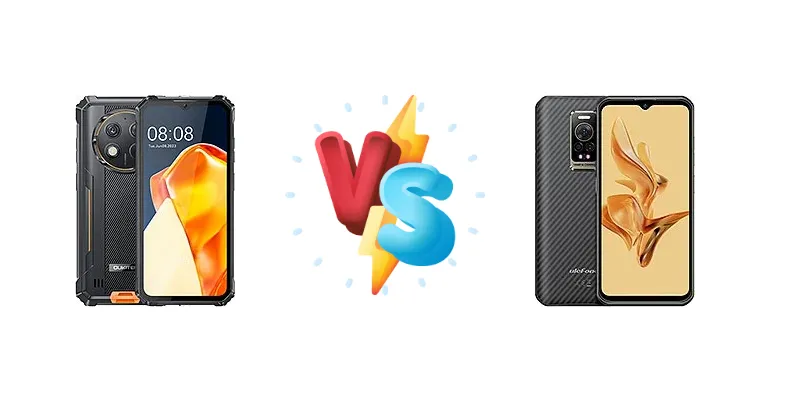
The rugged smartphone market caters to users needing durability, but often sacrifices performance. We pit the Oukitel WP28, a more basic offering, against the Ulefone Armor 17 Pro, which aims to deliver flagship-level processing power within a robust chassis. This comparison focuses on how these two phones balance toughness with usability and speed.
🏆 Quick Verdict
For the average user prioritizing performance and fast charging, the Ulefone Armor 17 Pro is the clear winner. Its Mediatek Helio G99 chipset and 66W charging significantly outperform the Oukitel WP28, making it a more responsive and convenient daily driver. However, the WP28 may appeal to those on a tighter budget who don't need the extra power.
| Network |
|---|
| 2G bands | GSM 850 / 900 / 1800 / 1900 | GSM 850 / 900 / 1800 / 1900 |
| 3G bands | HSDPA 850 / 900 / 1700(AWS) / 1900 / 2100 | HSDPA 800 / 850 / 900 / 1700(AWS) / 1900 / 2100 |
| 4G bands | LTE | 1, 2, 3, 4, 5, 7, 8, 12, 13, 17, 18, 19, 20, 25, 26, 28, 34, 38, 39, 40, 41, 66 |
| Speed | HSPA, LTE | HSPA, LTE |
| Technology | GSM / HSPA / LTE | GSM / HSPA / LTE |
| Launch |
|---|
| Announced | 2023, July | 2022, October 31 |
| Status | Available. Released 2023, July | Available. Released 2022, October 31 |
| Body |
|---|
| Dimensions | - | 172.7 x 80.4 x 12.5 mm (6.80 x 3.17 x 0.49 in) |
| SIM | Nano-SIM + Nano-SIM | Nano-SIM + Nano-SIM |
| Weight | - | 290 g (10.23 oz) |
| | - | IP68/IP69K dust/water resistant (up to 1.5m for 30 min)
Drop-to-concrete resistance from up to 1.5m
MIL-STD-810G compliant |
| Display |
|---|
| Protection | Corning Gorilla Glass | Corning Gorilla Glass 5 |
| Resolution | 720 x 1600 pixels, 20:9 ratio (~269 ppi density) | 1080 x 2408 pixels, 20:9 ratio (~401 ppi density) |
| Size | 6.52 inches, 102.6 cm2 | 6.58 inches, 104.3 cm2 (~75.1% screen-to-body ratio) |
| Type | IPS LCD | IPS LCD, 120Hz |
| Platform |
|---|
| CPU | - | Octa-core (2x2.2 GHz Cortex-A76 & 6x2.0 GHz Cortex-A55) |
| Chipset | - | Mediatek Helio G99 (6 nm) |
| GPU | - | Mali-G57 MC2 |
| OS | Android 13 | Android 12 |
| Memory |
|---|
| Card slot | microSDXC (uses shared SIM slot) | microSDXC (dedicated slot) |
| Internal | 256GB 8GB RAM | 256GB 8GB RAM |
| Main Camera |
|---|
| Dual | 48 MP, (wide)
2 MP (macro) | - |
| Features | LED flash | Triple-LED flash, HDR, panorama |
| Single | - | 16 MP, f/2.2, (wide), 1.0µm |
| Triple | - | 108 MP, f/1.9, (wide), 1/1.52”, 0.7µm, PDAF
8 MP, f/2.2, 119˚, (ultrawide), 1/4.0", 1.12µm
8 MP, (night vision), 2 infrared night vision lights |
| Video | 1080p@30fps | 1440p@30fps, 1080p@30fps |
| Selfie camera |
|---|
| Single | 5 MP | 16 MP, f/2.2, (wide), 1.0µm |
| Video | Yes | 1080p@30fps |
| Sound |
|---|
| 3.5mm jack | - | Yes |
| 35mm jack | Unspecified | Yes |
| Loudspeaker | Yes | Yes |
| Comms |
|---|
| Bluetooth | Yes | 5.2, A2DP, LE |
| NFC | No | Yes |
| Positioning | GPS, GLONASS, GALILEO, BDS | GPS, GLONASS, GALILEO, BDS |
| Radio | Unspecified | Wireless FM radio, RDS, recording |
| USB | USB Type-C 2.0 | USB Type-C 2.0, OTG |
| WLAN | Yes | Wi-Fi 802.11 a/b/g/n/ac, dual-band |
| Features |
|---|
| Sensors | Unspecified | Fingerprint (side-mounted), accelerometer, gyro, proximity, compass |
| | - | MagSafe compatible accessories |
| Battery |
|---|
| Charging | 18W wired | 66W wired, 53% in 15 min
15W wireless
Wireless reversed |
| Type | Li-Po 10600 mAh | Li-Po 5380 mAh |
| Misc |
|---|
| Colors | Black, Orange, Green | Black |
| Price | About 200 EUR | About 260 EUR |
Oukitel WP28
- Potentially lower price point
- Rugged design for durability
- Focus on essential functionality
- Significantly slower charging (18W)
- Likely weaker processor performance
- Limited information available
Ulefone Armor 17 Pro
- Fast 66W wired charging
- Powerful Mediatek Helio G99 chipset
- Wireless charging and reverse wireless charging
- Higher price compared to the WP28
- Rugged design may add bulk
- Potential for software bloat
Display Comparison
Neither device's display specifications are provided, so a direct comparison is limited. However, given the Armor 17 Pro's positioning, it likely features a higher resolution and potentially a higher refresh rate panel than the WP28. Rugged phones often prioritize durability over display quality, so expect both to have robust glass protection, but potentially lower peak brightness compared to standard smartphones. The absence of LTPO technology on either device suggests standard refresh rate operation, impacting power consumption during dynamic content.
Camera Comparison
Without detailed camera specifications for the Oukitel WP28, a comprehensive comparison is difficult. However, the Armor 17 Pro’s potential for a higher-resolution sensor and more advanced image processing algorithms gives it an edge. Rugged phones often prioritize practicality over photographic excellence, so expect both to offer decent image quality in good lighting conditions. The absence of information regarding OIS on either device suggests that image stabilization may be limited, potentially resulting in blurry photos in low-light scenarios. The inclusion of a 2MP macro lens on either device is likely a marketing gimmick, offering limited practical benefit.
Performance
The Ulefone Armor 17 Pro’s Mediatek Helio G99 (6nm) represents a substantial leap in processing power over the Oukitel WP28, which lacks chipset information. The G99’s octa-core configuration, with 2x2.2 GHz Cortex-A76 and 6x2.0 GHz Cortex-A55 cores, provides a noticeable advantage in multitasking and gaming. The 6nm process node also contributes to improved thermal efficiency, reducing the likelihood of performance throttling during sustained workloads. The WP28, lacking this information, likely utilizes a more basic chipset geared towards essential functions, making the Armor 17 Pro the preferred choice for users who demand responsiveness.
Battery Life
While both phones are rugged, their charging capabilities differ dramatically. The Ulefone Armor 17 Pro’s 66W wired charging, capable of delivering 53% charge in just 15 minutes, is a game-changer for users who value convenience. It also supports 15W wireless charging and reverse wireless charging, adding further versatility. The Oukitel WP28, limited to 18W wired charging, will take considerably longer to fully charge. Although battery capacity isn’t specified for either, the faster charging of the Armor 17 Pro effectively mitigates any potential capacity disadvantage.
Buying Guide
Buy the Oukitel WP28 if you need a highly durable phone for basic tasks like communication and occasional photography, and your budget is a primary concern. Buy the Ulefone Armor 17 Pro if you prefer a rugged phone that can handle demanding applications, gaming, and benefits from significantly faster charging speeds, even if it comes at a higher price point.
Frequently Asked Questions
❓ Does the Ulefone Armor 17 Pro's Helio G99 chipset get hot during extended gaming sessions?
The Mediatek Helio G99's 6nm process is designed for improved thermal efficiency. While some heat generation is inevitable during demanding tasks like gaming, the G99 is less prone to significant throttling compared to older, larger-node chipsets. The Armor 17 Pro's rugged design may also contribute to heat dissipation, but prolonged, intensive gaming will likely still result in some warming.
❓ Is the 18W charging on the Oukitel WP28 sufficient for overnight charging?
Yes, 18W charging is adequate for overnight charging, but it will take considerably longer to reach a full charge compared to the Ulefone Armor 17 Pro's 66W charging. Expect a full charge to take several hours, making it best suited for charging while you sleep.
❓ How does the ruggedness of these phones affect their usability with screen protectors?
Finding compatible screen protectors for rugged phones can be challenging due to the raised bezels and unique screen shapes. Standard screen protectors may not adhere properly or fully cover the display. It's recommended to search for screen protectors specifically designed for the Oukitel WP28 or Ulefone Armor 17 Pro to ensure a proper fit and optimal protection.