
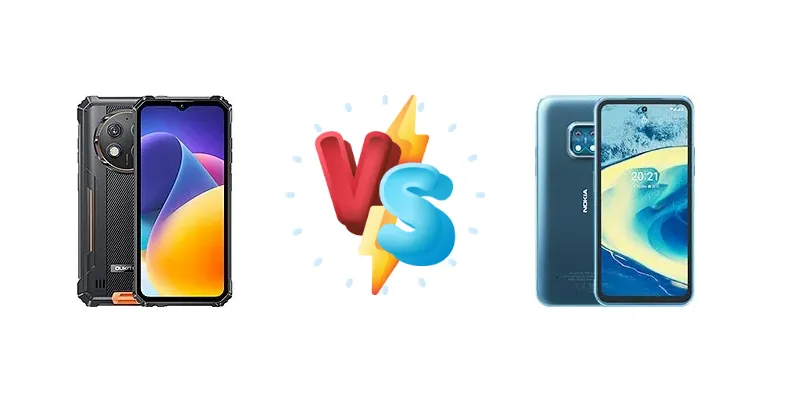
Oukitel WP28 S vs. Nokia XR20: A Deep Dive into Rugged Smartphone Choices
| Phones Images | |||||
|---|---|---|---|---|---|
|
🏆 Quick Verdict
For users prioritizing maximum uptime and cost-effectiveness, the Oukitel WP28 S is the clear winner. Its impressive 100-hour battery endurance and 1000 charge cycles outweigh the Nokia XR20’s 5G capabilities for those not reliant on consistently high data speeds. However, the XR20 is a better choice for users needing 5G and wireless charging.
| PHONES | ||
|---|---|---|
| Phone Names | Oukitel WP28 S | Nokia XR20 |
| Network | ||
|---|---|---|
| 2G bands | GSM 850 / 900 / 1800 / 1900 | GSM 850 / 900 / 1800 / 1900 |
| 3G bands | HSDPA 850 / 900 / 1700(AWS) / 1900 / 2100 | HSDPA 850 / 900 / 1700(AWS) / 1900 / 2100 |
| 4G bands | 1, 2, 3, 4, 5, 7, 8, 12, 17, 18, 19, 20, 25, 26, 28, 38, 40, 41, 66 | 1, 2, 3, 4, 5, 7, 8, 12, 13, 14, 20, 25, 26, 28, 30, 38, 40, 41, 48, 66, 71 |
| 5G bands | - | 2, 5, 25, 38, 41, 48, 66, 77, 78 SA/NSA |
| Speed | HSPA, LTE | HSPA, LTE, 5G |
| Technology | GSM / HSPA / LTE | GSM / CDMA / HSPA / EVDO / LTE / 5G |
| - | CDMA2000 1xEV-DO | |
| Launch | ||
|---|---|---|
| Announced | 2024, July | 2021, July 27 |
| Status | Available. Released 2024, August | Available. Released 2021, August 04 |
| Body | ||
|---|---|---|
| Dimensions | 174.2 x 82.3 x 17.4 mm (6.86 x 3.24 x 0.69 in) | 171.6 x 81.5 x 10.6 mm (6.76 x 3.21 x 0.42 in) |
| SIM | Nano-SIM | · Nano-SIM· Nano-SIM + Nano-SIM |
| Weight | 373 g (13.16 oz) | 248 g (8.75 oz) |
| - | IP68 dust/water resistant (up to 1.5m for 60 min) Drop-to-concrete resistance from up to 1.8m MIL-STD-810H compliant | |
| Display | ||
|---|---|---|
| Protection | Corning Gorilla Glass 5, Mohs level 5 | Corning Gorilla Glass Victus |
| Resolution | 720 x 1600 pixels, 20:9 ratio (~269 ppi density) | 1080 x 2400 pixels, 20:9 ratio (~395 ppi density) |
| Size | 6.52 inches, 102.6 cm2 (~71.6% screen-to-body ratio) | 6.67 inches, 107.4 cm2 (~76.8% screen-to-body ratio) |
| Type | IPS LCD | IPS LCD, 550 nits |
| Platform | ||
|---|---|---|
| CPU | Octa-core (2x1.6 GHz Cortex-A75 & 6x1.6 GHz Cortex-A55) | Octa-core (2x2.0 GHz Kryo 460 & 6x1.8 GHz Kryo 460) |
| Chipset | Unisoc T606 (12 nm) | Qualcomm SM4350 Snapdragon 480 5G (8 nm) |
| GPU | Mali-G57 MP1 | Adreno 619 |
| OS | Android 14 | Android 11, upgradable to Android 13 |
| Memory | ||
|---|---|---|
| Card slot | Unspecified | microSDXC (uses shared SIM slot) |
| Internal | 128GB 4GB RAM | 64GB 4GB RAM, 128GB 6GB RAM |
| Main Camera | ||
|---|---|---|
| Dual | - | 48 MP, f/1.8, (wide), 1/2.25", 0.8µm, PDAF 13 MP, f/2.4, 123˚ (ultrawide), 1/3.0", 1.12µm |
| Features | LED flash, panorama | Zeiss optics, Dual-LED dual-tone flash, second LED flash, HDR, panorama |
| Single | 13 MP, f/2.2, (wide), 1/3.06", PDAF | 8 MP, f/2.0 (wide), 1/4.0", 1.12µm |
| Video | 1080p@30fps | 1080p@30fps |
| Selfie camera | ||
|---|---|---|
| Single | 5 MP, f/2.2, (wide), 1/5.0" | 8 MP, f/2.0 (wide), 1/4.0", 1.12µm |
| Video | 720p@30fps | 1080p@30fps |
| Sound | ||
|---|---|---|
| 3.5mm jack | - | Yes |
| 35mm jack | No | Yes |
| Loudspeaker | Yes | Yes, with stereo speakers |
| Comms | ||
|---|---|---|
| Bluetooth | 5.0, A2DP, LE | 5.1, A2DP, LE, aptX Adaptive |
| NFC | Yes | Yes |
| Positioning | GPS, GLONASS, GALILEO, BDS | GPS (L1+L5), GLONASS, BDS, GALILEO, QZSS, NavIC |
| Radio | FM radio | Unspecified |
| USB | USB Type-C 2.0, OTG | USB Type-C 3.0 |
| WLAN | Wi-Fi 802.11 a/b/g/n/ac, dual-band | Wi-Fi 802.11 a/b/g/n/ac/6, dual-band, Wi-Fi Direct |
| Features | ||
|---|---|---|
| Sensors | Accelerometer, proximity, compass | Fingerprint (side-mounted), accelerometer, gyro, proximity, compass, barometer |
| Battery | ||
|---|---|---|
| Charging | 18W wired | 18W wired 15W wireless |
| Type | Li-Po 10600 mAh | Li-Po 4630 mAh |
| Misc | ||
|---|---|---|
| Colors | Black, Orange, Green | Ultra Blue, Granite Gray |
| Models | - | TA-1368, TA-1362 |
| Price | About 110 EUR | About 270 EUR |
| SAR EU | - | 1.13 W/kg (head) 1.43 W/kg (body) |
| EU LABEL | ||
|---|---|---|
| Battery | 100:16h endurance, 1000 cycles | - |
| Energy | Class B | - |
| Free fall | Class A (270 falls) | - |
| Repairability | Class C | - |
Oukitel WP28 S
- Exceptional battery life (100 hours claimed)
- High battery cycle count (1000 cycles)
- More affordable price point
- Less powerful chipset (Unisoc T606)
- No 5G connectivity
- No wireless charging
Nokia XR20
- 5G connectivity for faster data speeds
- Wireless charging support
- More powerful chipset (Snapdragon 480)
- Shorter battery life compared to WP28 S
- Higher price point
- Potentially more susceptible to throttling under sustained load
Display Comparison
Neither device boasts a cutting-edge display. Details on panel type, resolution, and refresh rate are missing for both, suggesting budget-oriented choices. However, the focus here is durability, not visual fidelity. The absence of high refresh rates likely contributes to battery savings on both devices. Bezels are expected to be substantial given the ruggedized design.
Camera Comparison
Without detailed camera specifications beyond the chipsets, a direct comparison is limited. However, the XR20’s Snapdragon 480 includes a more advanced image signal processor (ISP) than the T606, suggesting superior image processing capabilities. The XR20 is likely to deliver better dynamic range and noise reduction. The presence of a dedicated ISP in the XR20 is a key advantage, even if sensor sizes are similar. We can assume both phones will include basic camera functionality, but the XR20 will likely offer a more refined photographic experience.
Performance
The Nokia XR20’s Qualcomm Snapdragon 480 5G (8nm) represents a significant architectural advantage over the Oukitel WP28 S’s Unisoc T606 (12nm). The 8nm process node allows for greater transistor density and improved power efficiency, translating to better sustained performance and potentially lower temperatures under load. The XR20’s CPU, with 2x2.0 GHz Kryo 460 cores, also boasts a higher clock speed than the WP28 S’s 2x1.6 GHz Cortex-A75 cores. While both are octa-core designs, the XR20’s chipset is demonstrably more capable for demanding tasks and 5G connectivity.
Battery Life
The Oukitel WP28 S shines in battery endurance, claiming 100 hours of usage. While real-world results will vary, this is a substantial figure. The Unisoc T606’s lower power consumption, combined with a likely larger battery capacity (though unspecified), contributes to this longevity. The Nokia XR20 offers the convenience of 15W wireless charging, a feature absent on the WP28 S, but relies on 18W wired charging for faster replenishment. The WP28 S’s advertised 1000 charge cycles also suggest a longer lifespan for the battery itself.
Buying Guide
Buy the Oukitel WP28 S if you need a phone that can last for days on a single charge, work reliably in harsh environments, and offers exceptional value for money. This is ideal for construction workers, outdoor enthusiasts, or anyone who frequently travels off-grid. Buy the Nokia XR20 if you prioritize 5G connectivity for faster data speeds, require wireless charging convenience, and appreciate a more polished software experience with guaranteed updates.