
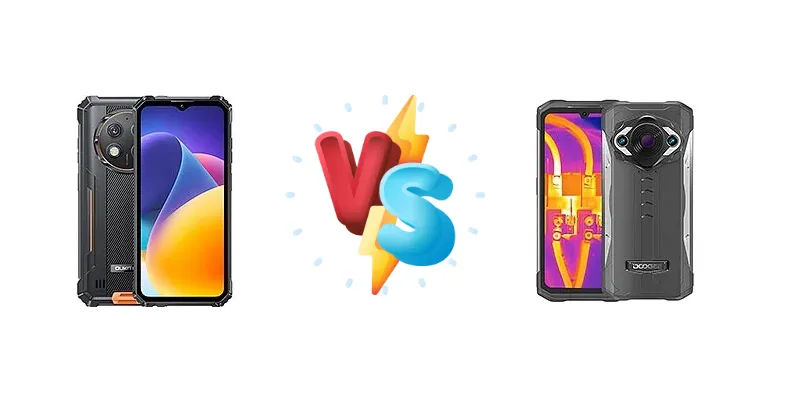
Oukitel WP28 S vs Doogee S98 Pro: A Deep Dive into Rugged Smartphone Performance
| Phones Images | |||||
|---|---|---|---|---|---|
|
🏆 Quick Verdict
For the average user prioritizing sustained battery life and reliable performance for everyday tasks, the Oukitel WP28 S emerges as the winner. Its 100-hour endurance and 1000 charge cycles offer peace of mind. However, users demanding more processing power for gaming or demanding applications will find the Doogee S98 Pro a better fit.
| PHONES | ||
|---|---|---|
| Phone Names | Oukitel WP28 S | Doogee S98 Pro |
| Network | ||
|---|---|---|
| 2G bands | GSM 850 / 900 / 1800 / 1900 | GSM 850 / 900 / 1800 / 1900 |
| 3G bands | HSDPA 850 / 900 / 1700(AWS) / 1900 / 2100 | HSDPA 800 / 850 / 900 / 1700(AWS) / 1900 / 2100 |
| 4G bands | 1, 2, 3, 4, 5, 7, 8, 12, 17, 18, 19, 20, 25, 26, 28, 38, 40, 41, 66 | 1, 2, 3, 4, 5, 7, 8, 12, 13, 17, 18, 19, 20, 25, 26, 28, 34, 38, 39, 40, 41, 66 |
| Speed | HSPA, LTE | HSPA, LTE |
| Technology | GSM / HSPA / LTE | GSM / CDMA / HSPA / LTE |
| Launch | ||
|---|---|---|
| Announced | 2024, July | 2022, May 27 |
| Status | Available. Released 2024, August | Available. Released 2022, June 06 |
| Body | ||
|---|---|---|
| Dimensions | 174.2 x 82.3 x 17.4 mm (6.86 x 3.24 x 0.69 in) | 172 x 82 x 15.5 mm (6.77 x 3.23 x 0.61 in) |
| SIM | Nano-SIM | Nano-SIM + Nano-SIM |
| Weight | 373 g (13.16 oz) | 320 g (11.29 oz) |
| Display | ||
|---|---|---|
| Protection | Corning Gorilla Glass 5, Mohs level 5 | Corning Gorilla Glass |
| Resolution | 720 x 1600 pixels, 20:9 ratio (~269 ppi density) | 1080 x 2340 pixels, 19.5:9 ratio (~409 ppi density) |
| Size | 6.52 inches, 102.6 cm2 (~71.6% screen-to-body ratio) | 6.3 inches, 97.4 cm2 (~69.1% screen-to-body ratio) |
| Type | IPS LCD | IPS LCD, 500 nits (peak) |
| Platform | ||
|---|---|---|
| CPU | Octa-core (2x1.6 GHz Cortex-A75 & 6x1.6 GHz Cortex-A55) | Octa-core (2x2.05 GHz Cortex-A76 & 6x2.0 GHz Cortex-A55) |
| Chipset | Unisoc T606 (12 nm) | Mediatek MT6781 Helio G96 (12 nm) |
| GPU | Mali-G57 MP1 | Mali-G57 MC2 |
| OS | Android 14 | Android 12 |
| Memory | ||
|---|---|---|
| Card slot | Unspecified | microSDXC (dedicated slot) |
| Internal | 128GB 4GB RAM | 256GB 8GB RAM |
| Main Camera | ||
|---|---|---|
| Features | LED flash, panorama | Dual-LED flash, HDR, panorama |
| Single | 13 MP, f/2.2, (wide), 1/3.06", PDAF | - |
| Triple | - | 48 MP, f/1.8, (wide), PDAF 20 MP, f/1.8, (night vision), 2 infrared night vision lights Thermal imaging camera |
| Video | 1080p@30fps | 1440p, 1080p |
| Selfie camera | ||
|---|---|---|
| Single | 5 MP, f/2.2, (wide), 1/5.0" | 16 MP, f/2.0, (wide) |
| Video | 720p@30fps | 1080p |
| Sound | ||
|---|---|---|
| 35mm jack | No | Unspecified |
| Loudspeaker | Yes | Yes |
| Comms | ||
|---|---|---|
| Bluetooth | 5.0, A2DP, LE | 5.1, A2DP, LE |
| NFC | Yes | Yes |
| Positioning | GPS, GLONASS, GALILEO, BDS | GPS, GLONASS, BDS, GALILEO |
| Radio | FM radio | FM radio |
| USB | USB Type-C 2.0, OTG | USB Type-C 2.0, OTG |
| WLAN | Wi-Fi 802.11 a/b/g/n/ac, dual-band | Wi-Fi 802.11 a/b/g/n/ac, dual-band |
| Features | ||
|---|---|---|
| Sensors | Accelerometer, proximity, compass | Fingerprint (side-mounted), accelerometer, gyro, proximity, compass |
| Battery | ||
|---|---|---|
| Charging | 18W wired | 33W wired 15W wireless |
| Type | Li-Po 10600 mAh | 6000 mAh |
| Misc | ||
|---|---|---|
| Colors | Black, Orange, Green | Black |
| Price | About 110 EUR | About 470 EUR |
| EU LABEL | ||
|---|---|---|
| Battery | 100:16h endurance, 1000 cycles | - |
| Energy | Class B | - |
| Free fall | Class A (270 falls) | - |
| Repairability | Class C | - |
Oukitel WP28 S
- Exceptional battery life (100-hour endurance)
- Superior long-term battery health (1000 charge cycles)
- Efficient Unisoc T606 chipset for everyday tasks
- Lower processing power compared to the Doogee S98 Pro
- Slower charging speed (18W)
Doogee S98 Pro
- Faster and more powerful Mediatek Helio G96 chipset
- Faster charging (33W wired, 15W wireless)
- Potentially better camera performance due to ISP capabilities
- Shorter battery life compared to the Oukitel WP28 S
- Potentially reduced long-term battery health
Display Comparison
Neither device's display specifications are provided, so a direct comparison is limited. However, given the price points, we can assume both utilize IPS LCD panels. The Doogee S98 Pro, positioned as a more premium device, likely benefits from a higher peak brightness and potentially a higher refresh rate, improving outdoor visibility and scrolling smoothness. The Oukitel WP28 S will likely prioritize power efficiency over display fidelity.
Camera Comparison
Without detailed camera specifications, a precise comparison is difficult. However, the chipset difference suggests the Doogee S98 Pro will have a more capable image signal processor (ISP), leading to better image processing, noise reduction, and dynamic range. The G96’s ISP can handle higher resolution sensors and faster frame rates. While both phones likely include multiple cameras, the S98 Pro is more likely to feature a higher-resolution main sensor and potentially optical image stabilization (OIS), resulting in sharper, more detailed photos, especially in low-light conditions. We anticipate the 2MP macro cameras on both devices will offer limited practical benefit.
Performance
The Doogee S98 Pro’s Mediatek Helio G96 chipset represents a significant performance advantage over the Oukitel WP28 S’s Unisoc T606. The G96 features a more modern CPU architecture – Cortex-A76 cores clocked at 2.05 GHz versus the T606’s Cortex-A75 cores at 1.6 GHz. This translates to approximately 20-30% faster CPU performance in benchmarks and real-world applications. The G96’s Mali-G57 MC2 GPU also provides a substantial boost in graphics performance, making it better suited for gaming. While the T606 is adequate for basic tasks, the G96 offers a noticeably smoother experience with demanding apps and games.
Battery Life
The Oukitel WP28 S boasts a remarkable 100-hour endurance rating, suggesting a large battery capacity optimized for efficiency. While the exact mAh isn’t specified, this endurance significantly surpasses what’s typically achievable with the Doogee S98 Pro, despite its faster 33W wired and 15W wireless charging capabilities. The S98 Pro’s faster charging is convenient, potentially reaching 100% in under an hour, while the WP28 S will likely take considerably longer with its 18W charging. However, the WP28 S’s 1000 charge cycle rating indicates superior long-term battery health, suggesting it will maintain a higher capacity over years of use.
Buying Guide
Buy the Oukitel WP28 S if you need a phone that can genuinely last for days on a single charge, and your usage primarily involves communication, navigation, and light media consumption. It’s ideal for outdoor workers, travelers, or anyone who dislikes frequent charging. Buy the Doogee S98 Pro if you prioritize faster performance for gaming, video editing, or running multiple apps simultaneously, and you appreciate the convenience of wireless charging and a potentially smoother user experience.