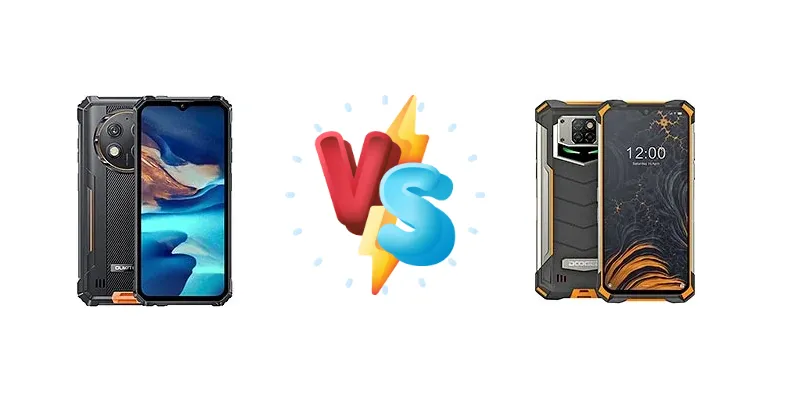
The rugged smartphone market caters to a specific user: those needing durability and extended battery life. The Oukitel WP28 E and Doogee S88 Pro both aim to deliver on this promise, but they take different approaches. The WP28 E focuses on maximizing battery endurance with a newer chipset, while the S88 Pro offers faster charging and a more established, albeit older, platform. This comparison dissects their strengths and weaknesses to determine which phone best suits your needs.
🏆 Quick Verdict
For the average user prioritizing sheer battery longevity and a modern chipset, the Oukitel WP28 E is the better choice. Its 100-hour endurance rating and Unisoc T606 offer a significant advantage. However, the Doogee S88 Pro’s faster charging and wireless capabilities make it compelling for those who value convenience.
| Network |
|---|
| 2G bands | GSM 850 / 900 / 1800 / 1900 | GSM 850 / 900 / 1800 / 1900 |
| 3G bands | HSDPA 850 / 900 / 1700(AWS) / 1900 / 2100 | HSDPA 850 / 900 / 1700(AWS) / 1900 / 2100 |
| 4G bands | 1, 2, 3, 4, 5, 7, 8, 12, 17, 18, 19, 20, 25, 26, 28, 38, 40, 41, 66 | 1, 3, 7, 8, 20 |
| Speed | HSPA, LTE | HSPA, LTE |
| Technology | GSM / HSPA / LTE | GSM / HSPA / LTE |
| Launch |
|---|
| Announced | 2024, July | 2020, June 06. Released 2020, June 06 |
| Status | Available. Released 2024, August | Discontinued |
| Body |
|---|
| Build | - | Glass front (Gorilla Glass), aluminum back with rubber, aluminum frame |
| Dimensions | 174.2 x 82.3 x 17.4 mm (6.86 x 3.24 x 0.69 in) | 171.6 x 85.5 x 18.7 mm (6.76 x 3.37 x 0.74 in) |
| SIM | Nano-SIM | Nano-SIM + Nano-SIM |
| Weight | 373 g (13.16 oz) | 372 g (13.12 oz) |
| Display |
|---|
| Protection | Corning Gorilla Glass 5, Mohs level 5 | Corning Gorilla Glass |
| Resolution | 720 x 1600 pixels, 20:9 ratio (~269 ppi density) | 1080 x 2340 pixels, 19.5:9 ratio (~409 ppi density) |
| Size | 6.52 inches, 102.6 cm2 (~71.6% screen-to-body ratio) | 6.3 inches, 97.4 cm2 (~66.4% screen-to-body ratio) |
| Type | IPS LCD | IPS LCD |
| Platform |
|---|
| CPU | Octa-core (2x1.6 GHz Cortex-A75 & 6x1.6 GHz Cortex-A55) | Octa-core (4x2.1 GHz Cortex-A73 & 4x2.0 GHz Cortex-A53) |
| Chipset | Unisoc T606 (12 nm) | Mediatek MT6771T Helio P70 (12 nm) |
| GPU | Mali-G57 MP1 | Mali-G72 MP3 |
| OS | Android 14 | Android 10 |
| Memory |
|---|
| Card slot | Unspecified | microSDXC (uses shared SIM slot) |
| Internal | 64GB 4GB RAM | 128GB 6GB RAM |
| Main Camera |
|---|
| Features | LED flash, panorama | Dual-LED dual-tone flash, HDR, panorama |
| Single | 13 MP, f/2.2, (wide), 1/3.06", PDAF | - |
| Triple | - | 21 MP, f/2.2, (wide), 1/2.4", 1.12µm, PDAF
8 MP, f/2.2, 130˚, (ultrawide), 1/4.0", 1.12µm
Auxiliary lens |
| Video | 1080p@30fps | 1080p@30fps |
| Selfie camera |
|---|
| Single | 5 MP, f/2.2, (wide), 1/5.0" | 16 MP, f/2.2, 26mm (wide) |
| Video | 720p@30fps | 1080p@30fps |
| Sound |
|---|
| 35mm jack | No | No |
| Loudspeaker | Yes | Yes |
| Comms |
|---|
| Bluetooth | 5.0, A2DP, LE | 4.2, A2DP |
| NFC | Yes | Yes |
| Positioning | GPS, GLONASS, GALILEO, BDS | GPS, GLONASS, BDS, GALILEO |
| Radio | FM radio | FM radio |
| USB | USB Type-C 2.0, OTG | USB Type-C 2.0, OTG |
| WLAN | Wi-Fi 802.11 a/b/g/n/ac, dual-band | Wi-Fi 802.11 b/g/n |
| Features |
|---|
| Sensors | Accelerometer, proximity, compass | Fingerprint (side-mounted), accelerometer, gyro, proximity, compass |
| Battery |
|---|
| Charging | 18W wired | 24W wired
10W wireless
5W Reverse wireless |
| Type | Li-Po 10600 mAh | 10000 mAh |
| Misc |
|---|
| Colors | Black, Orange, Green | Fire Orange, Army Green, Mineral Black |
| Price | - | About 130 EUR |
| EU LABEL |
|---|
| Battery | 100:16h endurance, 1000 cycles | - |
| Energy | Class B | - |
| Free fall | Class A (270 falls) | - |
| Repairability | Class C | - |
Oukitel WP28 E
- Exceptional 100-hour battery endurance
- Modern Unisoc T606 chipset for potentially better efficiency
- 1000 charge cycles promise long-term battery health
- Slower 18W charging
- Lack of wireless charging capabilities
- Display specifications are unknown
Doogee S88 Pro
- Faster 24W wired charging
- Convenient 10W wireless charging and 5W reverse wireless charging
- Higher display contrast ratio (1641:1)
- Significantly lower battery endurance (202 hours)
- Older MediaTek Helio P70 chipset
- Potentially less efficient chipset
Display Comparison
The Doogee S88 Pro boasts a contrast ratio of 1641:1, suggesting deeper blacks and more vibrant colors compared to what is typical for rugged phones. While the WP28 E’s display specifications are not provided, the S88 Pro’s contrast ratio indicates a potentially superior viewing experience, especially for media consumption. However, without knowing the WP28 E’s peak brightness or panel technology, a definitive judgment is difficult. The S88 Pro’s display is likely to be more visually appealing, but the WP28 E may prioritize durability and power efficiency in its display design.
Camera Comparison
Neither phone is positioned as a camera powerhouse. The context data doesn’t provide sufficient detail for a meaningful camera comparison. It’s safe to assume both phones feature a multi-camera setup, but without knowing sensor sizes, apertures, or image processing algorithms, it’s impossible to determine which offers superior image quality. The presence of a 2MP macro camera on either device is unlikely to significantly impact the overall camera experience; these sensors often deliver limited detail. Focusing on the main sensor specifications would be crucial for a proper camera assessment.
Performance
The Doogee S88 Pro’s MediaTek Helio P70 (MT6771T) utilizes a quad-core Cortex-A73 cluster clocked at 2.1 GHz, paired with a quad-core Cortex-A53 cluster at 2.0 GHz. This architecture, while capable, is older than the Oukitel WP28 E’s Unisoc T606. The T606 features a dual-core Cortex-A75 at 1.6 GHz and a hexa-core Cortex-A55 at 1.6 GHz. While the P70’s A73 cores have a higher clock speed, the T606 benefits from newer architecture in the A55 cores, potentially offering better efficiency. Both chipsets are built on a 12nm process, but the T606’s newer design may translate to improved sustained performance and thermal management, especially in demanding tasks. The P70’s GPU is likely more powerful, but the T606’s efficiency could be a benefit for gaming.
Battery Life
The Oukitel WP28 E’s standout feature is its impressive 100-hour endurance rating and 1000 charge cycles, suggesting exceptional longevity. The Doogee S88 Pro, with a reported 202-hour endurance, falls significantly behind. While the S88 Pro compensates with faster 24W wired charging, 10W wireless charging, and 5W reverse wireless charging, the WP28 E’s sheer endurance is a major advantage for users who frequently find themselves away from power outlets. The WP28 E’s 18W charging is slower, but the extended battery life minimizes the need for frequent top-ups.
Buying Guide
Buy the Oukitel WP28 E if you need a phone that can genuinely last for days on a single charge, and you prioritize a newer chipset for potentially better software support. Buy the Doogee S88 Pro if you prefer the convenience of 24W wired and 10W wireless charging, along with the added benefit of 5W reverse wireless charging to top up accessories, and are comfortable with an older chipset.
Frequently Asked Questions
❓ Does the Unisoc T606 in the Oukitel WP28 E struggle with demanding games like PUBG or Call of Duty?
While the Unisoc T606 isn't a flagship chipset, it's capable of running popular games like PUBG and Call of Duty. However, you'll likely need to lower graphics settings to achieve a smooth frame rate. The T606’s efficiency may help mitigate thermal throttling during extended gaming sessions compared to the older Helio P70.
❓ How useful is the reverse wireless charging feature on the Doogee S88 Pro in real-world scenarios?
The 5W reverse wireless charging on the Doogee S88 Pro is best suited for topping up small accessories like wireless earbuds or a smartwatch. It's not designed to quickly charge a phone, but it can be a lifesaver in emergencies when you need to share a small amount of power.
❓ What does '1000 charge cycles' mean for the Oukitel WP28 E's battery lifespan?
A charge cycle is completed when you've used 100% of the battery capacity. The Oukitel WP28 E's claim of 1000 cycles suggests the battery is designed to retain at least 80% of its original capacity after being fully charged and discharged 1000 times, indicating excellent long-term battery health.
❓ Is the Doogee S88 Pro’s Helio P70 chipset likely to receive future software updates?
Given the Helio P70 is an older chipset, the likelihood of significant software updates for the Doogee S88 Pro is limited. While security patches may still be provided, major Android version upgrades are unlikely. The Oukitel WP28 E, with its newer Unisoc T606, may have a slightly longer software support window.