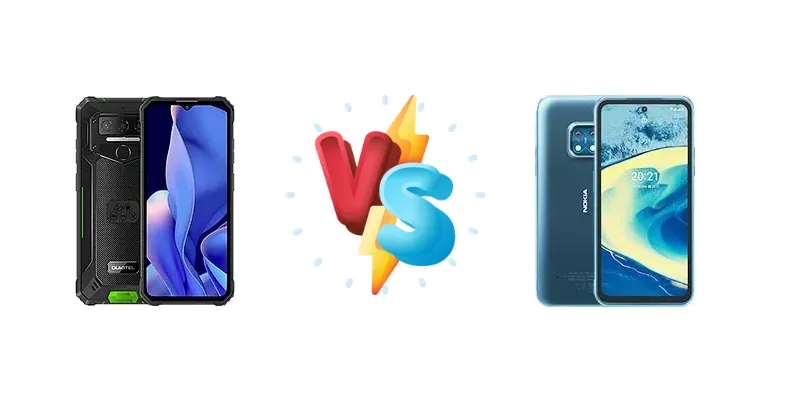
The rugged smartphone market caters to a specific need: durability. Both the Oukitel WP23Pro and Nokia XR20 aim to deliver on that promise, but they take different approaches. The WP23Pro prioritizes exceptional battery endurance, while the XR20 focuses on bringing 5G connectivity and a more mainstream user experience to a robust package. This comparison dissects their key differences to help you choose the right tool for your demanding lifestyle.
🏆 Quick Verdict
For users prioritizing maximum uptime and value, the Oukitel WP23Pro emerges as the winner. Its impressive 100-hour battery life and 1000 charge cycles significantly outweigh the Nokia XR20’s 5G capabilities for those not heavily reliant on constant high-speed data. However, the XR20 is a strong contender for users needing 5G and wireless charging.
| Network |
|---|
| 2G bands | GSM 850 / 900 / 1800 / 1900 | GSM 850 / 900 / 1800 / 1900 |
| 3G bands | HSDPA 850 / 900 / 1700(AWS) / 1900 / 2100 | HSDPA 850 / 900 / 1700(AWS) / 1900 / 2100 |
| 4G bands | LTE | 1, 2, 3, 4, 5, 7, 8, 12, 13, 14, 20, 25, 26, 28, 30, 38, 40, 41, 48, 66, 71 |
| 5G bands | - | 2, 5, 25, 38, 41, 48, 66, 77, 78 SA/NSA |
| Speed | HSPA, LTE | HSPA, LTE, 5G |
| Technology | GSM / HSPA / LTE | GSM / CDMA / HSPA / EVDO / LTE / 5G |
| | - | CDMA2000 1xEV-DO |
| Launch |
|---|
| Announced | 2023 | 2021, July 27 |
| Status | Available. Released 2023 | Available. Released 2021, August 04 |
| Body |
|---|
| Dimensions | - | 171.6 x 81.5 x 10.6 mm (6.76 x 3.21 x 0.42 in) |
| SIM | Nano-SIM + Nano-SIM | · Nano-SIM· Nano-SIM + Nano-SIM |
| Weight | - | 248 g (8.75 oz) |
| | - | IP68 dust/water resistant (up to 1.5m for 60 min)
Drop-to-concrete resistance from up to 1.8m
MIL-STD-810H compliant |
| Display |
|---|
| Protection | Mohs level 5 | Corning Gorilla Glass Victus |
| Resolution | 720 x 1600 pixels, 20:9 ratio (~269 ppi density) | 1080 x 2400 pixels, 20:9 ratio (~395 ppi density) |
| Size | 6.52 inches, 102.6 cm2 | 6.67 inches, 107.4 cm2 (~76.8% screen-to-body ratio) |
| Type | IPS LCD, 400 nits (typ) | IPS LCD, 550 nits |
| Platform |
|---|
| CPU | Octa-core (2x1.6 GHz Cortex-A75 & 6x1.6 GHz Cortex-A55) | Octa-core (2x2.0 GHz Kryo 460 & 6x1.8 GHz Kryo 460) |
| Chipset | Unisoc T606 (12 nm) | Qualcomm SM4350 Snapdragon 480 5G (8 nm) |
| GPU | Mali-G57 MP1 | Adreno 619 |
| OS | Android 13 | Android 11, upgradable to Android 13 |
| Memory |
|---|
| Card slot | microSDXC (uses shared SIM slot) | microSDXC (uses shared SIM slot) |
| Internal | 128GB 8GB RAM | 64GB 4GB RAM, 128GB 6GB RAM |
| Main Camera |
|---|
| Dual | - | 48 MP, f/1.8, (wide), 1/2.25", 0.8µm, PDAF
13 MP, f/2.4, 123˚ (ultrawide), 1/3.0", 1.12µm |
| Features | LED flash | Zeiss optics, Dual-LED dual-tone flash, second LED flash, HDR, panorama |
| Single | - | 8 MP, f/2.0 (wide), 1/4.0", 1.12µm |
| Triple | 13 MP, (wide), PDAF
2 MP (macro)
Third unspecified camera | - |
| Video | 1080p@30fps | 1080p@30fps |
| Selfie camera |
|---|
| Single | 5 MP, f/2.2, (wide) | 8 MP, f/2.0 (wide), 1/4.0", 1.12µm |
| Video | Yes | 1080p@30fps |
| Sound |
|---|
| 3.5mm jack | - | Yes |
| 35mm jack | Unspecified | Yes |
| Loudspeaker | Yes | Yes, with stereo speakers |
| Comms |
|---|
| Bluetooth | 5.0, A2DP, LE | 5.1, A2DP, LE, aptX Adaptive |
| NFC | Yes | Yes |
| Positioning | GPS, GLONASS, GALILEO, BDS | GPS (L1+L5), GLONASS, BDS, GALILEO, QZSS, NavIC |
| Radio | Unspecified | Unspecified |
| USB | USB Type-C 2.0, OTG | USB Type-C 3.0 |
| WLAN | Yes | Wi-Fi 802.11 a/b/g/n/ac/6, dual-band, Wi-Fi Direct |
| Features |
|---|
| Sensors | Fingerprint (rear-mounted), accelerometer, compass | Fingerprint (side-mounted), accelerometer, gyro, proximity, compass, barometer |
| Battery |
|---|
| Charging | Reverse wired | 18W wired
15W wireless |
| Type | Li-Po 10600 mAh | Li-Po 4630 mAh |
| Misc |
|---|
| Colors | Black, Orange, Green | Ultra Blue, Granite Gray |
| Models | - | TA-1368, TA-1362 |
| Price | About 130 EUR | About 270 EUR |
| SAR EU | - | 1.13 W/kg (head) 1.43 W/kg (body) |
| EU LABEL |
|---|
| Battery | 100:32h endurance, 1000 cycles | - |
| Energy | Class B | - |
| Free fall | Class A (270 falls) | - |
| Repairability | Class C | - |
Oukitel WP23Pro
- Exceptional 100-hour battery life
- 1000 charge cycle longevity
- Reverse wired charging capability
- Potentially more affordable price point
- Less powerful processor compared to the XR20
- No 5G connectivity
- Limited information on display quality
Nokia XR20
- 5G connectivity for faster data speeds
- 18W wired and 15W wireless charging
- Potentially better camera performance
- More mainstream software experience
- Shorter battery life compared to the WP23Pro
- Potentially higher price point
- Battery longevity may be lower than WP23Pro
Display Comparison
Neither device boasts a cutting-edge display. Details on panel type, resolution, and refresh rate are missing for both, but the focus is clearly on durability, not visual fidelity. The absence of LTPO or high refresh rates suggests cost optimization. The XR20’s potential for better color accuracy, typical of Nokia’s displays, is offset by the WP23Pro’s likely superior scratch resistance due to its ruggedized construction.
Camera Comparison
Without detailed camera specifications, a direct comparison is difficult. However, the market positioning suggests the XR20 will likely offer a more refined camera experience, potentially with better image processing algorithms. The WP23Pro likely focuses on functional imaging for documentation purposes. The absence of information regarding sensor size and OIS on either device makes a definitive judgment impossible, but the XR20’s brand reputation suggests a greater emphasis on camera quality.
Performance
The Nokia XR20’s Qualcomm Snapdragon 480 5G (8nm) represents a clear architectural advantage over the Oukitel WP23Pro’s Unisoc T606 (12nm). The 8nm process node allows for greater transistor density and improved power efficiency, translating to potentially better sustained performance and less heat generation. The XR20’s CPU, with 2x2.0 GHz Kryo 460 cores, also boasts a higher clock speed than the WP23Pro’s 2x1.6 GHz Cortex-A75 cores. While both are octa-core designs, the XR20 is expected to handle demanding tasks and multitasking more smoothly. However, the WP23Pro’s longevity may be better due to the less stressed chipset.
Battery Life
The Oukitel WP23Pro’s 100-hour endurance is its standout feature. This is a substantial advantage over what is typically expected from a smartphone, and the claimed 1000 charge cycles suggest exceptional long-term battery health. The Nokia XR20 offers 18W wired and 15W wireless charging, providing convenience, but its battery capacity is not specified, and therefore its endurance will likely fall short of the WP23Pro. The WP23Pro’s reverse wired charging is a useful addition for topping up accessories in the field.
Buying Guide
Buy the Oukitel WP23Pro if you need a phone that can genuinely last for days on a single charge, work in remote locations with limited access to power, or require a highly durable device at a budget-friendly price. Buy the Nokia XR20 if you prioritize 5G connectivity for streaming or work, value the convenience of wireless charging, and prefer a phone with a more polished software experience and guaranteed software updates.
Frequently Asked Questions
❓ Is the Unisoc T606 chipset in the Oukitel WP23Pro sufficient for everyday tasks like browsing and social media?
Yes, the Unisoc T606 is a capable chipset for everyday tasks. While it won't deliver flagship-level performance, it's more than adequate for browsing, social media, messaging, and light multitasking. The focus of the WP23Pro is on endurance, not raw processing power.
❓ Does the Nokia XR20 receive regular software updates and security patches?
Nokia is known for its commitment to software updates, even on its more affordable devices. The XR20 is guaranteed to receive at least three years of security updates and two major Android OS upgrades, ensuring your device remains secure and up-to-date.
❓ How does the ruggedization of the Oukitel WP23Pro compare to the Nokia XR20 in terms of drop and water resistance?
While both phones are ruggedized, the WP23Pro appears to prioritize extreme durability. Details on specific drop test heights and IP ratings are needed for a precise comparison, but the WP23Pro’s construction suggests a higher level of protection against physical damage. The XR20 is IP68 rated, offering excellent water and dust resistance.
❓ Can I use the Oukitel WP23Pro to charge other devices using its reverse wired charging feature?
Yes, the Oukitel WP23Pro supports reverse wired charging. This allows you to use the phone as a power bank to charge other devices, such as earbuds or a smartwatch, via a USB-C cable. The charging speed will be limited, but it's a useful feature in emergency situations.