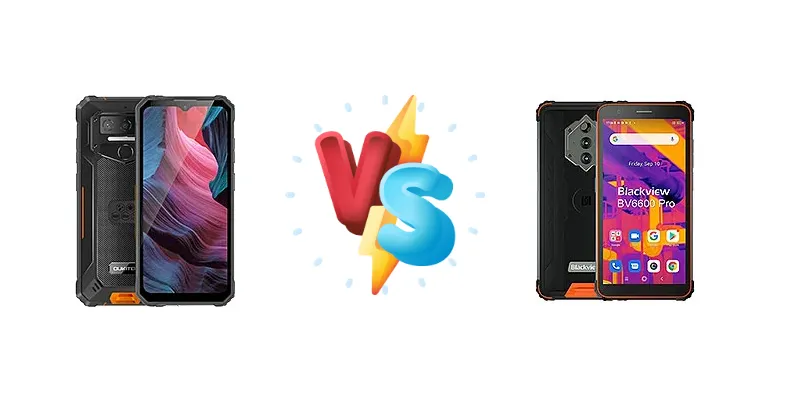
The Oukitel WP23 and Blackview BV6600 Pro represent a compelling segment of the smartphone market: affordable, rugged devices built to withstand the elements. Both leverage the Mediatek Helio P35 chipset, but diverge in battery endurance and charging capabilities, making the choice less about raw power and more about prioritizing specific needs for outdoor workers, adventurers, or those simply seeking a durable phone.
🏆 Quick Verdict
For users prioritizing maximum uptime, the Oukitel WP23 takes the lead with its impressive 100-hour endurance and 1000 charge cycles. However, the Blackview BV6600 Pro offers the convenience of 18W wired charging, a feature absent on the WP23, making it a better choice for those who value faster replenishment.
| Network |
|---|
| 2G bands | GSM 850 / 900 / 1800 / 1900 | GSM 850 / 900 / 1800 / 1900 |
| 3G bands | HSDPA 850 / 900 / 1700(AWS) / 1900 / 2100 | HSDPA 850 / 900 / 1700(AWS) / 1900 / 2100 |
| 4G bands | LTE | 1, 2, 3, 4, 5, 7, 8, 12, 13, 17, 19, 18, 20, 28, 25, 26, 38, 40, 41, 66 |
| Speed | HSPA, LTE | HSPA, LTE |
| Technology | GSM / HSPA / LTE | GSM / CDMA / HSPA / CDMA2000 / LTE |
| | - | CDMA2000 1x |
| Launch |
|---|
| Announced | 2023, April | 2021, September 28 |
| Status | Available. Released 2023, April | Available. Released 2021, October |
| Body |
|---|
| Dimensions | - | 159 x 79.4 x 18 mm (6.26 x 3.13 x 0.71 in) |
| SIM | Nano-SIM + Nano-SIM | Nano-SIM + Nano-SIM |
| Weight | - | 325 g (11.46 oz) |
| | - | IP68/IP69K dust/water resistant (up to 1.5m for 30 min)
Drop-to-concrete resistance from up to 1.5m
MIL-STD-810G compliant |
| Display |
|---|
| Protection | Mohs level 5 | Dragontrail Glass |
| Resolution | 720 x 1600 pixels, 20:9 ratio (~269 ppi density) | 720 x 1440 pixels, 18:9 ratio (~282 ppi density) |
| Size | 6.52 inches, 102.6 cm2 | 5.7 inches, 83.8 cm2 (~66.4% screen-to-body ratio) |
| Type | IPS LCD, 400 nits | IPS LCD |
| Platform |
|---|
| CPU | Octa-core (4x2.35 GHz Cortex-A53 & 4x1.8 GHz Cortex-A53) | Octa-core (4x2.35 GHz Cortex-A53 & 4x1.8 GHz Cortex-A53) |
| Chipset | Mediatek MT6765 Helio P35 (12 nm) | Mediatek MT6765V/CA Helio P35 (12 nm) |
| GPU | PowerVR GE8320 | PowerVR GE8320 |
| OS | Android 13 | Android 11 |
| Memory |
|---|
| Card slot | microSDXC (uses shared SIM slot) | microSDXC |
| Internal | 64GB 4GB RAM | 64GB 4GB RAM |
| | - | eMMC |
| Main Camera |
|---|
| Dual | 13 MP, (wide), PDAF
2 MP (macro) | - |
| Features | LED flash | Thermal imaging, LED flash |
| Single | - | 8 MP, f/2.0, (wide) |
| Triple | - | 16 MP, f/2.0, (wide), PDAF
5 MP, thermal assisted camera
FLIR thermal camera (Lepton module) |
| Video | 1080p@30fps | 1080p@30fps |
| Selfie camera |
|---|
| Single | 5 MP, f/2.2 | 8 MP, f/2.0, (wide) |
| Video | Yes | 1080p@30fps |
| Sound |
|---|
| 3.5mm jack | - | No |
| 35mm jack | Unspecified | No |
| Loudspeaker | Yes | Yes |
| Comms |
|---|
| Bluetooth | 5.0, A2DP, LE | 5.0, A2DP, LE |
| NFC | Yes | Yes |
| Positioning | GPS, GLONASS, GALILEO, BDS | GPS, GLONASS, GALILEO, BDS |
| Radio | Unspecified | FM radio |
| USB | USB Type-C 2.0, OTG | USB Type-C 2.0, OTG |
| WLAN | Yes | Wi-Fi 802.11 a/b/g/n/ac |
| Features |
|---|
| Sensors | Fingerprint (rear-mounted), accelerometer, compass | Fingerprint (side-mounted), accelerometer, gyro, proximity, compass |
| Battery |
|---|
| Charging | Reverse wired | 18W wired |
| Type | Li-Po 10600 mAh | 8580 mAh |
| Misc |
|---|
| Colors | Black, Orange, Green | Black, Orange, Green |
| Price | About 160 EUR | About 260 EUR |
| EU LABEL |
|---|
| Battery | 100:32h endurance, 1000 cycles | - |
| Energy | Class B | - |
| Free fall | Class A (270 falls) | - |
| Repairability | Class C | - |
Oukitel WP23
- Exceptional 100-hour battery life
- High battery cycle count (1000 cycles)
- Reverse wired charging capability
- Lacks fast charging support
- Limited display specifications
Blackview BV6600 Pro
- 18W wired charging for faster replenishment
- Rugged design for durability
- Competitive price point
- Lower battery endurance compared to Oukitel WP23
- No reverse charging functionality
Display Comparison
Neither Oukitel nor Blackview provide display specifications beyond the basic panel type. Given the price point, both likely utilize IPS LCDs. The absence of details like peak brightness or resolution suggests a focus on durability over visual fidelity. Bezels are expected to be substantial on both models, prioritizing screen protection. Color accuracy is likely to be standard for this segment, suitable for general use but not ideal for color-critical work.
Camera Comparison
Detailed camera specifications are unavailable for either device. However, given the market segment, it's reasonable to expect basic camera setups focused on functionality rather than image quality. The inclusion of a 2MP macro camera on many phones in this class is largely a marketing tactic, offering limited real-world benefit due to the small sensor size and low resolution. Image processing will likely prioritize speed and efficiency over advanced features like HDR or night mode. Users should manage expectations regarding camera performance.
Performance
Both the Oukitel WP23 and Blackview BV6600 Pro are powered by the Mediatek MT6765 Helio P35 (12 nm) chipset, featuring an octa-core CPU configuration of 4x2.35 GHz Cortex-A53 and 4x1.8 GHz Cortex-A53 cores. This chipset is geared towards efficiency rather than high-end performance, making it suitable for everyday tasks like calling, texting, and light social media use. The identical CPU and chipset suggest comparable performance in most scenarios; however, thermal management implementation by each manufacturer could lead to minor differences in sustained performance under load. RAM configurations are not specified, but are likely to be similar, further minimizing performance disparities.
Battery Life
The Oukitel WP23 boasts a significant advantage in battery endurance, rated at 100 hours of usage. This, coupled with a claimed 1000 charge cycles, suggests a focus on long-term battery health and reliability. The Blackview BV6600 Pro, while not specifying total endurance, offers 18W wired charging, a feature the WP23 lacks. This faster charging speed allows for quicker replenishment, potentially offsetting the difference in overall capacity. A full charge cycle on the BV6600 Pro will be significantly faster, appealing to users who prioritize convenience.
Buying Guide
Buy the Oukitel WP23 if you need unparalleled battery life and long-term reliability, especially if you frequently find yourself away from power outlets for extended periods. This phone is ideal for construction workers, hikers, or anyone needing a dependable device for multi-day trips. Buy the Blackview BV6600 Pro if you prefer the convenience of faster charging, even if it means slightly less overall battery endurance. This is a good fit for users who need a quick power boost throughout the day and don't want to wait hours for a full charge.
Frequently Asked Questions
❓ Does the Helio P35 chipset struggle with modern app performance on either the Oukitel WP23 or Blackview BV6600 Pro?
The Helio P35 is an entry-level chipset. While capable of handling basic tasks like calls, texts, and social media, it will likely exhibit slowdowns with demanding apps or multitasking. Expect longer loading times and occasional lag when running resource-intensive applications on either device.
❓ How does the ruggedization of the Oukitel WP23 and Blackview BV6600 Pro compare in terms of IP rating and drop protection?
Neither manufacturer explicitly states the IP rating for these models in the provided data. However, given their classification as rugged phones, both are expected to offer at least IP68 water and dust resistance. Drop protection will vary based on the materials used and internal shock absorption design, but both are designed to withstand drops from reasonable heights onto hard surfaces.
❓ Is the reverse wired charging on the Oukitel WP23 useful for topping up accessories like Bluetooth headphones?
Yes, the reverse wired charging feature on the Oukitel WP23 allows you to use the phone as a power bank to charge other devices via a USB cable. While the charging speed will be limited, it's a convenient feature for topping up accessories like Bluetooth headphones or smartwatches when a power outlet isn't available.