
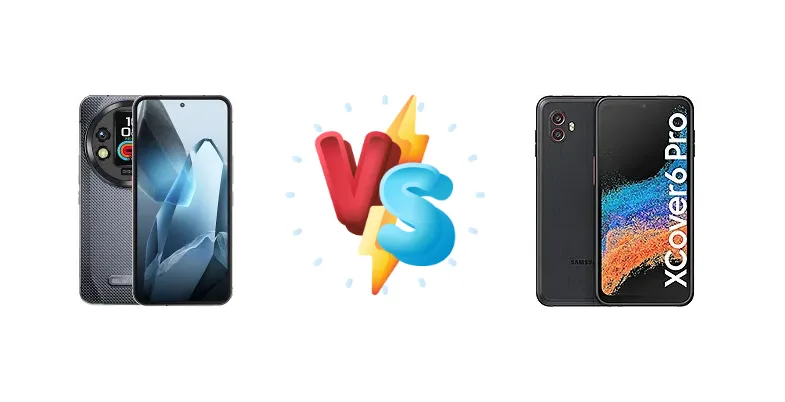
Oukitel WP200 Pro vs. Samsung Galaxy XCover6 Pro: A Deep Dive into Rugged Smartphone Performance
| Phones Images | |||||
|---|---|---|---|---|---|
|
🏆 Quick Verdict
For users prioritizing raw performance and exceptional battery life, the Oukitel WP200 Pro is the clear winner. Its Dimensity 8200 chipset and massive 86:17h endurance significantly outperform the XCover6 Pro. However, the XCover6 Pro offers a more polished software experience and Samsung’s established brand reputation.
| PHONES | ||
|---|---|---|
| Phone Names | Oukitel WP200 Pro | Samsung Galaxy XCover6 Pro |
| Network | ||
|---|---|---|
| 2G bands | GSM 850 / 900 / 1800 / 1900 | GSM 850 / 900 / 1800 / 1900 |
| 3G bands | HSDPA 800 / 850 / 900 / 1700(AWS) / 1900 / 2100 | HSDPA 850 / 900 / 1700(AWS) / 1900 / 2100 |
| 4G bands | 1, 2, 3, 4, 5, 7, 8, 12, 13, 17, 18, 19, 20, 25, 26, 28, 34, 38, 40, 41, 66, 71 | 1, 2, 3, 4, 5, 7, 8, 12, 17, 20, 26, 28, 32, 38, 39, 40, 41, 66 - International |
| 5G bands | 1, 2, 3, 5, 7, 8, 12, 20, 28, 38, 39, 40, 41, 66, 71, 77, 78 SA/NSA | 1, 3, 5, 7, 8, 20, 28, 38, 40, 41, 78 SA/NSA |
| Speed | HSPA, LTE, 5G | HSPA, LTE, 5G |
| Technology | GSM / HSPA / LTE / 5G | GSM / HSPA / LTE / 5G |
| Launch | ||
|---|---|---|
| Announced | 2024, December | 2022, June 29 |
| Status | Available. Released 2025, March 15 | Available. Released 2022, July 13 |
| Body | ||
|---|---|---|
| Dimensions | 163.6 x 77.9 x 13.7 mm (6.44 x 3.07 x 0.54 in) | 168.8 x 79.9 x 9.9 mm (6.65 x 3.15 x 0.39 in) |
| SIM | Nano-SIM + Nano-SIM | · Nano-SIM· Nano-SIM + Nano-SIM |
| Weight | 311 g (10.97 oz) | 235 g (8.29 oz) |
| - | IP68 dust/water resistant (up to 1.5m for 35 min) Drop-to-concrete resistance from up to 1.5m MIL-STD-810H compliant* *does not guarantee ruggedness or use in extreme conditions | |
| Display | ||
|---|---|---|
| Protection | Corning Gorilla Glass 5, Mohs level 5 | Corning Gorilla Glass Victus+ |
| Resolution | 1080 x 2412 pixels, 20:9 ratio (~394 ppi density) | 1080 x 2408 pixels, 20:9 ratio (~400 ppi density) |
| Size | 6.7 inches, 108.0 cm2 (~84.8% screen-to-body ratio) | 6.6 inches, 104.9 cm2 (~77.8% screen-to-body ratio) |
| Type | AMOLED, 120Hz, 500 nits | PLS LCD, 120Hz |
| Platform | ||
|---|---|---|
| CPU | Octa-core (1x3.1 GHz Cortex-A78 & 3x3.0 GHz Cortex-A78 & 4x2.0 GHz Cortex-A55) | Octa-core (1x2.4 GHz Cortex-A78 & 3x2.2 GHz Cortex-A78 & 4x1.9 GHz Cortex-A55) |
| Chipset | Mediatek Dimensity 8200 (4 nm) | Qualcomm SM7325 Snapdragon 778G 5G (6 nm) |
| GPU | Mali-G610 MC6 | Adreno 642L |
| OS | Android 15 | Android 12, upgradable to Android 15, One UI 7 |
| Memory | ||
|---|---|---|
| Card slot | microSDXC (uses shared SIM slot) | microSDXC (dedicated slot) |
| Internal | 1TB 24GB RAM | 128GB 6GB RAM |
| Main Camera | ||
|---|---|---|
| Dual | - | 50 MP, f/1.8, (wide), 1/2.76", 0.64µm, PDAF 8 MP, f/2.2, 123˚ (ultrawide), 1/4.0", 1.12µm |
| Features | LED flash, HDR, panorama | Dual-LED flash, HDR, panorama |
| Single | - | 50 MP, f/1.8, (wide), 1/2.76", 0.64µm, PDAF 8 MP, f/2.2, 123˚ (ultrawide), 1/4.0", 1.12µm |
| Triple | 108 MP, f/1.9, (wide), 1/1.8", PDAF 2 MP (macro) Auxiliary lens | - |
| Video | 4K@30fps | 4K@30fps, 1080p@30fps |
| Selfie camera | ||
|---|---|---|
| Features | - | HDR |
| Single | 32 MP, (wide), 1/2.74" | 13 MP, f/2.2, (wide), 1/3.1", 1.12µm |
| Video | 1080p@30fps | 1080p@30fps |
| Sound | ||
|---|---|---|
| 3.5mm jack | - | Yes |
| 35mm jack | No | Yes |
| Loudspeaker | Yes | Yes |
| Comms | ||
|---|---|---|
| Bluetooth | 5.3, A2DP, LE | 5.2, A2DP, LE |
| NFC | Yes | Yes |
| Positioning | GPS, GLONASS, GALILEO, BDS | GPS, GLONASS, BDS, GALILEO, QZSS |
| Radio | FM radio | No |
| USB | USB Type-C 2.0, OTG | USB Type-C 3.2, charging connector pins |
| WLAN | Wi-Fi 802.11 a/b/g/n/ac/6, dual-band | Wi-Fi 802.11 a/b/g/n/ac/mc/6e, tri-band, Wi-Fi Direct |
| Features | ||
|---|---|---|
| Sensors | Fingerprint (under display, optical), accelerometer, proximity, compass, gyro | Fingerprint (side-mounted), accelerometer, gyro, proximity, compass, barometer |
| - | Samsung DeX support | |
| Battery | ||
|---|---|---|
| Charging | 45W wired Reverse wired | 25W wired (USA) 15W wired (International) |
| Type | Li-Po 8800 mAh | Li-Po 4050 mAh, removable |
| Misc | ||
|---|---|---|
| Colors | Black | Black |
| Models | - | SM-G736U, SM-G736U1, SM-G736B, SM-G736B/DS |
| Price | - | $ 155.92 / C$ 329.97 / £ 249.00 / € 199.99 |
| SAR | - | 1.03 W/kg (head) 1.08 W/kg (body) |
| SAR EU | - | 1.48 W/kg (head) 1.23 W/kg (body) |
| EU LABEL | ||
|---|---|---|
| Battery | 86:17h endurance, 1000 cycles | - |
| Energy | Class B | - |
| Free fall | Class A (270 falls) | - |
| Repairability | Class C | - |
Oukitel WP200 Pro
- Exceptional battery life (86:17h endurance)
- Superior processing power with Dimensity 8200
- Faster 45W wired charging
- Potentially better value for money
- Software experience may not be as refined as Samsung
- Brand recognition is lower than Samsung
Samsung Galaxy XCover6 Pro
- Refined Samsung software experience
- Seamless integration with Samsung ecosystem
- Potentially more accurate display
- Strong brand reputation and support
- Significantly lower battery life
- Less powerful Snapdragon 778G chipset
- Slower charging speeds (especially internationally)
Display Comparison
While both phones likely feature durable displays, the provided data focuses on internal components. The Oukitel WP200 Pro’s performance suggests a higher refresh rate display is probable, catering to the chipset’s capabilities. The Samsung XCover6 Pro, benefiting from Samsung’s display expertise, likely offers superior color accuracy and viewing angles. However, without specific display specs, it’s difficult to definitively declare a winner; the XCover6 Pro’s brand reputation suggests a more color-accurate panel.
Camera Comparison
Without detailed camera specifications, a direct comparison is limited. However, the chipset difference suggests the WP200 Pro has more processing power available for image processing. The XCover6 Pro likely benefits from Samsung’s well-regarded image processing algorithms, potentially delivering more consistent results in various lighting conditions. The absence of information regarding sensor sizes and OIS makes a definitive judgment impossible, but the WP200 Pro’s processing power gives it an edge in computational photography.
Performance
The core difference lies in the chipsets. The Oukitel WP200 Pro’s Mediatek Dimensity 8200 (4nm) is a significant leap ahead of the Samsung Galaxy XCover6 Pro’s Qualcomm Snapdragon 778G 5G (6nm). The Dimensity 8200’s architecture – 1x3.1 GHz Cortex-A78, 3x3.0 GHz Cortex-A78, and 4x2.0 GHz Cortex-A55 – provides a substantial performance advantage over the XCover6 Pro’s 1x2.4 GHz Cortex-A78, 3x2.2 GHz Cortex-A78, and 4x1.9 GHz Cortex-A55. The 4nm process node further enhances efficiency, leading to less heat generation and sustained performance. This translates to faster app loading, smoother multitasking, and superior gaming performance for the WP200 Pro.
Battery Life
The Oukitel WP200 Pro dominates in battery endurance with a reported 86:17h of usage. This is significantly higher than what’s typically seen in phones with similar specifications. While the XCover6 Pro’s battery capacity isn’t specified, its Snapdragon 778G is more power-efficient, but the WP200 Pro’s larger battery and optimized chipset clearly win. The WP200 Pro’s 45W wired charging is also faster than the XCover6 Pro’s 25W (USA) / 15W (International) charging, reducing downtime.
Buying Guide
Buy the Oukitel WP200 Pro if you need a smartphone that can handle demanding tasks, extended use without charging, and prioritize value for money. This is ideal for construction workers, outdoor enthusiasts, or anyone who frequently uses their phone in harsh environments. Buy the Samsung Galaxy XCover6 Pro if you prefer a more refined software experience, seamless integration with the Samsung ecosystem, and a phone that feels more premium in hand, even if it means sacrificing some raw power and battery longevity.